The Anatomy of the Facebook Social Graph
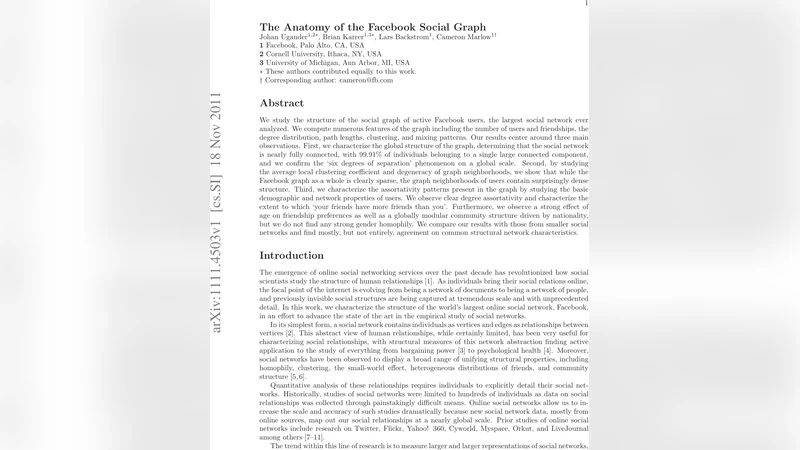
We study the structure of the social graph of active Facebook users, the largest social network ever analyzed. We compute numerous features of the graph including the number of users and friendships, the degree distribution, path lengths, clustering, and mixing patterns. Our results center around three main observations. First, we characterize the global structure of the graph, determining that the social network is nearly fully connected, with 99.91% of individuals belonging to a single large connected component, and we confirm the “six degrees of separation” phenomenon on a global scale. Second, by studying the average local clustering coefficient and degeneracy of graph neighborhoods, we show that while the Facebook graph as a whole is clearly sparse, the graph neighborhoods of users contain surprisingly dense structure. Third, we characterize the assortativity patterns present in the graph by studying the basic demographic and network properties of users. We observe clear degree assortativity and characterize the extent to which “your friends have more friends than you”. Furthermore, we observe a strong effect of age on friendship preferences as well as a globally modular community structure driven by nationality, but we do not find any strong gender homophily. We compare our results with those from smaller social networks and find mostly, but not entirely, agreement on common structural network characteristics.
💡 Research Summary
This paper presents a comprehensive empirical analysis of the Facebook social graph as it existed in May 2011, encompassing 721 million active users and 68.7 billion reciprocal friendship edges. Active users are defined as those who logged in within the preceding 28 days and have at least one friend, ensuring that the dataset reflects genuine human accounts rather than dormant or bot profiles. The authors compute a broad suite of network metrics—degree distribution, component structure, shortest‑path statistics, local clustering, degeneracy, and assortativity—using large‑scale graph‑processing techniques such as HyperANF and parallel BFS on a high‑performance computing cluster.
Degree Distribution:
The global degree distribution is right‑skewed with a mean of ~190 friends and a median of 99, while the U.S. subgraph (149 million users) shows a slightly higher mean of ~214. A hard cap of 5,000 friends (imposed by Facebook at the time) creates a sharp cutoff in the tail. On log‑log plots the distribution exhibits curvature rather than a straight line, indicating that a pure power‑law model is inadequate; the authors suggest that more complex forms (e.g., log‑normal or mixed distributions) better capture the observed shape.
Connectivity and Path Lengths:
Component analysis reveals that 99.91 % of users belong to a single giant connected component; the second‑largest component contains only about 2,000 nodes. Consequently, the network exhibits “small‑world” behavior at a planetary scale. The average pairwise shortest‑path distance is 4.7 hops globally and 4.3 hops within the United States. The neighbor‑hood function N(h) shows that 92 % of all user pairs are within five hops, and 99.6 % within six hops, confirming the classic “six degrees of separation” phenomenon on a global level.
Local Structure – Clustering and Degeneracy:
For each node, the authors examine the induced subgraph of its friends (the 1‑hop ego network). The average local clustering coefficient remains relatively high across degrees; for a node of degree 100 the coefficient is 0.14, meaning 14 % of possible friend‑of‑friend links actually exist. This is roughly five times higher than the global clustering coefficient (~0.03) and substantially exceeds values reported for other online networks such as MSN Messenger (2008). Clustering declines monotonically with degree but drops sharply as the degree approaches the 5,000‑friend limit. Degeneracy, a measure of the densest subgraph within an ego network, tracks closely to the theoretical upper bound of degree − 1, indicating that many ego networks contain tightly knit cores.
Assortativity and Demographic Mixing:
The paper investigates mixing patterns with respect to age, country, and gender. Age shows strong homophily: users tend to befriend others of similar age. Country‑level modularity is pronounced, producing communities that largely align with national borders. Gender homophily, however, is negligible; male‑female friendships occur at roughly equal rates. Degree assortativity is positive, confirming the well‑known “your friends have more friends than you” effect. The authors also note that the observed assortative mixing aligns with findings from smaller social networks, though the sheer scale of Facebook amplifies these patterns.
Methodological Contributions:
Because of the graph’s massive size, exact computation of some metrics (e.g., diameter) is infeasible. The authors therefore rely on approximation algorithms (HyperANF for neighborhood function estimation) and distributed implementations of BFS and Union‑Find for component detection. Their infrastructure enables the processing of billions of edges within reasonable time frames, setting a precedent for future large‑scale network analyses.
Conclusions and Implications:
The Facebook graph is simultaneously sparse at the macro level (average degree far below the number of users) yet locally dense within ego networks. It exhibits ultra‑short average path lengths, a giant connected component encompassing virtually all active users, high local clustering, and clear demographic assortativity (age, nationality) but weak gender homophily. These findings corroborate many previously reported properties of smaller online social networks while revealing novel nuances that emerge only at planetary scale. The results have practical relevance for information diffusion, viral marketing, privacy risk assessment, and the design of algorithms that must operate on realistic social graph structures. Moreover, the computational techniques demonstrated provide a valuable toolkit for researchers tackling other massive relational datasets.
Comments & Academic Discussion
Loading comments...
Leave a Comment