A New Paradigm for Quantum Nonlocality
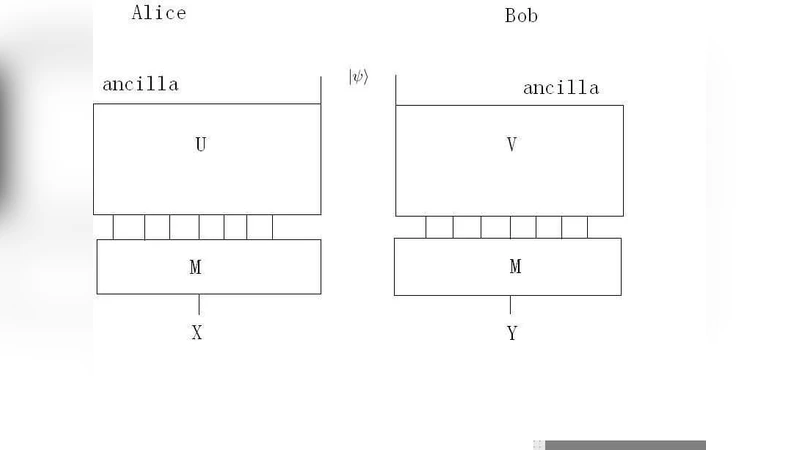
Bell’s theorem basically states that local hidden variable theory cannot predict the correlations produced by quantum mechanics. It is based on the assumption that Alice and Bob can choose measurements from a measurement set containing multiple elements. We establish a new paradigm that departs from Bell’s paradigm by assuming that there are no choices for Alice and Bob and that the measurements Alice and Bob will make are fixed from the start. We include a process of quantum computation in our model. To the best of our knowledge, we are the first to connect quantum computation and nonlocality, the two faces of entanglement.
💡 Research Summary
The paper proposes a new framework for studying quantum nonlocality that departs from the traditional Bell‑inequality setting by eliminating the assumption of free choice of measurement settings. In the standard Bell scenario, Alice and Bob each select one measurement from a set of alternatives, and the impossibility of reproducing quantum correlations with any local hidden‑variable (LHV) model is demonstrated under this “free‑will” premise. The authors instead fix the measurement that both parties will perform from the outset, thereby removing any counter‑factual reasoning. To compensate for the loss of freedom, they introduce a step of local quantum computation: Alice applies a fixed unitary U to her qubits, Bob applies a fixed unitary V to his, and then both measure in the standard computational basis. The initial state |ψ_i⟩ is an entangled state of Q qubits (Q ≤ n), possibly supplemented with ancillae so that each party holds n qubits in total.
The central question is how well a classical LHV model—characterized by a shared random variable Z and private randomness r_A, r_B—can approximate the joint probability distribution P_r of the measurement outcomes (X, Y) produced by the quantum protocol. Two notions of approximation are considered:
- Multiplicative error β: for all outcome pairs (x, y), (1−β) P_r(x,y) ≤ P_c(x,y) ≤ (1+β) P_r(x,y).
- Additive (variational) distance ε: ‖P_c − P_r‖₁ ≤ ε.
The authors prove two theorems quantifying the amount of shared randomness required for each approximation regime.
Theorem 1 (Multiplicative error).
Take Q = 1, i.e., a single Bell pair |ψ_i⟩ = (|00⟩+|11⟩)/√2, possibly with ancillae. By choosing suitable unitaries U and V, the resulting distribution P_r has zero diagonal entries and non‑zero off‑diagonal entries. Any classical simulation achieving β‑closeness must use at least log₂ n bits of shared randomness. The proof hinges on the fact that the support of P_r contains N = 2ⁿ distinct outcome pairs, forcing the shared random variable’s sample space to have size at least N, which translates to a log₂ n lower bound.
Theorem 2 (Additive error).
Now let Q = O(log n). The authors construct a target distribution P_u that is uniform over all pairs of n‑bit strings (x, y) with Hamming weight √n that are disjoint. Using spectral decomposition, they obtain a unitary U₁ such that, after applying U₁⊗U₁ to a suitably prepared state, the quantum distribution P_r is ε‑close to P_u. They then argue that any classical LHV model approximating P_r within ε must also approximate P_u within 2ε, and that approximating P_u requires a shared random variable whose sample space has size at least 2^{Ω(√n)}. Consequently, at least Ω(√n) bits of shared randomness are necessary.
These results exhibit exponential separations: in the multiplicative‑error regime the gap is “log n versus 1”, while in the additive‑error regime it is “√n versus log n”. The authors claim that even when measurements are fixed, quantum entanglement remains vastly more powerful than classical shared randomness for reproducing the same correlations.
The paper positions its contribution as the first to link quantum computation (the local unitaries) with nonlocality under a no‑free‑will assumption. It argues that this avoids the counter‑factual complications of Bell’s theorem and provides a fresh perspective on the role of entanglement in both quantum information processing and nonlocal correlations.
Critical assessment.
While the idea of removing free choice is conceptually interesting, the technical novelty is limited. Fixed‑measurement scenarios are essentially instances of communication‑complexity or non‑local game problems, for which similar lower bounds on shared randomness versus entanglement have been established. The inclusion of local unitaries does not fundamentally change the model; it merely corresponds to pre‑processing the shared state, a standard operation in LOCC protocols. Moreover, the proofs are sketched at a high level and rely heavily on supplemental material that is not presented, leaving several steps (e.g., the construction of the specific unitaries, the spectral analysis of P_u) insufficiently justified. The paper also contains numerous typographical errors, inconsistent notation, and a lack of rigorous definitions, which hampers readability.
The claim of being “the first to connect quantum computation and nonlocality” is inaccurate, as prior work on quantum communication complexity, distributed quantum computation, and non‑local games already explores this connection. The authors’ discussion of experimental relevance is minimal; the fixed‑measurement model does not readily map onto realistic Bell‑test setups, where free choice of settings is a crucial loophole‑closing requirement.
In summary, the paper introduces a modest variation on the Bell scenario by fixing measurements and adding local quantum gates, and it derives lower bounds on the amount of shared randomness needed to approximate the resulting quantum correlations. The derived separations reinforce the intuition that entanglement can generate correlations that are hard to simulate classically, even without measurement freedom. However, the contribution is incremental, the technical exposition lacks rigor, and the broader significance relative to existing literature remains unclear. Further work would need to provide tighter proofs, clarify the novelty relative to communication‑complexity results, and discuss potential experimental implementations.
Comments & Academic Discussion
Loading comments...
Leave a Comment