Origin of the submillimeter radio emission during the time-extended phase of a solar flare
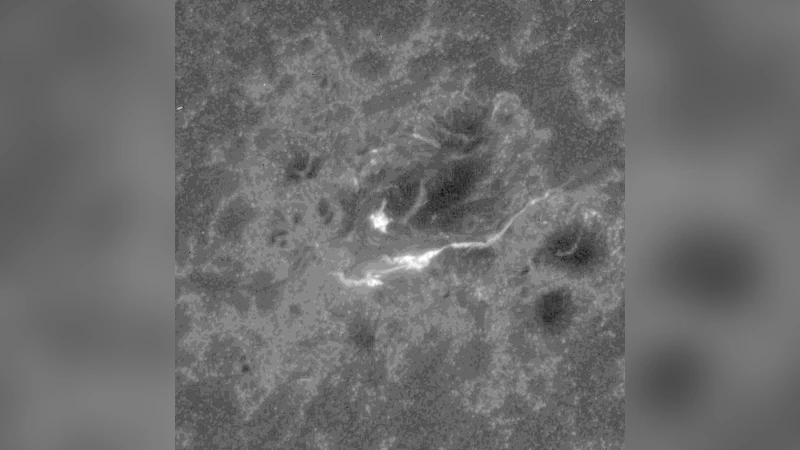
Solar flares observed in the 200-400 GHz radio domain may exhibit a slowly varying and time-extended component which follows a short (few minutes) impulsive phase and which lasts for a few tens of minutes to more than one hour. The few examples discussed in the literature indicate that such long-lasting submillimeter emission is most likely thermal bremsstrahlung. We present a detailed analysis of the time-extended phase of the 2003 October 27 (M6.7) flare, combining 1-345 GHz total-flux radio measurements with X-ray, EUV, and H{\alpha} observations. We find that the time-extended radio emission is, as expected, radiated by thermal bremsstrahlung. Up to 230 GHz, it is entirely produced in the corona by hot and cool materials at 7-16 MK and 1-3 MK, respectively. At 345 GHz, there is an additional contribution from chromospheric material at a few 10^4 K. These results, which may also apply to other millimeter-submillimeter radio events, are not consistent with the expectations from standard semi-empirical models of the chromosphere and transition region during flares, which predict observable radio emission from the chromosphere at all frequencies where the corona is transparent.
💡 Research Summary
The paper presents a comprehensive multi‑wavelength analysis of the long‑lasting sub‑millimeter radio emission observed during the gradual phase of the 2003 October 27 M6.7 solar flare. Radio fluxes were recorded from 1 GHz up to 405 GHz using a suite of instruments: the USAF Radio Solar Telescope Network (RSTN), the Bumishus patrol telescopes, the Solar Submillimeter Telescope (SST) at 212 GHz and 405 GHz, the Kölner Observatorium für SubMillimeter Astronomie (KOSMA) at 230 GHz and 345 GHz, and the Bernese Multibeam Radiometer for KOSMA (BEMRAK) at 210 GHz. Complementary data from GOES soft X‑rays, RHESSI hard X‑rays, TRACE EUV/UV, and Hα imaging were used to constrain the thermal environment of the flare.
The radio time profile clearly separates a short (≈3 min) impulsive burst—interpreted as gyrosynchrotron emission from relativistic electrons—from a slowly varying, time‑extended component that persists for about 45 minutes. The spectral shape of the extended component is flat below ≈200 GHz and rises at higher frequencies, a signature of optically thin thermal bremsstrahlung at lower frequencies turning to partially optically thick emission at the highest frequencies.
By fitting the observed spectrum with thermal bremsstrahlung models, the authors demonstrate that two coronal plasma components are required to reproduce the fluxes up to 230 GHz: a hot component with temperatures of 7–16 MK and emission measure (EM) of order 10⁴⁸ cm⁻³, and a cooler component with temperatures of 1–3 MK and EM ≈10⁴⁷ cm⁻³. These two components, when combined, account for the observed flat spectrum below 200 GHz. However, at 345 GHz the measured flux exceeds the prediction from the coronal plasma alone. Adding a third, much cooler source—chromospheric material at a few × 10⁴ K with EM ≈10⁴⁶ cm⁻³—provides the necessary additional optically thick bremsstrahlung to match the data. This chromospheric contribution is negligible at lower frequencies because the corona is already optically thin there.
The authors also exploit the non‑detection at 405 GHz and the beam‑pattern information of the SST to constrain the source size and location. Modeling shows that the emitting region must be compact (radius 10–70 arcsec) and situated between the RHESSI soft‑X‑ray footpoints and the TRACE UV ribbons, consistent with a low‑lying loop system. The derived source parameters are compatible with the magnetic topology previously reported for this event, which indicated a confined, low‑lying energy release region.
A key implication of the study is the inconsistency with standard semi‑empirical flare atmosphere models (e.g., the VAL‑type chromosphere and transition region). Those models predict that, wherever the corona is transparent, the chromosphere should produce observable radio emission at all sub‑millimeter frequencies. The observations, however, show that the chromospheric contribution is essentially absent below 230 GHz and only becomes significant at 345 GHz. This suggests that during the gradual phase the chromosphere is either not heated to the levels assumed in the semi‑empirical models, or that the radiative transfer conditions (e.g., density stratification, non‑LTE effects) differ markedly from the static models.
In conclusion, the paper provides strong evidence that the time‑extended sub‑millimeter emission of this flare is thermal bremsstrahlung dominated, with coronal hot and cool plasma accounting for the bulk of the emission up to 230 GHz and a modest chromospheric component contributing at higher frequencies. The findings challenge existing flare atmospheric models and highlight the need for high‑resolution, multi‑frequency sub‑millimeter observations to unravel the detailed energy transport and heating processes in solar flares.
Comments & Academic Discussion
Loading comments...
Leave a Comment