Auslander-Buchweitz context and co-t-structures
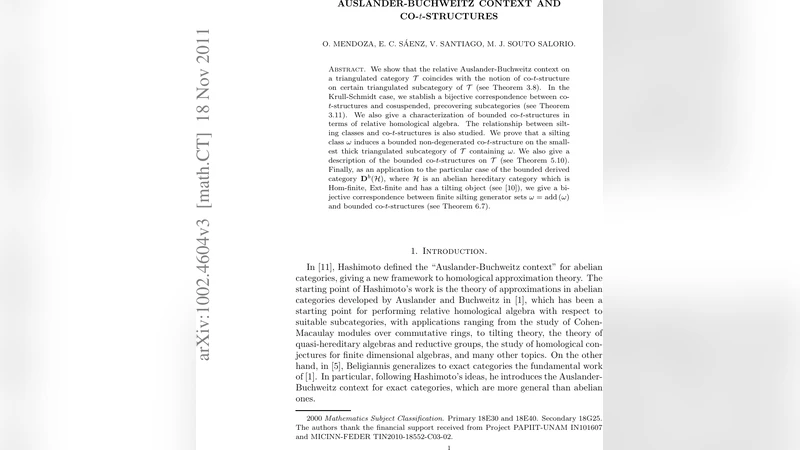
We show that the relative Auslander-Buchweitz context on a triangulated category $\T$ coincides with the notion of co-$t$-structure on certain triangulated subcategory of $\T$ (see Theorem \ref{M2}). In the Krull-Schmidt case, we stablish a bijective correspondence between co-$t$-structures and cosuspended, precovering subcategories (see Theorem \ref{correspond}). We also give a characterization of bounded co-$t$-structures in terms of relative homological algebra. The relationship between silting classes and co-$t$-structures is also studied. We prove that a silting class $\omega$ induces a bounded non-degenerated co-$t$-structure on the smallest thick triangulated subcategory of $\T$ containing $\omega.$ We also give a description of the bounded co-$t$-structures on $\T$ (see Theorem \ref{Msc}). Finally, as an application to the particular case of the bounded derived category $\D(\HH),$ where $\HH$ is an abelian hereditary category which is Hom-finite, Ext-finite and has a tilting object (see \cite{HR}), we give a bijective correspondence between finite silting generator sets $\omega=\add,(\omega)$ and bounded co-$t$-structures (see Theorem \ref{teoH}).
💡 Research Summary
The paper establishes a deep connection between the relative Auslander‑Buchweitz (AB) context on a triangulated category 𝒯 and the notion of a co‑t‑structure on a suitable triangulated subcategory of 𝒯. The main result, Theorem M2, shows that whenever an AB context (𝒰, 𝒱, 𝒲) is defined on a subcategory 𝒰⊆𝒯, the pair (𝒜, ℬ) obtained by taking the co‑aisle 𝒜 = 𝒱 and the aisle ℬ = 𝒲 satisfies the axioms of a co‑t‑structure, and conversely any co‑t‑structure induces an AB context. This equivalence bridges the classical relative homological algebra (originally formulated for module categories) with the modern language of triangulated categories.
In the Krull‑Schmidt setting, where every object decomposes uniquely into indecomposables, the authors prove a bijective correspondence (Theorem correspond) between co‑t‑structures on 𝒯 and subcategories that are both cosuspended (closed under negative shifts and extensions) and precovering (every object admits a morphism from an object of the subcategory that is right minimal). This result refines the known asymmetry between t‑structures and co‑t‑structures by providing a symmetric description in terms of intrinsic subcategory properties.
The paper then turns to boundedness. A co‑t‑structure (𝒜, ℬ) is called bounded if both 𝒜 and ℬ are contained in finite shifts of each other; it is non‑degenerate when the intersection 𝒜∩ℬ is zero. Using relative homological algebra, the authors give a characterization of bounded co‑t‑structures: they correspond precisely to AB contexts where the associated projective and injective classes generate the whole category after finitely many shifts.
Silting theory plays a central role in the subsequent sections. A silting class ω⊂𝒯 is a set of objects that generates a thick subcategory and satisfies a self‑orthogonality condition. Theorem Msc proves that any silting class ω induces a bounded, non‑degenerate co‑t‑structure on the smallest thick triangulated subcategory thick(ω). Explicitly, the co‑aisle is the smallest extension‑closed subcategory containing ω, while the aisle is its right orthogonal shifted by one. This construction provides a systematic method to produce co‑t‑structures from silting data.
The authors further describe all bounded co‑t‑structures on 𝒯 (Theorem Msc) by showing that each such structure arises from a silting class, and conversely every silting class yields a unique bounded co‑t‑structure. This bijection mirrors the well‑known correspondence between tilting objects and t‑structures, but now in the dual setting of silting and co‑t‑structures.
Finally, the paper applies the general theory to the bounded derived category 𝒟(ℋ) of a hereditary abelian category ℋ that is Hom‑finite, Ext‑finite, and possesses a tilting object (as in Happel‑Ringel). In this concrete situation, Theorem teoH establishes a one‑to‑one correspondence between finite silting generator sets ω (i.e., ω = add(ω)) and bounded co‑t‑structures on 𝒟(ℋ). The proof relies on the fact that in a hereditary setting every object has a two‑term resolution, which simplifies the verification of the silting conditions and ensures that the generated thick subcategory coincides with the whole derived category.
Overall, the paper achieves three major contributions: (1) it identifies the AB context with co‑t‑structures, providing a unified framework for relative homological algebra in triangulated categories; (2) it gives a precise classification of co‑t‑structures in Krull‑Schmidt categories via cosuspended precovering subcategories; and (3) it connects silting theory to co‑t‑structures, culminating in a complete description of bounded co‑t‑structures in terms of silting generators, with explicit applications to derived categories of hereditary algebras. These results open new pathways for studying mutation phenomena, stability conditions, and categorical approximations in representation theory and beyond.
Comments & Academic Discussion
Loading comments...
Leave a Comment