Robust Rate-Adaptive Wireless Communication Using ACK/NAK-Feedback
To combat the detrimental effects of the variability in wireless channels, we consider cross-layer rate adaptation based on limited feedback. In particular, based on limited feedback in the form of link-layer acknowledgements (ACK) and negative ackno…
Authors: C. Emre Koksal, Philip Schniter
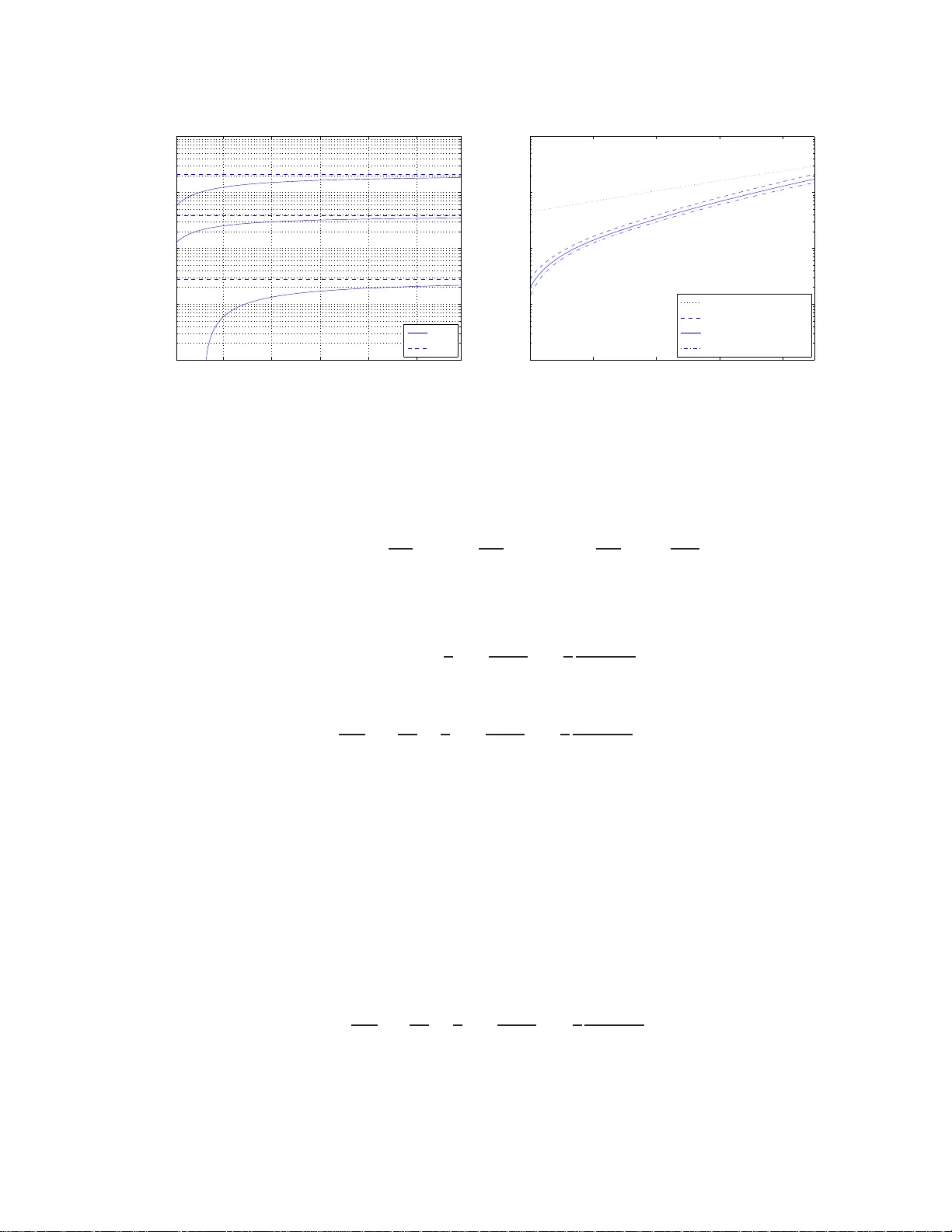
1 Rob ust Rate-Adapti v e W ire less Communication Using A CK/N AK-Feedback C. Emre K oksal and Philip Schniter Abstract T o com bat the d etrimental effects of the variability in wire less ch annels, we consider cro ss-layer rate adaptation based on limited feedback. In particular , based on limited feedback in the form of link- layer ackn owledgements (A CK) an d negative ackno wledg ements (N AK), we maximize th e ph ysical-layer transmission rate subject to an upper bound on the expected packet error rate. W e take a robust approach in th at we d o n ot assume any par ticular pr ior distribution on the channe l state. W e first analyze the fundam ental limitation s o f s uch systems and der iv e an u pper boun d on th e ach iev able ra te for signa ling schemes based on un coded QAM and random Gaussian ensembles. W e show th at, for cha nnel estimation based on binary A CK/N AK feed back, it may be prefera ble to use a separa te training sequence a t hig h error rates, rather than to explo it lo w-err or-rate data p ackets themselves. W e also develop an ad aptive recursive estimator, which is provably asymp totically optim al and asympto tically efficient. Index T erms — adaptive modulatio n, rate adap tation, auto matic repeat request, cross-layer strategies. I . I N T RO D U C T I O N Channel variation is a principal feature of wireless communication. On one ha nd, ch annel variation poses a hindranc e to reliable co mmunication, in that cha nnel fading can make the received signal-to-noise ratio (SNR) arbitrarily low at any given time instant, making reliable co mmunication virtually imposs ible. On the other hand, c hanne l variation pos es an o pportunity , in that a channel-state-aware transmitter can communicate reliably at high rates during channel quality peaks. The k ey to taming and e xploiting chann el The authors are with the Dept. of Electrical and Computer Engineering at The Ohio State Univ ersity , Columbus, OH 43210. P lease direct all correspond ence to P rof. C. Emre K oksal, Dept. ECE , 2015 Neil A ve., Columbu s OH 43210, phone 614.688.43 69, fax 614.292.7596 , and e-mail koksa l@ece.osu.edu. Philip Schniter can be reached at the same address and fax, phone 614.247.6488, and e-mail schniter@ece.osu.edu. Nov ember 2, 201 8 DRAFT 2 variati on therefore lies in the judiciou s u se of transmitter ch annel state information (CSI). While accurate r eceive r CSI is relati vely easy to maintain, accurate transmitter CSI is o ften difficult to maintain due to limited feedback res ources. W e partition l imited feedback sc hemes (see [1] f or an overview) into tw o classes: those based on channel-state feedback a nd tho se based on er r or-r ate feedback . In limited chan nel-state feedback sche mes (e.g., [2]–[5]), the ch annel-state e stimate computed by the receiver is quantized 1 and then fed bac k to the transmitter . In limited error-rate feedba ck sche mes (e.g., [6]–[17]), a quantized error-rate estimate is fed back to the transmitter , from which it can infer CSI r elative to the previously emp loyed transmission rate. For example, with Au tomatic Repea t reQues t (ARQ) [18], a n egati ve ac knowledgement (N AK) o f packet reception s ugges ts that the cha nnel quality w as below that needed for reliable c ommunication at the previously employed transmission rate, wh ereas a positiv e ac knowledgement (A CK) of pa cket reception sugges ts the opposite. Although ACK/ NAK feedbac k c an be employed for the es timation of transmitter CSI, its primary role is that of maintaining a d esired packet error rate at the link layer throug h controlled pa cket re-transmission (see, e.g., [18]). In fact, since the packet a cknowledgement is a standard provision of most practical link layers, we reason that—for the purpose of ch annel-state estimation—it comes at ess entially no cost to the phy sical layer , unlike traditional channel-state feedback sch emes, which require the dedication of rev erse-cha nnel bandwidth b eyond that required for pa cket ack nowledgements. In this se nse, A CK/N AK- based transmitter-CSI sche mes require even less total feed back ban dwidth tha n “on e-bit” chan nel-state feedback schemes (e.g., [19], [ 20]), giv en that systems employing “one-bit” chan nel-state feedbac k include A CK/N AK a s w ell, for the pu rpose of ARQ. W ith the above motiv ation, we focus on the exclusive u se of limited error-r ate feedback for the maintenance o f transmitter CSI, from which trans mission rate and /or power resources are sub seque ntly adapted. While examples of this strategy can b e found in a number of previous works (e.g., [6]–[17]), there are limitations in how it has be en a pplied. For examp le, in [6]–[10 ], the a daptation algorithms are designed heuristically , ba sed o n practical experiences gained for a spe cific application in a spe cific operating e n vironment. In [11]–[17], on the other hand , transmiss ion rates an d/or p owers are chose n carefully to ma ximize a certain performance metric. T o a chieve this o bjectiv e, a Baye sian approa ch is 1 In s ome cases, the receiv er uses its channel estimate to calculate discrete transmitter rate and/or po wer param eters, and then feeds back those parameters directly . Since these transmitter parameters can be put in one-to-one corresponden ce with some quantized channel-state estimate, we consider such schemes to be equiv alent to channel-state feedback schemes. Nov ember 2, 2018 DRAFT 3 taken, i.e., a model is as sumed for the c hanne l variations an d an as sociated o ptimization problem is solved ba sed on this model. T y pically , the channe l is as sumed to v ary according to a finite-state Markov model [11 ], [12 ], [14 ]–[16] or a Gaus s-Markov process [17]. The sho rtcoming of a mode l-based approa ch is that, it may n ot be pos sible to ass ign a ccurate priors over a wide ran ge o f cha nnel operating co nditions. Consider , for example, that ch annel variations sp an a wide rang e of time sc ales, from bits to thousan ds of packets. For ins tance, relative movement of the transmitter-r ece i ver pair ma y caus e variations a t relativ ely long time scale s, since a very large numbe r of packets can be transmitted during the time it takes for the stations to move far eno ugh to cau se s ignificant chang e in the channe l. On the other h and, c o-chann el interference ca n ch ange signific antly from one pac ket transmiss ion to anothe r . Finally , the multipath nature of the propag ation me dium can cause fast and/or slow fading in the chan nel, depen ding on the relati ve movement of the sc atterers. In this pap er , w e ta ke a rob ust Bayesian [21] approa ch to ra te-adaptation from limited error -rate feedback , wh ere “robust Ba yesian” refers to the fact that we treat the cha nnel state as a ran dom q uantity without as suming a ny pa rticular p rior distributi on on it. In pa rticular , we first de ri ve c onditions on the “quality” of CSI needed for a mo del-independ ent A CK/N AK-based rate adaptation system to ma ximize data rate while keeping the packet error probability belo w a specified threshold. Based on these conditions, we d eri ve funda mental bounds on the rate ac hiev able under a given error probability c onstraint. Finally , we de sign an A CK/N AK-feedback-bas ed non -Bayesian cha nnel-state estimator with prov able asymptotic optimality . Our findings are illustrated through both unc oded QAM and random Gaussian signaling. W e emp hasize that the packet-le vel retransmissions orchestrated by link-layer ARQ would be performed on top of the A CK/N AK-based rate-control that we study . In fact, s ince our phy sical-layer optimization criterion (i.e., maximization o f transmission rate su bject to a giv en target pac ket e rror probability) is by n ature d ecoup led from the functioning of highe r layers, we d o n ot explicitly cons ider ARQ in our analysis. In other words, from the p erspective of our phy sical lay er , the link-layer ARQ mec hanism merely specifies the c ontents o f the packets that are to b e transmitted. The remainde r of the pap er is o r ganize d a s follows. In Sec tion II, we detail the syste m model and provide a mathema tical statemen t o f the problem. In Section III, we de ri ve conditions for succ essful rate adaptation with impe rfect CSI, and in Section IV , we e valuate boun ds on the ac hiev able rates with A CK/N AK fee dback. In Sec tion V, we develop an recursi ve cha nnel es timator b ased on s uch feedback , and in Section VI we con clude. Nov ember 2, 2018 DRAFT 4 P S f r a g r e p l a c e m e n t s rate controller encoder f orward channel decoder f eedback re verse channel data H t , γ t F t − 1 R t X t Y t ˆ X t ε ( γ t , R t ) F t Fig. 1. The rate adaptation system. I I . S Y S T E M M O D E L A. S ystem Componen ts Figure 1 de picts our model of the phys ical-layer a daptiv e co mmunication system. At e ach discrete packet index t , the transmitter transmits a p acket X t = [ X t, 1 , . . . , X t,n ] containing a fixed number , n , of symbols { X t,k } n k =1 , wh ich are e ncode d at a rate o f R t bits/symbol, chose n by the rate controller from the set of possible rates R . W e assu me that the transmit power is cons tant an d n ormalize a ll power lev els such that the energy per symbo l is E | X t,k | 2 = 1 . For this p acket, the corresp onding cha nnel ou tputs are Y t,k = H t X t,k + W t,k , k = 1 , . . . , n, (1) for c omplex-valued c hannel g ain H t and additiv e white circularly symme tric complex Gau ssian noise W t,k with two-sided power spec tral de nsity N o . Some co mmon mo dels for H t include Ray leigh-, Rician- and Nakag ami-fading (se e e.g., [22]). Howe ver , we will no t assu me any specific statistical model for H t and we will make only weak a ssumptions on the d istrib ution of H t in the sequel. The qua ntity γ t = | H t | 2 / N o can be interpreted as the t th packet’ s channel SNR . Sinc e each symb ol has unit en ergy , γ t is also the r eceive d SNR for pac ket t . Thus, we will simply refer to γ t as the SNR. Due to lac k of power a daptation, γ t is an exog enous qua ntity over which the s ystem has no control. W e assume that, for all t , γ t takes on values from s ome prior distrib ution p ( · ) ∈ P , where P is a set of distrib utions with finite mean a nd variance. Howe ver , we make no further as sumptions on set P . W e do not ev en ass ume kn owledge of this set by the transmitter or the rec eiv er . W e as sume that the recei ver has access to perfect CSI and uses a maximum lik elihood deco der to decode the rec eiv ed packet. Let ˆ X t denote the d ecode d estimate of packet X t based on rec eiv ed pac ket Y t = [ Y t, 1 , . . . , Y t,n ] , and the corresp onding probab ility of d ecoding error be ε ( γ t , R t ) = Pr ˆ X t 6 = X t | γ t , R t . Note that ε ( · , · ) depend s on the p acket size n and the coding/modu lation sche mes, wh ich are ass umed Nov ember 2, 2018 DRAFT 5 to be kn own at the de coder . For now , we as sume only that the coding/modulation scheme s are su ch that ε ( γ t , R t ) is a conv ex, continuou s, and increa sing function of R t and a c on vex, continuous, and decreas ing function of γ t . Later , we detail the behavior of our propo sed s chemes for the specific case s of u ncoded QAM and random Ga ussian signaling. Based o n the rece i ved packet Y t and the dec oded packet ˆ X t , the dec oder gene rates a feedback packet F t which is co mmunicated to the transmitter through a reverse c hannel. Ass uming that the receiver is capable of perfect e rror detection, we take F t to be a binary A CK/N AK (i.e., F t = 0 for A CK an d F t = 1 for NAK), so that Pr F t = f | γ t , R t = ε ( γ t , R t ) , f = 1 1 − ε ( γ t , R t ) , f = 0 . (2) W e assume that the rev erse channe l is error- free but introduces a delay of a s ingle 2 packet interval. Thus, the “information” a vailable to the transmitter when choosing rate R t is I t = [ F 1 , F 2 , . . . , F t − 1 , R 1 , R 2 , . . . , R t − 1 ] . W e fin d it c on venient to explicitly include the previous rates { R τ } τ < t in the information vector I t becaus e the A CK/N AK fee dback F τ characterizes chan nel quality relative to the transmission rate R τ . Note that the controller c hoose s the trans mission rate a t time t solely b ased on the information vec tor I t , which is av ailable at the rec eiv er as well. W e a ssume that the rece i ver is also aware of the controller’ s rate allocation strategy , s o tha t it can comp ute the current and previous values of R t . Finally , we ass ume in the sequel that the S NR is c onstant over e ach block o f T ≫ 1 packets, a nd tha t it change s indep endently from block to block , i.e ., that the channel is “ block fading. ” In the s equel, we focus (without los s o f g enerality) on the first bloc k, for which t ∈ { 1 , . . . , T } , and omit the t -depen dence on the SNR, writing γ t as “ γ . ” In a ddition, we use p ( γ | I t ) to d enote the posterior SNR distrib ution, which can be a ssociated with the prior distribution p ( γ ) through the co nditional mass func tion P ( F t | γ , R t ) giv en in (2). Fu rthermore, we deno te the set of possible posterior probability distributions u sing P ( I t ) . B. Ide al Rate S election W e de fine the ideal p -hypothes ized con tr oller as the o ne that, at time t , ba sed on the h ypothesiz ed pos - terior p ( γ | I t ) , jointly optimizes the transmission rates ( R t , . . . , R T ) to max imize the sum-rate P T τ = 1 R τ subject to a co nstraint on expected error probability . In doing s o, we allow any packet to be declared a pr obe packet , wh ich is exempt from the expected-error-probability co nstraint but contributes nothing to 2 It is straightforward to generalize al l of our results to a general delay of d > 1 packet intervals. While the generalization does not alter the fundamental nature of our results, it requires a more complex notation, which we avoid for clari ty . Nov ember 2, 2018 DRAFT 6 sum rate. Probe pa ckets are us ed exclusively to le arn about the SNR γ , in the hope of more efficient allocation of future data packets . In particular , the ideal controller choose s r ates acc ording to the foll owing constrained optimization problem: max ( D t ,...,D T ) ∈{ 0 , 1 } T − t +1 , ( R t ,...,R T ) ∈R T − t +1 T X τ = t D τ R τ (3) subject to D τ E p [ ε ( γ , R τ ) | I t ] 6 e − α for a ll τ = t, . . . , T . (4) Here, D τ ∈ { 0 , 1 } indicates whe ther the τ th packet is a da ta pa cket ( D τ = 1 ) o r a prob e packet ( D τ = 0 ), and α > 0 is an app lication-depende nt quality-of-service (QoS) parameter . Note that the expectation E p [ · ] in (4) is taken over the c onditional distrib ution p ( γ | I t ) . W ith A CK/N AK feedback, recall that I t = [ F 1 , F 2 , . . . , F t − 1 , R 1 , R 2 , . . . , R t − 1 ] . Thus, the choice of R t aff ects n ot only the c ontrib ution to the sum-rate but also the “q uality” of the co nditional SNR distrib ution p ( γ | I τ ) a t times τ ≥ t + 1 . As these future SNR estimates g et worse, the controller is force d to cho ose more con servati ve (i.e., lower) rates in order to satisfy the expec ted error-r ate c onstraint. (W e justify this statement in the sequel.) Th us, the se lection of R t has both short-term a nd long-term cons equenc es, which ma y be in co nflict. Conse quently , the so lution to the idea l rate adaptation p roblem (3,4) under A CK/N AK feedback is a cons trained partially observable Markov dec ision process (POMDP) [23]. For practical horizons T , it is c omputationally impractical to implement this P OMDP , as n ow d escribed. Firstly , n otice tha t the s tate of the c hannel is continuous . Even if the c hanne l state was discretized (at the expen se of some los s in pe rformance), the required memo ry to impleme nt the optimal sch eme would grow exponentially with the horizon T . Ind eed, this P OMDP lies in the sp ace of P SP A CE-complete problems, i.e., it req uires bo th comp lexity and memory that g row exponentially with the horizon T [24]. Next, c onsider the (ge nie-aided) cas e of perfect CSI, i.e., I t = γ for a ll t . Whe n the c hanne l is k nown, there is no ne ed for probe pac kets, and thus the optimal so lution choo ses D τ = 1 ∀ τ . Furthermore, since the rate choice does n ot affect the quality of the SNR estimate, the idea l rate assignme nt problem decoup les, so that the best c hoice for R t becomes R perf-CSI t ( γ ) , arg max R t ∈R R t s.t. ε ( γ , R t ) 6 e − α . (5) Indeed, with pe rfect CSI, cons traint (4) is ac ti ve for all t = 1 , . . . , T , since ε ( γ , R t ) is a conv ex increasing function o f R t and the objective function is linear in R t . Notice that, in this case , ideal rate selection is greedy a nd R perf-CSI t ( γ ) is in variant 3 to time t . 3 This inv ariance holds as long as ε ( · , · ) is t -in v ariant, i.e., the coding/modu lation scheme does not change with time. Nov ember 2, 2018 DRAFT 7 P S f r a g r e p l a c e m e n t s I T p +1 ˆ γ ( I T p +1 ) { R T p +1 , . . . , R T } channel estimator rate allocator Fig. 2. The controller decomposed into two componen ts: a channel estimator and a rate allocator . C. Prac tical Rate Selection In practice, we have neither the exact pos terior p ( γ | I t ) , nor the perfect CSI. Thu s, we c onsider a practical (non-ideal) app roach, motiv ated b y technique s from the field o f a daptive control [25], which deviates from the ideal app roach in two principal ways: 1) the probe packet locations are set at the first T p packets in eac h T - block, and 2) the c ontroller is s plit into two componen ts: a channel e stimator , which produces an SNR estimate ˆ γ ( I T p +1 ) based o n the prob e-packet feedba ck I T p +1 , a nd a rate alloca tor , which a ssigns the data packet rate base d on ˆ γ ( I T p +1 ) . (See Fig. 2.) As before, the rate allocator choos es the data-packet rates ( R T p +1 , . . . , R T ) in order to maximize s um-rate under an expected-error-probability constraint. In particular , at each time t ∈ { T p + 1 , . . . , T } , the rate R t is chosen via: max ( R t ,...,R T ) ∈R T − t +1 T X τ = t R τ (6) subject to E p ε ( γ , R τ ) | ˆ γ ( I T p +1 ) 6 e − α (7) for a ll τ = t , . . . , T , where the expectation in (7) is taken over some posterior d istrib ution p ( γ | ˆ γ ( I T p +1 )) . Let u s denote ˆ γ T p +1 , ˆ γ ( I T p +1 ) and the s et of pos sible p osterior distributions with P ( ˆ γ T p +1 ) , which, in turn, is de cided by the particular c hoice o f the e stimator ˆ γ ( · ) . While related, the co nstraints (4) an d (7) have an important dif ference: the information co ntained by I t in (4) is su mmarized by the poss ibly inc omplete sta tistic ˆ γ ( I T p +1 ) in (7). Cons equen tly , sa tisfaction of (7) do es not necess arily gu arantee s atisfaction of (4) or vice versa. Due to the fact that the probing period is limited to the first T p packets, { R T p +1 , . . . , R T } does n ot aff ect the quality of future SNR estimates, the rate assignmen t prob lem (6)-(7) de couples , an d the value of R t satisfying (6)-(7) redu ces to R ∗ t , arg max R t ∈R R t s.t. E p ε ( γ , R t ) | ˆ γ ( I T p +1 ) 6 e − α . (8) Nov ember 2, 2018 DRAFT 8 Moreover , (8) implies that R ∗ t is i n variant to time t . Note that the decoupling that occurs here is r eminisce nt of the decou pling that occurred with ideal rate selection (3)-(4) un der perfect channe l s tate information, i.e., (5). In the n ext section, we shall se e tha t the choice of estimator plays a key role in the overall performanc e of the practical rate adapta tion s cheme. Recall tha t the es timator determines p ( γ | ˆ γ ( I T p +1 )) , which determines the expected e rror proba bility constraint. Under certain s cenarios , we shall s ee that a solution to (8) do es not exist, i.e., that no rates within R satisfy the expected error probability constraint. La ter , in Section V, we dev elop a non-Bay esian es timator in and s how that, with that estimator , the set P ( ˆ γ T p +1 ) will contain merely the class of Gauss ian distrib utions, as ymptotically as T p → ∞ , for any se t, P , of prior d istrib utions with finite mean and v ariance for the S NR. I I I . R A T E A DA P TA T I O N W I T H I M P E R F E C T C S I Before studying the practical rate allocator (8), we first co nsider a pa rticular “ naiv e” d ata-rate a llocator , in orde r to draw intuition on how estimation errors aff ect syste m performance . Giv en SNR estimate ˆ γ , generated from a pa rticular u nbiased e stimator , the na i ve allocator as signs the data rate R nai ve t ( ˆ γ ) , arg max R t ∈R R t s.t. ε ( ˆ γ , R t ) 6 e − α (9) for all t = T p + 1 , . . . , T . Due to the lack of expectation in the error-probability cons traint o f (9), the naiv e rates may violate the d esired expec ted-error -probability cons traint in (8). This follows from the fact that, when the po sterior distributi on p ( γ t | ˆ γ t ) is non-a tomic (i.e., σ 2 γ | ˆ γ > 0 ), Jense n’ s inequality 4 implies that E p [ ε ( γ , R t ) | ˆ γ ] > ε ( ˆ γ , R t ) ∀ R t . (10) Therefore, to ensure the expected -error-probability constraint in (8), the practical allocator must “back- off ” the rate relativ e to R nai ve t ( ˆ γ ) . T o do s o, it choose s R ∗ t ( ˆ γ ) 6 R nai ve t ( ˆ γ ) , whe re equality occurs if and only if the e stimation e rror N , γ − ˆ γ is zero-valued (with probability o ne). When the estimator is perfect (i.e., ˆ γ = γ ), we n ote that the naiv e ra te coincides with the idea l rate under perfect CSI (i.e., R nai ve t ( ˆ γ ) = R perf-CSI t ( γ ) | γ = ˆ γ ). In this ca se, R nai ve t acts as an up per bound on the ideal R t under A CK/N AK fee dback , as spec ified by (3)-(4). Acco rdingly , we make the follo wing two definitions. 4 For unbiased ˆ γ , (10) immediately follows fr om Jensen’ s inequality . For biased ˆ γ , (10) still holds but requires some effort to deriv e. W e skip these details since our focus is on unbiased ˆ γ . Nov ember 2, 2018 DRAFT 9 Definition 1: Th e rate pena lty asso ciated w ith estimator ˆ γ is the smallest δ (in bits/symbol) t hat satisfies E p ε ( γ , R nai ve t ( ˆ γ ) − δ ) | ˆ γ 6 e − α . (11) Definition 2: Th e p ower pe nalty ass ociated with es timator ˆ γ is the sma llest sc ale factor µ that sa tisfies E p ε ( µγ , R nai ve t ( ˆ γ )) | ˆ γ 6 e − α . (12) Next, we analyze two different s cenarios for the de scribed rate a daptation system. In the first sc enario, the n symbols in the packet are ass umed to b e unco ded QAM symb ols, while in the se cond sce nario, the n symbols are a Gauss ian random code d en semble. W ithin the se cond s cenario, we foc us on the high-SNR and low-SNR case s s eparately . For bo th s cenarios, we u se the ana lysis presented next, in Sec. III-A. A. Ga ussian Appr oximation of the Estimation Err or Under the pos terior distribution p ( γ | ˆ γ ) , let the estimation error N = γ − ˆ γ have the dis trib ution q ( N | ˆ γ ) = p ( N + ˆ γ | ˆ γ ) . L et g N | ˆ γ ( r ) and Λ N | ˆ γ ( r ) d enote the moment generating function and the semi- in variant log moment gen erating function [26 ] of N giv en ˆ γ , respec ti vely . W e assu me that the re exists some r max > 0 suc h that Λ N | ˆ γ ( r ) < ∞ for all | r | < r max . It is we ll known [26] that Λ N | ˆ γ (0) = 0 , Λ ′ N | ˆ γ (0) = E q [ N | ˆ γ ] , a nd Λ ′′ N | ˆ γ (0) = σ 2 N | ˆ γ . Then, for any | r | < r max , E q [exp( r N ) | ˆ γ ] = g N | ˆ γ ( r ) = exp Λ N | ˆ γ ( r ) (13) = exp E q [ N | ˆ γ ] r + 1 2 Λ ′′ N | ˆ γ ( r ′ ) r 2 (14) for s ome r ′ between 0 a nd r (having the same sign as r ), where (14) follows from T aylor’ s theorem. Furthermore, applying T aylor’ s theorem to the third-order expansion, we ge t g N | ˆ γ ( r ) = exp E q [ N | ˆ γ ] r + 1 2 σ 2 N | ˆ γ r 2 + 1 6 Λ ′′′ N | ˆ γ ( r ′′ ) r 3 (15) for s ome r ′′ between 0 and r . In many cases , the first two terms of the expa nsion (15) lea d to insightful expres sions to illustrate the impact of the first- an d sec ond-order statistics of “cha nnel variabili ty . ” Th is will be referred to as the Gaussian appr oximation , since, when N | ˆ γ is Gaussian, the cu mulants of h igher o rder than the variance vanish. Further , for an unbiased e stimator , E q [ N | ˆ γ ] = 0 . In this case, the Gauss ian approx imation yields the simple secon d-order approximation: Λ N | ˆ γ ( r ) ≈ 1 2 σ 2 N | ˆ γ r 2 . (16) Nov ember 2, 2018 DRAFT 10 Regardless of the p osterior distribution p ( N | ˆ γ ) , the ap proximation (16) is asymptotically ac curate for the non-Bay esian es timator proposed in Sec tion V, which is asymp totically un biased and asy mptotically normal, as will b e prov ed. B. R ate Adaptation with Un coded QAM Here, we study the sce nario in whic h the n symbo ls { X t,k } n k =1 of packet t are uncod ed and selected from a QAM constellation of size M t . Since the constellation size is c onstant over the pa cket, the rate equals R t = log 2 M t bits/symbol. The follo wing is a tight 5 approximation [2, p. 289 ] on the sy mbol e rr or rate as sociated with minimum-distance decision making [27, p . 280]: ε k ( γ , R t ) ≈ 0 . 2 exp − 3 2 γ 2 R t − 1 . (17) The associated pa cket e rror rate is ε ( γ , R t ) = 1 − (1 − ε k ( γ , R t )) n , (18) since ε k ( γ , R t ) remains constant for all k , a s γ and R t remain constant over the pac ket. Since we can write (1 − ε k ( γ , R t )) n 6 1 − nε k ( γ , R t ) + 1 2 n ( n − 1) ε 2 k ( γ , R t ) , (19) it follows that ε ( γ , R t ) > n 2 ε k ( γ , R t ) for all ( γ , R t ) su ch that ε k ( γ , R t ) < 1 n − 1 . Similarly , (18) implies that ε ( γ , R t ) < 1 − (1 − 1 n − 1 ) n for the same ( γ , R t ) . This latter bou nd is an increa sing function o f n , and, for n ≫ 1 , it a pproximately equa ls 1 − e − 1 , wh ich is muc h highe r than typ ical error rate s. W e a ssume that n is lar ge en ough and the p ossible o utcomes of ( γ , R t ) are such that ε ( γ , R t ) > n 2 ε k ( γ , R t ) for all t with prob ability close to 1 . W e further elaborate on this next, a fter we derive a sufficient co ndition for the error c onstraint to b e me t. T o me et the expe cted-error- probab ility cons traint (8), it is necess ary that n 2 E p [ ε k ( γ , R t ) | ˆ γ ] ≈ n 2 E p 0 . 2 exp − 3 2 γ 2 R t − 1 ˆ γ (20) = n 2 E q 0 . 2 exp − 3 2 ˆ γ + N 2 R t − 1 ˆ γ 6 e − α . (21) 5 The bound holds within approximately 1 dB from the true v alue for a wide range of SNRs [2 , p. 289]. Nov ember 2, 2018 DRAFT 11 Using the unbias ed Gaussian app roximation (16), condition (21) can be rewri tten as follo ws, after taking the natural log o f b oth s ides: − 3 2 ˆ γ 2 R t − 1 + σ 2 N | ˆ γ 2 3 2 1 2 R t − 1 2 6 − α − ln 0 . 1 n. (22) For the existence of a fea sible rate R t , the s olution se t for Inequa lity (22) must be non-empty , for which it is necess ary that ˆ γ 2 σ 2 N | ˆ γ > 2( α + ln 0 . 1 n ) . (23) Condition (23) implies that ˆ γ 2 /σ 2 N | ˆ γ , the effective SNR of estimator ˆ γ , must b e at lea st 2( α + ln 0 . 1 n ) to gu arantee an expected error rate of e − α . Us ing similar steps, 6 a s ufficient cond ition ˆ γ 2 /σ 2 N | ˆ γ > 2( α + ln 0 . 2 n ) can also be de ri ved, illustrating the tightness of (23). W e will in vestigate the difficulty of achieving this condition in the next section. Gi ven that (23 ) is s atisfied, one c an so lve (22) to find the upper b ound R ∗ t 6 ¯ R ∗ t ( ˆ γ , σ 2 N | ˆ γ ) , where ¯ R ∗ t ( ˆ γ , σ 2 N | ˆ γ ) , log 2 1 + ˆ γ · 3 2 σ 2 N | ˆ γ ˆ γ 2 1 − s 1 − 2( α + ln 0 . 1 n ) σ 2 N | ˆ γ ˆ γ 2 ! − 1 . (24) Fig. 3(a) plots the uppe r b ound (24) as a function of the es timator’ s eff ective SNR ˆ γ 2 /σ 2 N | ˆ γ for ˆ γ ∈ { 13 , 20 , 25 } d B, a d esired pa cket error rate of e − α = 10 − 3 , and a pa cket size of n = 500 symbols. The naiv e rate alloca tion R nai ve t ( ˆ γ ) = log 2 1 + ˆ γ · 3 2 1 α + ln 0 . 1 n (25) (deri ved from (21) with N = 0 ) is als o shown on the sa me plot. The re quired effecti ve SNR ˆ γ 2 /σ 2 N | ˆ γ , as imposed by (23), is 21 . 6 here. Fig. 3(a) shows that R nai ve t ( ˆ γ ) < 2 bits/symbo l for ˆ γ 6 13 dB. Sinc e 2 bits/symbol is the minimum possible rate for uncode d QAM, we conc lude that it is impos sible to meet the tar get packet-error ra te of 10 − 3 when ˆ γ 6 13 dB, ev en with pe rfect CSI. By d efinition, the rate pena lty is the sma llest δ that satisfie s δ = R nai ve t ( ˆ γ ) − R ∗ t ( ˆ γ , σ 2 N | ˆ γ ) . Thus, a n upper bound o n δ is giv en b y ¯ δ ( ˆ γ , σ 2 N | ˆ γ ) , R nai ve t ( ˆ γ ) − ¯ R ∗ t ( ˆ γ , σ 2 N | ˆ γ ) . (26) 6 From (18 ) and the fact that ( 1 − ǫ t,k ) n > 1 − nǫ t,k , we have ε ( γ , R t ) 6 nε k ( γ , R t ) for al l ( t, k ) with probability 1 . Conseque ntly , for satisfaction of (8), it is sufficient that n E p [ ε k ( γ , R t ) | ˆ γ ] 6 e − α . Replicating (21)-(23), we obtain t he suf ficiency condition. Nov ember 2, 2018 DRAFT 12 40 60 80 100 0 1 2 3 4 5 6 rate (bits/symbol) (a) P S f r a g r e p l a c e m e n t s ˆ γ = 25 dB ˆ γ = 20 dB ˆ γ = 13 dB ¯ R ∗ t R naive t ˆ γ 2 /σ 2 N | ˆ γ 40 60 80 100 0 0.5 1 1.5 2 2.5 3 3.5 (b) power penalty (dB) P S f r a g r e p l a c e m e n t s ˆ γ 2 /σ 2 N | ˆ γ Fig. 3. For QAM signaling, (a) rates ¯ R ∗ t and R naive t versus estimator’ s effecti ve SNR ˆ γ 2 /σ 2 N | ˆ γ , and (b) po wer penalty lo wer bound µ versus estimator’ s effecti ve SNR ˆ γ 2 /σ 2 N | ˆ γ . From Fig. 3(a), we c an see that ¯ δ ( ˆ γ , σ 2 N | ˆ γ ) de pends on the effecti ve SNR ˆ γ 2 /σ 2 N | ˆ γ : it is significa nt when the eff ective SNR is ne ar the minimum value established by (23), but s hrinks as ˆ γ 2 /σ 2 N | ˆ γ gets lar ge. In addition, ¯ δ ( ˆ γ , σ 2 N | ˆ γ ) gro ws in proportion to ˆ γ . By defin ition, the power pen alty is the s mallest µ that s atisfies R ∗ t ( ˆ γ ) = R nai ve t ( ˆ γ /µ ) . T hus, a lower bound µ ( ˆ γ , σ 2 N | ˆ γ ) on the power pena lty can be found by solving ¯ R ∗ t ( ˆ γ , σ 2 N | ˆ γ ) = R nai ve t ( ˆ γ /µ ) for µ . The power pen alty lower bou nd µ ( ˆ γ , σ 2 N | ˆ γ ) is p lotted in Fig. 3(b) as a function of ef fective SNR ˆ γ 2 /σ 2 N | ˆ γ for the s ame expected pa cket-error rate, 10 − 3 , an d pac ket s ize, n = 500 , as in Fig. 3(a). T he power penalty is seen to be as high as 3 dB when the effecti ve SNR is n ear the minimum value es tablished by (23), but shrinks as ˆ γ 2 /σ 2 N | ˆ γ gets lar ge. C. Ra te Adaptation with Ra ndom Gau ssian E nsembles Next, we stud y the random c oding [28], [29] sc enario in which the cod ew ords a re se lected from a Gaussian e nsemble. Le t R max be the maximum rate in R . Then the Gau ssian ens emble cons ists of 2 nR max possible pac kets, wh ere each symbol, X t,k , of packet t is chos en independe ntly from a N ( 0 , 1) distrib ution. 7 (W e u se unit variance h ere b ecaus e earlier we as sumed E | X t,k | 2 = 1 .) At time t , say that 7 W e use real-value d symbols, i nstead of comple x-valued symbols, f or si mplicity . Consequently , the data rates will be represented in units of bits per real-symbol. For fair comparison with uncode d QAM, one should simply double these data rates. Nov ember 2, 2018 DRAFT 13 transmission rate R t ∈ R is c hosen. Then o ne packet from a s ize- 2 nR t subset of the initially gen erated set o f 2 nR max packets is chose n arbitrarily for transmission. The receiver is assumed to know the su bsets of possible packets correspon ding to eac h ad missible rate R t ∈ R . Based on its observation of the t th packet, the recei ver finds the mos t likely p acket within the subs et o f 2 nR t possible packets. No te that, unlike the u ncode d QAM sc enario, where each s ymbol is dec oded separately , here the entire p acket is deco ded a s a unit. An up per boun d for the asso ciated decoding error p robability is (e .g., [28]) ε ( γ , R t ) 6 exp nρ R t ln 2 − 1 2 ln 1 + γ 1 + ρ , (27) where ρ ∈ [0 , 1] is the u nion bo und parameter . One can minimize (27) over ρ ∈ [0 , 1] to find the tightest bound, if so desired. T o satisfy the expected -error -probability constraint (8 ), it suffices that there exists a ρ ∈ [0 , 1] for which E p exp nρ R t ln 2 − 1 2 ln 1 + γ 1 + ρ ˆ γ 6 e − α . (28) 1) Low-SNR Regime: Wh en Pr γ ≪ 1 | ˆ γ ≈ 1 , we can write ln 1 + γ 1 + ρ ≈ γ 1 + ρ = ˆ γ + N 1 + ρ . (29) For an u nbiased estimator , E q ˆ γ + N 1+ ρ ˆ γ = ˆ γ 1+ ρ and var q ˆ γ + N 1+ ρ ˆ γ = σ 2 N | ˆ γ (1+ ρ ) 2 . Thus , us ing the Ga ussian approximation (16), the co nstraint (28) is satisfied if there exists a ρ ∈ [0 , 1] for which α 6 − n ρ R t ln 2 − ˆ γ 2(1 + ρ ) + 1 8 nρ (1 + ρ ) 2 σ 2 N | ˆ γ , (30) or , e quiv alently , for which R t 6 1 ln 2 − α nρ + ˆ γ 2(1 + ρ ) − 1 8 nρ (1 + ρ ) 2 σ 2 N | ˆ γ . (31) Thus, if the re exists some ρ ∈ [0 , 1] for which the right s ide o f (31) is pos iti ve, then any R t below it is feasible. For this to be p ossible, we need 2 α (1 + ρ ) 2 − ˆ γ nρ (1 + ρ ) + 1 4 ( nρ ) 2 σ 2 N | ˆ γ 6 0 Nov ember 2, 2018 DRAFT 14 for s ome ρ ∈ [0 , 1] , which leads to the following nec essa ry c ondition 8 for the e stimator: ˆ γ 2 σ 2 N | ˆ γ > 2 α. (32) One can then find an upper bound on R t ∈ R satisfying (28) a s follo ws: ¯ R ∗ t ( ˆ γ , σ 2 N | ˆ γ ) = max ρ ∈ [0 , 1] 1 ln 2 − α nρ + ˆ γ 2(1 + ρ ) − 1 8 nρ (1 + ρ ) 2 σ 2 N | ˆ γ . (33) Like wise, o ne can deduce from (27) and (29) that the naiv e rate is R nai ve t ( ˆ γ ) = max ρ ∈ [0 , 1] 1 ln 2 − α nρ + ˆ γ 2(1 + ρ ) . (34) The rate upp er bou nd ¯ R ∗ t is plotted in Fig. 4(a) as a function of the e stimator’ s e f fective SNR ˆ γ 2 /σ 2 N | ˆ γ for ˆ γ ∈ {− 3 , − 8 , − 12 } dB, a des ired packet error rate of e − α = 10 − 3 , an d a packet size o f n = 500 symbols. The rate R nai ve t from (34) is also sh own on the same plot. E very point on the rate curves was computed using the optimal v alue of ρ ∈ [0 , 1] , found numerically . W e n ote that, with the se parameters, (32) implies that ˆ γ 2 /σ 2 N | ˆ γ must be at least 13 . 8 . F igure 4(a) also s hows that the rate penalty ¯ δ ( ˆ γ , σ 2 N | ˆ γ ) = R nai ve t ( ˆ γ ) − ¯ R ∗ t ( ˆ γ , σ 2 N | ˆ γ ) is significant when ˆ γ 2 /σ 2 N | ˆ γ is near the lower boun d e stablished by (32), but that the rate pen alty s hrinks as ˆ γ 2 /σ 2 N | ˆ γ increases . For the sa me tar get pa cket e rror rate ( 10 − 3 ) and pa cket size ( n = 500 ), Fig. 4(b) plots ¯ R ∗ t versus ˆ γ for e stimator eff ective SNR ˆ γ 2 /σ 2 N | ˆ γ ∈ { 60 , 100 } . In the sa me figure, R nai ve t and the “na i ve” Shann on limit (i.e., er godic capacity) 1 2 log 2 (1 + ˆ γ ) b its/real-symbol are sh own. By c omparing the naiv e Shannon limit with R nai ve t , one can obse rve tha t, in the low-SNR regime, the power penalty o f Gaussia n sign aling scheme can be significant, espe cially at small values of ˆ γ . From the same plot, one can obse rve that the additional power pe nalty d ue to imperfect SNR e stimation, µ ( ˆ γ ) , is quite small: less than 0 . 5 d B when ˆ γ 2 /σ 2 N | ˆ γ = 100 and less tha n 1 dB when ˆ γ 2 /σ 2 N | ˆ γ = 60 . 2) High-SNR Regime: Whe n P r γ ≫ 1 | ˆ γ ≈ 1 , we c an write ln 1 + γ 1 + ρ ≈ ln γ 1 + ρ = ln ˆ γ + N 1 + ρ = ln ˆ γ 1 + ρ + ln 1 + N ˆ γ . (35) 8 Note that condition (32) is not exactly analogous to condition (23). Condition (32) is necessary for a non-empty solution set to exist f or inequality (31), whereas (23) i s necessary for the existence of a f easible rate that satisfies the expec ted-error bound. In order to deriv e an analogous necessary condition, one can use a sphere-packing (SP) bound for t he Gaussian channel (see, e. g., [30]). W ith the SP lo wer bound, our findings would be qualitatively similar , but the deriv ation would be extremely tedious. For this reason, we assume that the upper bound is a good approximation for the actual error rate. Nov ember 2, 2018 DRAFT 15 40 60 80 100 120 10 −4 10 −3 10 −2 10 −1 10 0 rate (bits/real−symbol) (a) P S f r a g r e p l a c e m e n t s ˆ γ = − 3 dB ˆ γ = − 8 dB ˆ γ = − 12 dB ¯ R ∗ t R naive t ˆ γ 2 /σ 2 N | ˆ γ −12 −10 −8 −6 −4 10 −4 10 −3 10 −2 10 −1 10 0 rate (bits/real−symbol) (b) P S f r a g r e p l a c e m e n t s R naive t ¯ R ∗ t at ˆ γ 2 /σ 2 N | ˆ γ = 60 ¯ R ∗ t at ˆ γ 2 /σ 2 N | ˆ γ = 100 naive Shannon limit ˆ γ (dB) Fig. 4. For Gaussian si gnaling at low SNR, rates ¯ R ∗ t and R naive t versus (a) estimator’ s effecti ve SNR ˆ γ 2 /σ 2 N | ˆ γ and (b) estimated SNR ˆ γ . Thus, for an unbiase d e stimator , E q ln γ 1+ ρ ˆ γ ≈ ln ˆ γ 1+ ρ and var q ln γ 1+ ρ ˆ γ ≈ σ 2 N | ˆ γ ˆ γ 2 . Similar to the low SNR s cenario, w e can u se the Gau ssian a pproximation (16) to claim that (28) is satisfie d if there exists a ρ ∈ [0 , 1] for which α > − n ρ R t ln 2 − 1 2 ln ˆ γ 1 + ρ + 1 8 nρ ˆ γ 2 /σ 2 N | ˆ γ ! , (36) or , e quiv alently , R t 6 1 ln 2 − α nρ + 1 2 ln ˆ γ 1 + ρ − 1 8 nρ ˆ γ 2 /σ 2 N | ˆ γ ! . (37) Hence, if there exists some ρ ∈ [0 , 1] for whic h the right s ide of (37) is positiv e, then any R t below it is feasible. In the high-SNR regime, we have ˆ γ ≫ 1 w ith high probability , a nd thus there almos t a lw ays exists some ρ ∈ [0 , 1] for which a feas ible R t > 0 exists. One c an deduc e from this observation that, a principal diff erenc e betwee n the high-SNR a nd low- SNR regimes is that, in the high-SNR regime, the expected error proba bility co nstraint is sa tisfied muc h mo re easily , with nearly any SNR estimator . One can then fi nd an up per bound on R t ∈ R sa tisfying (28) as follows: ¯ R ∗ t ( ˆ γ , σ 2 N | ˆ γ ) = max ρ ∈ [0 , 1] 1 ln 2 − α nρ + 1 2 ln ˆ γ 1 + ρ − 1 8 nρ ˆ γ 2 /σ 2 N | ˆ γ ! . (38) Nov ember 2, 2018 DRAFT 16 Like wise, o ne can deduce from (27) and (35) that the naiv e rate is R nai ve t ( ˆ γ ) = max ρ ∈ [0 , 1] 1 ln 2 − α nρ + 1 2 ln ˆ γ 1 + ρ . (39) 40 60 80 100 120 0 0.5 1 1.5 2 2.5 3 3.5 4 4.5 rate (bits/real−symbol) (a) P S f r a g r e p l a c e m e n t s ˆ γ = 25 dB ˆ γ = 20 dB ˆ γ = 13 dB ¯ R ∗ t R naive t ˆ γ 2 /σ 2 N | ˆ γ 12 14 16 18 20 22 24 26 0 0.5 1 1.5 2 2.5 3 3.5 4 4.5 rate (bits/real−symbol) (b) P S f r a g r e p l a c e m e n t s R naive t ¯ R ∗ t at ˆ γ 2 /σ 2 N | ˆ γ = 60 ¯ R ∗ t at ˆ γ 2 /σ 2 N | ˆ γ = 20 naive Shannon limit ˆ γ (dB) Fig. 5. For Gaussian si gnaling at high SNR, rates ¯ R ∗ t and R naive t versus (a) estimator’ s effecti ve S NR ˆ γ 2 /σ 2 N | ˆ γ and (b) estimated SNR ˆ γ . The rate upp er bou nd ¯ R ∗ t ( ˆ γ , σ 2 N | ˆ γ ) is plotted in Fig. 5(a) as a func tion of the estimator’ s effecti ve SNR ˆ γ 2 /σ 2 N | ˆ γ for ˆ γ ∈ { 13 , 20 , 25 } dB, a desired pa cket error ra te of e − α = 10 − 3 , an d a pac ket size of n = 500 symbols. T he rate R nai ve t ( ˆ γ ) from (39) is also shown on the same plot. Every point on the rate c urves was computed using the optimal value of ρ ∈ [0 , 1] , fou nd numerically . W e emp hasize that the rate s plotted in Fig. 5(a) are expresse d in b its per r eal-symb ol , a nd thus s hould be dou bled for fair comparison with the QAM rates presen ted in Fig. 3(a). For Gau ssian signa ling, if w e c ompare the high-SNR results in Figs. 5(a)-5(b) to the low-SNR results in Figs . 4(a)-4(b), we can see that the n ormalized rate penalty ¯ δ / ¯ R ∗ t is muc h s maller in the high-SNR regime. For instance , at ˆ γ 2 /σ 2 N | ˆ γ = 20 , ¯ δ is no mo re than 0 . 5 bits/symbol a nd ¯ δ / ¯ R ∗ t is less than 25% for all three values of ˆ γ . Th is de crease in rate pe nalty is exp ected, since, in the high -SNR regime, the rate scales roug hly with the log of the SNR. For the sa me tar get packet error rate ( 10 − 3 ) and pa cket siz e ( n = 500 ) , Fig. 5(b) plots ¯ R ∗ t ( ˆ γ , σ 2 N | ˆ γ ) versus ˆ γ for e stimator eff ective SNR ˆ γ 2 /σ 2 N | ˆ γ ∈ { 60 , 100 } . In the same fi gure, R nai ve t ( ˆ γ ) and the naive Shannon limit 1 2 log 2 (1 + ˆ γ ) are sh own. There we obs erve that, in the high-SNR regime, the power penalty for Gaus sian signaling is con stant with ˆ γ , a nd no more than 1 . 5 dB. The additional p ower p enalty due to impe rfect SNR estimation, µ ( ˆ γ , σ 2 N | ˆ γ ) , is approximately 1 dB when ˆ γ 2 /σ 2 N | ˆ γ = 60 and approximately Nov ember 2, 2018 DRAFT 17 2 . 5 dB when ˆ γ 2 /σ 2 N | ˆ γ = 20 . I V . F U N DA M E N TA L L I M I TA T I O N S O F AC K / NA K - B A S E D R AT E A DA P T A T I O N In the previous section, we s tudied the performance of the rate ada ptation sys tem for a gene ric unbiased estimator . W e an alyzed the feasible rates with particular c oding/modulation scheme s a s a func tion of the “quality” of the es timation provided by the estimator , for which the relev ant metric was the estimator’ s eff ective SNR ˆ γ 2 /σ 2 N | ˆ γ . Note tha t w e assume d no knowledge of the prior SNR distribution p ( γ ) . In this se ction, we view the SNR of the c urrent bloc k, γ , as an unknown parame ter , 9 and pose the estimation o f γ as a non -Bayesian pa rameter es timation problem. W e first in vestigate the fundame ntal limitations of SNR estimators that are bas ed on packet-lev el A CK/N AK feedb ack, e.g., ˆ γ = ˆ γ ( I T p +1 ) . Using that analysis, we s how that it is dif ficult to make g ood SNR e stimates while simultaneous ly keeping packet-error -rate low . This latter prope rty moti vates SNR-estimation via probe p ackets tha t come without error -rate constraints (in contrast to d ata pa ckets, which are e rror -rate constrained) as assumed in Sec . II. Finally , we discus s o ptimization o f the probing period T p , and we deriv e an upper bound on the optimal sum rate R ∗ sum . A. F undamen tal Limitations of ACK/N AK-Based SNR Estimation Consider the SNR e stimator ˆ γ ( I T p +1 ) , based o n the T p A CK/N AKs in I T p +1 = [ F 1 , F 2 , . . . , F T p , R 1 , R 2 , . . . , R T p ] , where R t denotes the rate and F t denotes the A CK/N AK feed back for pa cket t . In the sequel, we abbreviate ˆ γ ( I T p +1 ) by ˆ γ . Re call that R t and F t are connec ted throug h the pac ket error proba bility ε ( γ , R t ) , as s pecified in (2). Theorem 1: For true SNR γ and any unbiased estimator ˆ γ based on T p A CK/N AKs, the estimation error variance, σ 2 N | ˆ γ , var γ − ˆ γ | ˆ γ , is lower b ounded by : σ 2 N | ˆ γ > T p X t =1 ( ε ′ ( γ , R t )) 2 ε ( γ , R t ) [1 − ε ( γ , R t )] − 1 , (40) where ε ( γ , R t ) is c ontinuously dif ferentiable in γ and ε ′ ( γ , R t ) , ∂ ∂ γ ε ( γ , R t ) . 9 W e assume that γ is a random variable, taking on an independent value for each block, but that the distribution of γ i s unkno wn to the transmitter . Nov ember 2, 2018 DRAFT 18 Pr oof: Given γ and the rates R 1 , . . . , R T p , the fee dback F 1 , . . . , F T p satisfies Pr F 1 = f 1 , . . . , F T p = f T p | γ , R 1 , . . . , R T p = T p Y t =1 Pr F t = f t | γ , R t . (41) Then V ( γ , R t , f t ) , ∂ ∂ γ ln Pr F t = f t | γ , R t = ∂ ∂ γ ln [ ε ( γ , R t )] f t [1 − ε ( γ , R t )] 1 − f t = ε ′ ( γ , R t ) 1 − ε ( γ , R t ) f t ε ( γ , R t ) − 1 . (42) The Fisher information [31] as sociated with F t is: Φ( γ , R t ) = var ( V ( γ , R t , f t ) | γ , R t ) = ( ε ′ ( γ , R t )) 2 ε ( γ , R t ) [1 − ε ( γ , R t )] , (43) and the c umulativ e Fisher information is P T p t =1 Φ( γ , R t ) . Theo rem 1 follows since the Cramer-Rao lower bound (CRLB) for un biased estimators is the reciprocal of the F isher information [31]. B. L ower Bounds on the Requ ir ed Probing P e riod T p In Sec. III, we deri ved lower bounds ( 23) and (32) on the v alue of ˆ γ 2 /σ 2 N | ˆ γ (i.e., the estimator’ s ef fecti ve SNR) required to facilitate the us e o f d ata trans mission via un coded QAM signaling and randomly coded Gaussian signaling, resp ectiv ely . In this section, we translate those lo wer bounds (on required ˆ γ 2 /σ 2 N | ˆ γ ) into lower bounds on req uired prob e-duration T p , recognizing tha t the quality of SNR es timates (and thus ˆ γ 2 /σ 2 N | ˆ γ ) increases with T p . From these boun ds, we sha ll se e that the required value of T p depend s heavily on t he probe error rate, and in pa rticular that the required v alue of T p grows very large as the probe error rate decrea ses. This motiv ates the optimization of probe error ra te, which requires the decou pling of probe e rror rate from da ta e rror rate (since the latter is usually constrained b y the a pplication). In this sec tion, we a ssume that both the modulation/coding sche me and the rate is fixed over the p robe interval, i.e., that R t = R p for t ∈ { 1 , . . . , T p } . In this ca se, the CRLB (40) reduces to σ 2 N | ˆ γ > 1 T p ε ( γ , R p ) [1 − ε ( γ , R p )] ( ε ′ ( γ , R p )) 2 , (44) which is in versely proportional to T p . Nov ember 2, 2018 DRAFT 19 Recall that, to make unc oded QAM signaling feas ible, condition (23 ) must be satisfied, and to make random Gaus sian sign aling feasible in the low-SNR regime, condition (32) must be sa tisfied. Tho ugh (23) and (32 ) are expressed in terms of the es timator’ s effecti ve SNR, w e c an rewri te them as σ 2 N | ˆ γ 6 1 2 ˆ γ 2 / ( α + ln 0 . 1 n ) a nd σ 2 N | ˆ γ 6 1 2 ˆ γ 2 /α , respec ti vely , and a pply the CRLB (44) to arri ve (see Append ix A) at the following. For unco ded QAM, we need T p > T min p , where T min p = 2( α + ln 0 . 1 n ) ε ( γ , R p ) (1 − ε ( γ , R p )) (1 − ε ( γ , R p )) − 1 /n − 1 2 ln 2 5 1 − (1 − ε ( γ , R p )) 1 /n ( n ˆ γ /γ ) 2 , (45) and for ran dom G aussian signaling in the low-SNR regime, we need T p > T min p , where T min p = 8 α 1 − ε ( γ , R p ) 1 + ρ ∗ + γ 2 ε ( γ , R p )( nρ ∗ ˆ γ ) 2 (46) and where ρ ∗ is the union bound pa rameter c orresponding to the tightest error bound (27), which itself depend s on γ , R p , and n . 10 −4 10 −2 10 0 10 0 10 1 10 2 10 3 10 4 (a) 10 −4 10 −2 10 0 10 0 10 1 10 2 10 3 10 4 (b) P S f r a g r e p l a c e m e n t s ˆ γ = − 3 dB ˆ γ = − 7 dB ˆ γ = − 10 dB ε ( γ , R p ) ε ( γ , R p ) T min p T min p Fig. 6. Lowe r bound on required probing duration T min p versus probe packet-error rate ε ( γ , R p ) for (a) uncoded QAM and (b) random Gaussian signaling. Figures 6(a)-(b) plot T min p as a func tion of the p robe error rate ε ( γ , R p ) for uncoded QAM signa ling and ran dom Ga ussian s ignaling, res pectiv ely . For the p lots, we as sume ˆ γ ≈ γ , w hich eliminates the depend ence of T min p on ˆ γ and γ in the QA M case; for the Gaus sian case , we s how T p for the values ˆ γ ∈ {− 3 , − 7 , − 10 } dB. As in our p revious plots, we a ssumed n = 500 an d e − α = 10 − 3 . T he key observation to make from these plots is that the numbe r of p robe packets inc reases quickly as ε ( γ , R p ) shrinks. In fact, the plots sugges t that T p is roughly propo rtional to 1 /ε ( γ , R p ) . T his in verse relationship Nov ember 2, 2018 DRAFT 20 is somewhat intuitiv e beca use, giv en a prob e packet-error rate of ε ( γ , R p ) , one must wait for 1 /ε ( γ , R p ) packets (on a verage) to see a single N AK. Re call, h owe ver , that Fig. 6 shows o nly a lower bound T min p on the probe du ration required for c ommunication with positiv e rate; the o ptimal value of T p is expected to be even larger . The main conclus ion to draw from this s ection is that, to keep the probing period sma ll, one must allow relati vely high probe error rate ε ( γ , R p ) . For sys tems which estimate SNR using only A CK/N AK feedback from da ta packets, this implies tha t if the data error rate e − α is small, the n the nu mber of packets required to get a decent S NR estimate will be large. Su ch systems would on ly be suitable for channe ls that are very slowly fading. C. An Up per B ound on the Optimal Su m-Rate Recall that, in our practical rate ad aptation sys tem, the data p acket rates { R t } R T t = T p +1 are chosen ba sed on the SNR estimated using A CK/N AKs from probe packets with rates { R t } T p t =1 . T o complete the system design, we must choose the rates { R t } T t =1 as well as the probe duration T p . In doing so , we aim to maximize the sum da ta rate R sum = P T t = T p +1 R t while satisfying the expected error- probab ility constraint in (8). Intuiti vely , we k now tha t increas ing T p improves the SNR e stimate which, in turn, allows a higher data rate (since less rate “ba ck-off ” is nee ded to satisfy the e rror constraint). On the o ther hand, for a fixed block length T , the number of d ata pa ckets, T − T p , s hrinks a s T p increases . Therefore, the choice of T p in v olves a tradeoff b etween these two objectiv es. In this se ction, we discuss the ch oice of { T p , R 1 , . . . , R T } a nd deri ve an upper bound on the su m rate R sum that le verages the rate bounds from Sec. III and the CRLB from Sec. IV -A. In Sec . II-C, we recognized that the da ta-rate assign ment problem deco uples in such a way that the optimal data rates { R ∗ t } T t = T p +1 become indepe ndent of time t . Th us, in the seq uel, we focus on choos ing a single data rate R d , whose optimal value will be deno ted by R ∗ d . The s ystem design problem then reduces to the following su m-rate maximization: R ∗ sum , max T p 6 T , ( R 1 ,...,R T p ,R d ) ∈R T p +1 ( T − T p ) R d (47) s.t. E p ε ( γ , R d ) | ˆ γ ( I T p ) 6 e − α . As argued in Sec. III, the optimal da ta rate R ∗ d increases monotonically with the quality of the SNR estimate, i.e., with the in verse of the estimator variance 1 /σ 2 N | ˆ γ . Thus , the optimal p robe p arameters { T p , R 1 , . . . , R T p } are those that minimize σ 2 N | ˆ γ . From the CRLB in Theo rem 1, we know tha t σ 2 N | ˆ γ > Nov ember 2, 2018 DRAFT 21 σ 2 N | ˆ γ ( γ ) , where σ 2 N | ˆ γ ( γ ) , min ( R 1 ,...,R T p ) ∈R T p T p X t =1 [ ε ′ ( γ , R t )] 2 ε ( γ , R t )[1 − ε ( γ , R t )] − 1 (48) = T p X t =1 max R t ∈R [ ε ′ ( γ , R t )] 2 ε ( γ , R t )[1 − ε ( γ , R t )] − 1 . (49) Thus, if γ was provided by a g enie, and if the SNR e stimator was efficient (i.e., C RLB achieving), then (49) suggests to s et the p robe rate at R genie p ( γ ) = arg max R t ∈R [ ε ′ ( γ , R t )] 2 ε ( γ , R t )[1 − ε ( γ , R t )] , (50) which is in variant to bo th time t and probe duration T p . This y ields σ 2 N | ˆ γ ( γ ) = 1 T p ε ( γ , R genie p ( γ ))[1 − ε ( γ , R genie p ( γ ))] [ ε ′ ( γ , R genie p ( γ ))] 2 . (51) Using the genie-aided p robe rate R genie p ( γ ) , we ca n uppe r bo und the op timal s um rate (47) by R genie sum , max T p 6 T , R d ∈R ( T − T p ) R d (52) s.t. E p h ε ( γ , R d ) | ˆ γ ( R genie p ( γ ) , T p ) i 6 e − α , where we explicitly denote the d epend ence of the estimate ˆ γ on both T p and R genie p ( γ ) . Next, rec all that we e stablished, in Sec. III, upper bounds on the largest da ta rate that s atisfies an expected error c onstraint of the type in ( ?? ). In particular , (24) gave an upper bou nd for uncoded QAM signaling, and (33) and (38) gave upper bo unds for Gauss ian sign aling in the low-SNR an d high-SNR regimes, respec ti vely . Thes e data-rate upper bound s, ¯ R ∗ d ( ˆ γ , σ 2 N | ˆ γ ) , can be ap plied to ( ?? ) to bound the optimal sum rate as R ∗ sum 6 ¯ R ∗ sum , whe re ¯ R ∗ sum , max T p 6 T ( T − T p ) ¯ R ∗ d ( ˆ γ , σ 2 N | ˆ γ ) , (53) and where ˆ γ an d σ 2 N | ˆ γ are depend ent on both T p and R p ( γ ) . S ince ¯ R ∗ d ( ˆ γ , σ 2 N | ˆ γ ) increases monotonically in 1 /σ 2 N | ˆ γ , we can uppe r bo und ¯ R ∗ d using the lower bo und on σ 2 N | ˆ γ established in (51). This yields ¯ R ∗ sum 6 R max sum for R max sum , max T p 6 T ( T − T p ) ¯ R ∗ d ( ˆ γ , σ 2 N | ˆ γ ( γ )) . (54) Figures 7(a) and 7(b) plot the normalized su m-rate bound 1 T R max sum as a func tion of the estimated SNR ˆ γ for uncode d QAM and Gauss ian e nsembles , respectively , at T = 5 and T = 50 . As before, we use target error rate 10 − 3 and packet size n = 500 . For the genie-aided probe rate R genie p ( γ ) use d to Nov ember 2, 2018 DRAFT 22 15 20 25 30 0 2 4 6 8 10 Rate (bits/symbol) (a) naive Shannon limit P S f r a g r e p l a c e m e n t s R naive t 1 T R max sum , T = 5 1 T R max sum , T = 50 ˆ γ (dB) −10 −8 −6 −4 −2 0 0 0.1 0.2 0.3 0.4 0.5 Rate (bits/real−symbol) (b) naive Shannon limit P S f r a g r e p l a c e m e n t s R naive t 1 T R max sum , T = 5 1 T R max sum , T = 50 ˆ γ (dB) Fig. 7. Normalized sum-rate bound 1 T R max sum as a function of SNR ˆ γ for (a) QAM and (b) Gaussian signaling in the low-SNR regime. calculate σ 2 N | ˆ γ ( γ ) , we a ssumed that γ ≈ ˆ γ . Th e fig ures also show R nai ve d and the naive Sh annon limit 1 2 log 2 (1 + ˆ γ ) , for comp arison. Note that the difference b etween the naiv e rate R nai ve d and the u pper b ound 1 T R max sum increases significantly as T de crease s. T his is due to the fact that, as T dec reases, it is too costly to allocate a long p robing interval, implying that the qua lity of SNR estimates de creases , so that more rate ba ck-off is required. Note a lso that the difference b etween the naive rate a nd the uppe r b ound increases as the SNR inc reases. This implies that the lack o f perfect CS I b ecomes more costly a s the SNR increases . V . A N A S Y M P T OT I C A L L Y O P T I M A L S N R E S T I M A T O R The qua lity of SNR es timates based on A CK/N AKs from a probe interval is strongly dep enden t on both the probe rates { R t } T p t =1 and the p robe interval T p . For the su m-rate upper bound de ri ved in Sec. IV -C, the probe rate R genie p ( γ ) in (50) was selec ted in a genie -aided manner , assuming knowledge of the true SNR γ . Clearly , γ is no t known in prac tice. In this sec tion, we develop a practical SNR estimator that, d uring the probing interval t ∈ { 1 , . . . , T p } , r ecursive ly u pdates the p robe rate R t and ˆ γ t (i.e., the time- t estimate 10 of γ ) u sing the latest fee dback pair { F t − 1 , R t − 1 } . W e sh ow that the probe rate a daptation is a symptotically optimal , in that R t con ver ges 10 W e emphasize that ˆ γ t is t he time- t estimate of t he time-in va riant SNR γ , and should not be confused wit h the time-varying SNR γ t that was briefly used in Sec. II before the time-inv ariance assumption was introduced. Nov ember 2, 2018 DRAFT 23 to R genie p ( γ ) for any initial probe rate R 1 . Moreover , we sh ow that our SNR e stimator is asy mptotically efficient and asymptotically normal , i.e., that the correspo nding estimation error N t , ˆ γ t − γ con ver ges to a z ero-mean Gauss ian ran dom vari able w hose variance is ide ntical to the CRLB ac hieved with the genie-aided probe rate R genie p ( γ ) . T he normality of the error helps to justify the Gauss ian approx imation used to de ri ve the rate bound s (45) and (46) for the u ncoded QAM and Gaus sian ca ses, respectiv ely . The SNR Es timator: 1) At time t = 1 , choose a n arbitrary rate R 1 ∈ R an d a n arbitrary estimate ˆ γ 1 . 2) At each time t = 2 , . . . , T p , update the e stimate a s ˆ γ t = ˆ γ t − 1 + F t − 1 − ε ( ˆ γ t − 1 , R t − 1 ) ( t − 1) ε ′ ( ˆ γ t − 1 , R t − 1 ) , (55) and choose the rate R t as: R t = argmax R ∈R Φ( ˆ γ t , R ) , (56) where Φ( · , · ) is the Fishe r information as defined in (43). W e p rove the following for ou r estimator . Theorem 2: For both uncoded QAM and Gauss ian ens embles, as T p → ∞ , p T p ˆ γ T p − γ d → N T p ∼ N 0 , Φ − 1 ( γ , R genie p ( γ )) . (57) Pr oof: See Appe ndix B. Theorem 2 implies that our es timator (55) is a symptotically efficient a nd consisten t. Moreover , without any prior information o n γ , rate alloca tion (56) gu arantees the p erformance achieved with the ge nie-aided probe rate R genie p ( γ ) . Next, we s imulate the e stimator . Instea d of the t − 1 on the den ominator , we use ( t − 1) β for various values of β ∈ (0 , 1] . 0 100 200 300 400 500 0 1 2 3 4 5 6 time (packets) Rate (bits/symbol) γ =15 dB γ =20 dB γ =10 dB (a) R t vs. t 0 100 200 300 400 500 0 5 10 15 20 25 time (packets) SNR estimate (dB) γ =10 dB γ =15 dB γ =20 dB (b) ˆ γ t vs. t for β = 0 . 5 0 500 1000 1500 2000 0 5 10 15 20 25 time (packets) SNR estimate (dB) γ =20 dB γ =10 dB γ =15 dB (c) ˆ γ t vs. t for β = 1 Fig. 8. Example trajectories of the recursiv e SNR estimator when uncoded QAM is used. Nov ember 2, 2018 DRAFT 24 In Fig. 8, a single realization of the es timator and the correspond ing assigne d rate are illustrated for dif ferent values of γ , over a block o f T p = 500 prob e packets of size n = 500 symbols. The value of γ and the a symptotic rate R genie p ( γ ) are also s hown on the as sociated graphs. The initial points for the e stimator are ˆ γ 1 = 3 d B, R 1 = 1 b it/symbol, an d the s et of poss ible rates are R = { 1 , 2 , . . . , 10 } in bits/complex-symbol, i.e ., the possible co nstellation sizes a re integer p owers of 2 . For β = 0 . 5 , one can obse rve that the o ptimal rate is reac hed with approx imately 2 0 probe pa ckets for all values of SN R. Once that point is reached , the e stimation error vari anc e dec ays fairly s lowl y due to the low de cay rate β = 0 . 5 . W ith a h igher β , it takes longer to approac h the vicinity o f γ , from the initial v alue ˆ γ 1 , but the estimation error variance is lo wer once in stea dy state. This obse rvati on is illustrated in Fig. 8 (c), where β = 1 and the probing block size is T p = 2000 packets. In the rea lization co rresponding to γ = 20 dB, the “stea dy state” is yet to be reached a fter 2000 p ackets. On the other hand, the amplitude of the fluctuations around the fin al point decay muc h faster , as o ne can observe in the realization c orrespond ing to γ = 10 dB. Dif ferent choice s for β and the ass ociated tradeoffs in volv ed in stochastic a pproximation algorithms are s tudied in [32 ]. 0 100 200 300 400 500 0 1 2 3 4 time (packets) Rate (bits/1D symbol) γ =20 dB γ =3 dB γ =10 dB (a) R t vs. t 0 100 200 300 400 500 0 5 10 15 20 25 time (packets) SNR estimate (dB) γ =20 dB γ =10 dB γ =3 dB (b) ˆ γ t vs. t for β = 0 . 5 0 500 1000 1500 2000 0 5 10 15 20 25 time (packets) SNR estimate (dB) γ =20 dB γ =10 dB γ =3 dB (c) ˆ γ t vs. t for β = 1 Fig. 9. Example trajectories of the recursiv e SNR estimator when Gaussian signaling is used. W e illustrate our estimator resp onse for Gau ssian ense mbles in Fig. 9 . As the s et of rates R , we p icked 100 po ints, e qually spa ced betwee n 0 and 5 bits/real-symbo l. The initial SNR es timate, ˆ γ 1 = 0 dB, was much smaller than the initial one in the QAM simulations, but the initial rate, R 1 = 0 . 5 bits/complex- symbol, was identical to the one in the QAM simulations. He re, we analyze SNR realizations γ = 3 , 10 and 20 dB. W ith Gaus sian ensemble s, the con vergence speed is s lightly lower than tha t with QA M. While the co n ver gence is almost immediate for γ = 3 dB, it takes 30 -40 pa ckets for 10 dB a nd 130-14 0 packets for γ = 20 dB. Th is d if ference is mainly due to the d if ference in the distance s between the initial an d final p oints. On the other h and, due to the large s ize of the s et of poss ible rates (unlike QAM, where Nov ember 2, 2018 DRAFT 25 only a few discrete points are p ossible), there exists some R t ∈ R that is very close to the g enie-aided probe rate R genie p ( γ ) . Cons equen tly , the estimation e rror variance deca ys much faster o nce R t comes n ear the vicinity of R genie p ( γ ) . W e also illustrate the estimator with β = 1 in F ig. 9(c) and one can notice the slow con ver genc e, similar to the QAM simulations. V I . C O N C L U S I O N In this pap er , we studied rate adaptation b ased on A CK/N AK feedbac k. In p articular , we s tudied methods that maximize data rate subject to a cons traint on expec ted packet-error prob ability , assuming that the transmitter ha s no knowledge of the SNR distrib ution. Bec ause op timal ra te allocation was identified as a POMDP , which is impractica l to implement, we focus ed on a s uboptimal framew ork where a c hanne l es timate is ca lculated base d on previous fee dback and a rate is chos en based on this channe l estimate. T o aid the initial rate a llocation, we allowed the use of T p probe p ackets at the start of each da ta block. First we con sidered a so-called “ naive” rate a llocator that maximizes rate s ubject to a constraint on instantaneous packet-error probability , calculated from a given u nbiased estimate ˆ γ of the true SNR γ . Due to the inevitable error in SNR estimation, we a r gue d that one must either back-off the naiv e rate, or c orrespond ingly increa se the SNR, to mee t the stricter expec ted error probability co nstraint. Based on a Gauss ian approximation of the estimation error N = γ − ˆ γ , w e d eri ved conditions on the “effecti ve estimator SNR” ˆ γ 2 /σ 2 N | ˆ γ that are nec essa ry for the existence of a feasible transmission rate, as well as an upper bound on the transmission rate when this nec essa ry con dition is satisfied. T his latter analysis was c arried out for both uncode d QAM sign aling a nd random Gaussia n signaling (the latter in both the low- SNR an d high-SNR regimes). Next, we considered unbiase d S NR estimation via A CK/N AK feedback . First, we lo wer bou nded the error variance of tho se estimates (for ge neral signaling sche mes), and ba sed on that boun d, we lower bou nded the nec essa ry probing duration T p and uppe r bounde d the sum data rate (for both uncoded QAM signaling and random Ga ussian signaling). Finally , we proposed a p ractical unbiased A CK/N AK-base d S NR e stimator and s howed tha t (as the probe duration increase s) our estimator is asy mptotically e f ficient and asymptotically normal. R E F E R E N C E S [1] D. J. Love, R. W . Heath, V . K. N. Lau, D. Gesbert, B. D. R ao, and M. Andrews, “ A n ov erview of limited feedback in wireless communication systems, ” IEEE J. Select. Ar eas I n Commun. , vol. 26, no. 8, pp. 1341–1365 , 2008. [2] A. Goldsmith, W ire less Communications . New Y ork: Cambridge Univ ersity Press, 2005. [3] A. Goldsmith and S. Chua, “V ariable r ate variable power M-QAM for fading channels, ” IEEE T rans. Commun. , vo l. 45, pp. 1218–1230, Oct. 1997. Nov ember 2, 2018 DRAFT 26 [4] D. L. Goeck el, “ Adaptiv e coding for time-varying channels using outdated fading estimates, ” IEE E Tr ans. Commun. , vol. 47, pp. 844–855, June 1999. [5] K. Balachandran, S . R. Kadaba, and S. Nanda, “Channel quality estimation and rate adaptation for cellular mobile r adio, ” IEEE J. Select. Ar eas In Commun. , vol. 17, pp. 1244–125 6, July 1999. [6] G. Holland, N. V aidya, and P . Bahl, “ A rate adaptiv e MA C protocol for multi-hop wireless networks, ” in Proc . ACM Internat. Conf. on Mobile Computing and Networking , vol. 5, pp. 3246–3 250, 2001. [7] B. Sadegi, V . Kanodia, A. Sabharw al, and E. Knightly , “Opportunistic media access for multirate ad hoc networks, ” in Pr oc. ACM Internat. Conf. on Mobile Computing and Networking , vol. 5, (Atlanta, GA), pp. 3246–3250, 2001. [8] J. C. Bicket, “Bit-rate selection in wireless networks, ” Master’ s thesis, Massachusetts Institute of T echno logy , Feb 2005. [9] S. W ong, H. Y ang, S. Lu, and V . Bhargha v an, “Robust rate adaptation f or 802.11 wireless networks, ” in Pr oc. ACM Internat. Conf. on Mobile Computing and Networking , 2006. [10] H. Minn, M. Zeng, and V . K. Bharga va, “On ARQ scheme with adaptiv e error control, ” IEEE Tr ans. V eh. T ech. , vol. 50, pp. 1426–1436, Nov . 2001. [11] M. Rice and S. B. Wick er , “ Adapti ve error control for slowly varyin g channels, ” IEEE T rans. Commun. , vol. 42, pp. 917– 925, Feb./Mar ./Apr . 1994. [12] Y .-D. Y ao, “ An effecti ve go-back-N ARQ scheme for variable-error -rate channels, ” IEEE Tr ans. Commun. , vol. 43, pp. 20– 23, Jan. 1995. [13] S. S . Chakraborty , M. Liinabarja, and E . Yli-Juuti, “ An adaptiv e ARQ scheme with packet combining for time va rying channels, ” IEEE C ommun. L etters , vol. 3, pp. 52–54, Feb . 1999. [14] S. Choi and K . G. Shin, “ A class of hybrid ARQ schemes for wi reless links, ” IEEE Tr ans. V eh. T ech. , vol. 50, pp. 777–790 , May 2001. [15] A. K. Karmokar , D. V . Djonin, and V . K. Bharga v a, “POMDP-based coding rate adaptation f or Type-I hybrid ARQ systems ov er fading channels with memory , ” IEEE T ran s. W ir eless Commun. , vol. 5, pp. 3512–3 523, Dec. 2006. [16] D. V . Dj onin, A. K. Karmokar , and V . K. Bhargav a, “Joint rate and po wer adaptation for t ype-I hybrid ARQ systems ov er correlated fading channels under differen t buffer -cost constraints, ” IEEE Tr ans. V eh. T ec h. , vol. 57, pp. 421–435, Jan. 2008. [17] R. Aggarwal, P . Schniter , and C. E . K oksal, “Rate adaptation via link-layer feedback for goodp ut maximization over a time-v arying channel, ” IE EE T rans. W ir eless Commun. , vol. 8, pp. 4276–42 85, Aug. 2009. [18] D. Bertsekas and R. Gallager , Data Networks . Prentice Hall, 2nd ed., 1992. [19] V . Hassel, D. Gesbert, M. Alouini, and G. E. Oi en, “ A t hreshold-based channel state feedback algorithm for modern cellular systems, ” IEE E T rans. W ir eless Commun. , vol. 6, no. 7, pp. 2422–242 6, 2007. [20] Y . Rong, S. A. V orobyo v , and A. B. Gershman, “ Adaptiv e ofdm techniques wit h one-bit-per-su bcarrier channel-state feedback, ” IEE E T rans. Commun. , vol. 54, no. 6, pp. 1993–20 03, 2006. [21] J. O. Berger , ed., Statistical Decision Theory and Bayesian Analysis . New Y ork: Springer-V erlag, 1985. [22] M. K. S imon and M. S . Alouini, Di gital Communication over F ading Channels . New Y ork: Wiley , 2000. [23] G. E. Monah an, “ A surve y of partially observ able Marko v decision processe s: Theory , mod els, and algorithms, ” Mana gement Science , vol. 28, pp. 1–16, Jan. 1982. [24] C. H. Papadimitriou and J. N. Tsitsiklis, “The complex ity of Markov decision processes, ” Mathematics of Operations Resear ch , vol. 12, no. 3, pp. 441–450, 1987. [25] P . R. Kumar and P . V araiya, Stochastic Systems: Estimation, Idnetification and Adaptive Contr ol . Englew ood Cliffs, N J: Prentice-Hall, 1986. Nov ember 2, 2018 DRAFT 27 [26] R. Gallager , Discr ete Stochastic Pr ocesses . New Y ork: Springer, 1996. [27] J. G. Proakis, Digital Communications . New Y ork: McGraw-Hill, 3rd ed., 1995. [28] R. G. Gallager , Information Theory and Reliable Communication . New Y ork: Wiley , 1968. [29] A. J. V iterbi and J. Omura, Principles of Digital Communication and Decoding . New Y ork: McGraw-Hill, 1979. [30] G. Wiech man and I. Sason, “ An improve d sphere-packing bound for finite-length codes ove r symmetric memoryless channels, ” IEEE Tr ans. Inform. Theory , vol. 54, pp. 1962–19 90, May 2008. [31] H. V . Poor, A n Intro duction to Signal Detection and Esti mation . New Y ork: Springer , 2nd ed., 1994. [32] H. Kushner and G. Y in, Stochastic A ppr oximation Algorithms and A pplications . New Y ork: Springer-V erlag, 1997. [33] M. B. Ne velson and R. Z. Hasminskii, Stochastic Appro ximation and Recurs ive Estimation . Providence, RI: American Mathematical Society , 1972. A P P E N D I X A D E R I V AT I O N O F T min p F O R U N C O D E D Q A M A N D G AU S S I A N S I G NA L I N G In this section, we deriv e (45) and (46). For brevity , we write ε , ε p ( γ , R p ) and ε ′ , ε ′ p ( γ , R p ) . Rec all that, from (23) and (44), we have for , unc oded QAM, T min p = ε (1 − ε ) ( ε ′ ) 2 2( α + ln 0 . 1 n ) ˆ γ 2 (58) where, from (18), ε ′ = ∂ ∂ γ 1 − 1 − 0 . 2 exp − 1 . 5 γ 2 R p − 1 | {z } (1 − ε ) 1 /n n (59) = n (1 − ε ) n − 1 n 0 . 2 exp − 1 . 5 γ 2 R p − 1 | {z } 1 − (1 − ε ) 1 /n − 1 . 5 2 R p − 1 (60) = (1 − ε ) (1 − ε ) − 1 /n − 1 − 1 . 5 γ 2 R p − 1 | {z } ln(5(1 − (1 − ε ) 1 /n )) n γ . (61) Thus T min p = ε (1 − ε )( ε ′ 1 − ε ) 2 2( α + ln 0 . 1 n ) ˆ γ 2 (62) = ε (1 − ε ) (1 − ε ) − 1 /n − 1 2 ln 2 5 1 − (1 − ε ) 1 /n × 2( α + ln 0 . 1 n ) ( n ˆ γ /γ ) 2 . (63) From (32) a nd (44), we have for , Gaussian signaling in the low-SNR regime, T min p = ε (1 − ε ) ( ε ′ ) 2 2 α ˆ γ 2 (64) Nov ember 2, 2018 DRAFT 28 where, from (27), ε ′ = ∂ ∂ γ exp nρ ∗ R p ln 2 − 1 2 ln 1 + γ 1 + ρ ∗ (65) = ε − nρ ∗ 2 1 (1 + γ 1+ ρ ∗ ) 1 1 + ρ ∗ = ε − nρ ∗ 2(1 + ρ ∗ + γ ) . (66) Thus T min p = (1 − ε ) ε ( ε ′ ε ) 2 2 α ˆ γ 2 = 8 α (1 − ε ) ε (1 + ρ ∗ + γ ) 2 ( nρ ∗ ˆ γ ) 2 . (67) A P P E N D I X B P RO O F O F T H E O R E M 2 W e will directly apply Theorem 2 .1 [33, p. 223]. The ne cessa ry conditions for asy mptotic normality and asymptotic ef ficiency to hold in our system a re: 1) The expectation, E [ F t ] , of o bservation F t must exist and must be b ounded : E [ F t ] = ε ( γ , R t ) exists and is clearly bounded by 1 for all t . 2) The partial de ri vati ve ∂ E [ F t ] ∂ γ must be jointly continuous (in γ an d R t ) a nd bounded . For both QAM (17) an d Gaussian (27) signals , | ∂ E [ F t ] ∂ γ | = | ∂ ε ( γ ,R t ) ∂ γ | is c ontinuous and boun ded for γ > 0 and R t > 0 . 3) The vari ance var ( F t ) of ob servation F t must be continuous in γ a nd R t . For both QAM and Gauss ian signaling, v ar ( F t ) = ε ( γ , R t )(1 − ε ( γ , R t )) is continuous and boun ded for γ > 0 and R t > 0 . 4) Fisher information Φ ( γ , R t ) must be continuous , positiv e and for ea ch γ , it must have a unique maximum in R t . For both QAM and Ga ussian s ignaling, the Fisher information Φ( γ , R t ) as gi ven in (43) is co ntin- uous and positi ve for γ > 0 an d R t > 0 . Moreover , it has a unique maximum R t = R genie p ( γ ) for each γ > 0 , since Φ( γ , R t ) is a s trictly concave and continuous function of R t . 5) For some b > 2 , E | F t | b must be bounded f or all poss ible values o f γ a nd associated rate R genie p ( γ ) . Since F t ∈ { 0 , 1 } , we know that E | F t | b is bounded for all b > 2 and for all values of ( γ , R genie p ( γ )) . Nov ember 2, 2018 DRAFT 29 Furthermore, the asymptotic e f ficiency [33, p. 186,22 4] of the estimator is Φ( γ , R t ) · ∂ ∂ γ E [ F t ] 2 var ( F t ) R t = R genie p ( γ ) = Φ( γ , R genie p ( γ )) · ε ′ ( γ , R genie p ( γ )) 2 ε ( γ , R genie p ( γ ))(1 − ε ( γ , R genie p ( γ ))) = 1 . The asymptotic optimality , i.e., T p σ 2 N T p | ˆ γ T p → h Φ( γ , R genie p ( γ )) i − 1 as T p → ∞ follows as a conseq uence of Theorem 2 .1 [33, p. 223]. Nov ember 2, 2018 DRAFT
Original Paper
Loading high-quality paper...
Comments & Academic Discussion
Loading comments...
Leave a Comment