Continuous-time Discontinuous Equations in Bounded Confidence Opinion Dynamics
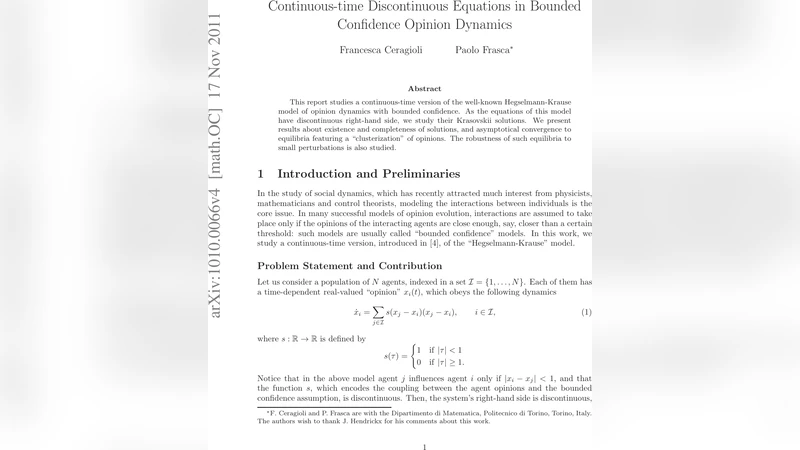
This report studies a continuous-time version of the well-known Hegselmann-Krause model of opinion dynamics with bounded confidence. As the equations of this model have discontinuous right-hand side, we study their Krasovskii solutions. We present results about existence and completeness of solutions, and asymptotical convergence to equilibria featuring a “clusterization” of opinions. The robustness of such equilibria to small perturbations is also studied.
💡 Research Summary
This paper revisits the classic Hegselmann‑Krause (HK) bounded‑confidence model of opinion dynamics, but instead of the usual discrete‑time formulation it studies a continuous‑time version. In the continuous setting each agent’s opinion (x_i(t)\in\mathbb R) evolves according to a differential equation that only sums the differences with agents whose opinions lie within a confidence radius (r). Because the neighbor set (\mathcal N_i(x)={j:|x_j-x_i|\le r}) changes abruptly when an opinion crosses the confidence boundary, the right‑hand side of the system is discontinuous. Classical Carathéodory solutions therefore do not apply, and the authors adopt the Krasovskii set‑valued solution concept, which is a well‑established tool for handling differential equations with discontinuous right‑hand sides.
The paper proceeds in a rigorous, step‑by‑step fashion. First, the authors formalize the model and define the discontinuous vector field (F(x)). They then construct the Krasovskii map (K
Comments & Academic Discussion
Loading comments...
Leave a Comment