Spaces of Operad Structures
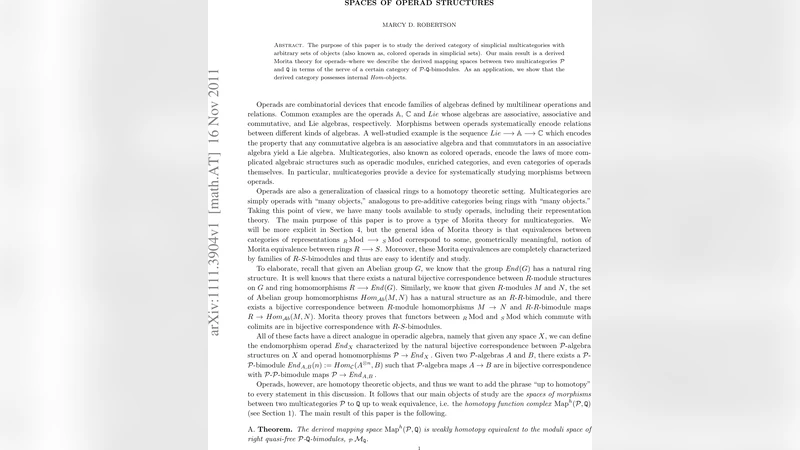
The purpose of this paper is to study the derived category of simplicial multicategories with arbitrary sets of objects (also known as, colored operads in simplicial sets). Our main result is a derived Morita theory for operads-where we describe the derived mapping spaces between two multicategories P and Q in terms of the nerve of a certain category of P-Q-bimodules. As an application, we show that the derived category possesses internal Hom-objects.
💡 Research Summary
The paper develops a homotopical framework for simplicial multicategories (also called colored operads) and establishes a derived Morita theory for these objects. After recalling the basic definitions of multicategories—objects, n‑ary operations, symmetric group actions, and composition—the author introduces the model category structure on the category of all small simplicial multicategories. Weak equivalences are defined as maps that are simultaneously weak equivalences of operads (in the sense of Rezk, Berger‑Moerdijk) and categorical equivalences on the underlying linear part. Using Reedy model structures and Dwyer‑Kan localization, the author obtains a well‑behaved homotopy theory for multicategories.
The central result (Theorem A) states that for any two simplicial multicategories (P) and (Q), the derived mapping space (\operatorname{Map}^h(P,Q)) is weakly homotopy equivalent to the nerve of a certain category of right quasi‑free (P)–(Q) bimodules, denoted (P\mathcal{M}Q). The proof proceeds by constructing cofibrant replacements of bimodules, describing (\operatorname{Map}^h(P,Q)) via various zig‑zag models (Dwyer‑Kan’s zig‑zag categories, cosimplicial resolutions, etc.), and then identifying these models with the nerve of the bimodule category. This identification yields a concrete description of the homotopy type of mapping spaces between operads, extending the classical Morita theory for rings to the operadic setting.
An immediate corollary is that two multicategories are “derived Morita equivalent” precisely when they lie in the same connected component of (\operatorname{Map}^h(P,Q)). In other words, the existence of a path in the derived mapping space corresponds to an equivalence of their representation theories (the categories of modules or algebras over them). The paper also distinguishes its results from those of Berger‑Moerdijk, noting that while the latter give sufficient conditions for derived equivalences of algebras, the present work focuses on the Dwyer‑Kan localization of the whole multicategory.
Using the derived Morita equivalence, the author proves that the homotopy category of simplicial multicategories possesses internal Hom objects. The internal Hom is constructed by interpreting the bimodule category as a new multicategory, thereby endowing the derived category with a closed monoidal structure. Moreover, a cosimplicial model for the mapping space is provided, yielding a filtration by bimodule degree that is useful for explicit calculations (as in the work of Dwyer‑Hess on long knots).
The paper concludes with remarks on possible extensions: the techniques apply to multicategories enriched in other symmetric monoidal model categories (e.g., spectra or chain complexes) after suitable technical adjustments. It also points out that the symmetric actions used here allow a stronger description of mapping spaces than the non‑symmetric case treated by Dwyer‑Hess, and that the cosimplicial model aligns with observations of Berger‑Moerdijk regarding filtrations of derived mapping spaces.
Overall, the work provides a comprehensive homotopical treatment of colored operads, a clear description of their derived mapping spaces via bimodules, and establishes that the derived category of simplicial multicategories is a closed monoidal homotopy theory with internal Hom objects, thereby extending classical Morita theory to a higher‑categorical, homotopical context.
Comments & Academic Discussion
Loading comments...
Leave a Comment