Corner Occupying Theorem for the Two-dimensional Integral Rectangle Packing Problem
This paper proves a corner occupying theorem for the two-dimensional integral rectangle packing problem, stating that if it is possible to orthogonally place n arbitrarily given integral rectangles into an integral rectangular container without overlapping, then we can achieve a feasible packing by successively placing an integral rectangle onto a bottom-left corner in the container. Based on this theorem, we might develop efficient heuristic algorithms for solving the integral rectangle packing problem. In fact, as a vague conjecture, this theorem has been implicitly mentioned with different appearances by many people for a long time.
💡 Research Summary
The paper addresses the two‑dimensional Integral Rectangle Packing (IRP) problem, where a set of n axis‑aligned rectangles with integer widths, heights, and optionally rotated, must be placed without overlap inside an integer‑sized rectangular container. The authors prove a “Corner Occupying Theorem” that guarantees the existence of a feasible packing constructed solely by a sequence of “corner‑occupying actions”. A corner‑occupying action places a rectangle onto a bottom‑left corner formed by already placed rectangles and the container’s four borders, and the placed rectangle becomes bottom‑left stable (i.e., it cannot be moved further down or left without causing overlap).
The development proceeds through several key steps. First, Lemma 1 shows that any feasible packing can be transformed into an equivalent packing where every rectangle is bottom‑left stable, without changing the order or orientation of the rectangles. The proof defines an overlap‑area function O over all rectangle positions, identifies the set S₀ of zero‑overlap configurations, and selects the configuration minimizing the sum Σ(x_i + y_i). Minimality forces each rectangle to be unable to move down or left, establishing bottom‑left stability.
Lemma 2 (the “Escaping Lemma”) states that in any bottom‑left stable packing, after removing the container’s four walls, at least one rectangle can move freely upward and rightward. By sorting rectangles according to the lexicographic order of their top‑right corners and iteratively selecting the rightmost‑topmost rectangle that is not blocked by any rectangle above it, the authors guarantee the existence of such a rectangle because the process must terminate after at most n steps.
Theorem 1 leverages Lemma 2 to construct a numbering of the rectangles: repeatedly remove a freely movable rectangle, record its number, and continue until the container is empty. Reversing this removal order yields a placement order in which each rectangle i can be placed onto a bottom‑left corner formed solely by rectangles 1…i‑1 and the container borders. Consequently, any bottom‑left stable packing can be generated by a sequence of corner‑occupying actions.
Theorem 2 (the Corner Occupying Theorem) combines Lemma 1 and Theorem 1 to claim that if a feasible packing exists at all, then there exists a feasible packing that can be obtained by successively applying corner‑occupying actions. In other words, the bottom‑left corner heuristic is complete for the integral rectangle packing problem when the rectangle order is chosen appropriately. This result provides a solid theoretical foundation for designing exact or heuristic algorithms that rely on bottom‑left corner placement, because it guarantees that no feasible instance will be missed if the algorithm explores all possible orderings of rectangles.
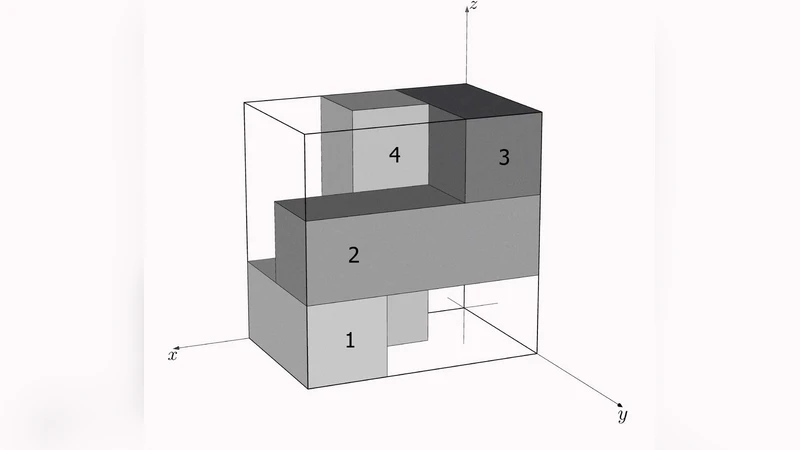
The paper also investigates whether the same reasoning extends to three dimensions. While Lemma 1 can be generalized, Lemma 2 fails in 3‑D: a counter‑example is presented (Fig. 7) where every box is blocked in the positive x, y, and z directions, so no box can “escape” upward‑rightward‑forward. Consequently, the current proof technique does not directly yield a 3‑D corner‑occupying theorem, leaving the three‑dimensional case as an open problem.
Overall, the contribution is twofold: (1) a rigorous proof that bottom‑left corner placement is universally sufficient for integral 2‑D rectangle packing, and (2) an identification of the limitation of this approach in higher dimensions. The theorem can be used to prune the search space of exact branch‑and‑bound algorithms, to design more effective heuristic strategies, and to inspire further research on extending similar completeness results to non‑integral or higher‑dimensional packing problems.
Comments & Academic Discussion
Loading comments...
Leave a Comment