Multi-Instantons and Multi-Cuts
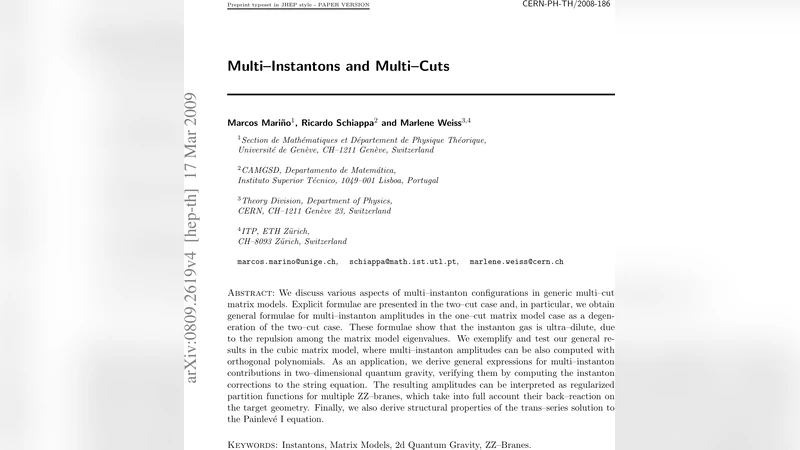
We discuss various aspects of multi-instanton configurations in generic multi-cut matrix models. Explicit formulae are presented in the two-cut case and, in particular, we obtain general formulae for multi-instanton amplitudes in the one-cut matrix model case as a degeneration of the two-cut case. These formulae show that the instanton gas is ultra-dilute, due to the repulsion among the matrix model eigenvalues. We exemplify and test our general results in the cubic matrix model, where multi-instanton amplitudes can be also computed with orthogonal polynomials. As an application, we derive general expressions for multi-instanton contributions in two-dimensional quantum gravity, verifying them by computing the instanton corrections to the string equation. The resulting amplitudes can be interpreted as regularized partition functions for multiple ZZ-branes, which take into full account their back-reaction on the target geometry. Finally, we also derive structural properties of the trans-series solution to the Painleve I equation.
💡 Research Summary
The paper provides a comprehensive study of multi‑instanton configurations in generic multi‑cut matrix models and explores their implications for two‑dimensional quantum gravity and the Painlevé I equation. After a brief motivation, the authors first focus on the two‑cut case, where the eigenvalue distribution is supported on two disjoint intervals on the complex plane. By solving the loop equations and applying a variational principle, they obtain explicit expressions for the non‑perturbative action governing tunnelling of eigenvalues from one cut to the other. The instanton action is proportional to the distance between the cuts and to the difference of the spectral densities; the corresponding amplitude takes the familiar exponential form (A\sim\exp(-S/g_s)). A crucial observation is that the eigenvalue repulsion (the Vandermonde interaction) makes the instanton gas “ultra‑dilute”: the interaction between distinct instantons is strongly suppressed, so that multi‑instanton contributions factorise into a product of single‑instanton amplitudes. This factorisation is encoded in compact formulas (eqs. 3.27‑3.31) involving beta and gamma functions.
The second major step is to degenerate the two‑cut results to the one‑cut model. By continuously shrinking the gap between the cuts, the authors derive a systematic limit in which the two‑cut instanton data collapse onto a one‑cut background. The resulting general multi‑instanton amplitudes for the one‑cut case are presented in eqs. 4.12‑4.15. These expressions reveal that the instanton series is an ultra‑dilute expansion in powers of the string coupling (g_s) and that each instanton contributes a factor of order (\exp(-\mathcal{A}/g_s)) with a universal prefactor.
To test the formalism, the cubic matrix model (V(M)=\frac12 M^2+\frac{g}{3}M^3) is examined. This model possesses a well‑studied two‑cut phase, making it an ideal laboratory. The authors compute multi‑instanton amplitudes using orthogonal polynomial techniques, obtaining explicit 1‑, 2‑, 3‑ and 4‑instanton contributions. They then compare these results with the general formulas derived earlier and find perfect agreement, confirming both the ultra‑dilute nature of the instanton gas and the correctness of the universal prefactors.
Having established the matrix‑model side, the paper turns to applications in two‑dimensional quantum gravity, i.e. the (2,3) minimal string. In this context instantons are identified with ZZ‑branes. The multi‑instanton amplitudes derived above are interpreted as regularised partition functions for configurations of multiple ZZ‑branes, now including their full back‑reaction on the target geometry. By inserting the instanton corrections into the string equation (the KdV hierarchy) the authors verify that the modified equation reproduces the known non‑perturbative structure of the minimal string. This provides a concrete physical realisation of the abstract multi‑instanton calculus.
Finally, the authors analyse the trans‑series solution of the Painlevé I equation, which governs the double‑scaled limit of the one‑cut matrix model. They show that the multi‑instanton sectors correspond to the exponentially suppressed terms in the trans‑series, and that the ultra‑dilute property leads to a simple recursive structure for the Stokes data. The analysis uncovers logarithmic branching and a non‑trivial Stokes phenomenon that are fully compatible with the matrix‑model instanton picture.
In summary, the work delivers explicit, universal formulas for multi‑instanton amplitudes in both two‑cut and one‑cut matrix models, demonstrates their ultra‑dilute character, validates them in the cubic model, and translates them into concrete non‑perturbative effects in 2D quantum gravity and Painlevé I. The results deepen the bridge between random matrix theory, non‑critical string theory, and the theory of nonlinear differential equations, and open the way to explore more intricate multi‑cut geometries and their associated brane configurations.
Comments & Academic Discussion
Loading comments...
Leave a Comment