The univalence axiom in posetal model categories
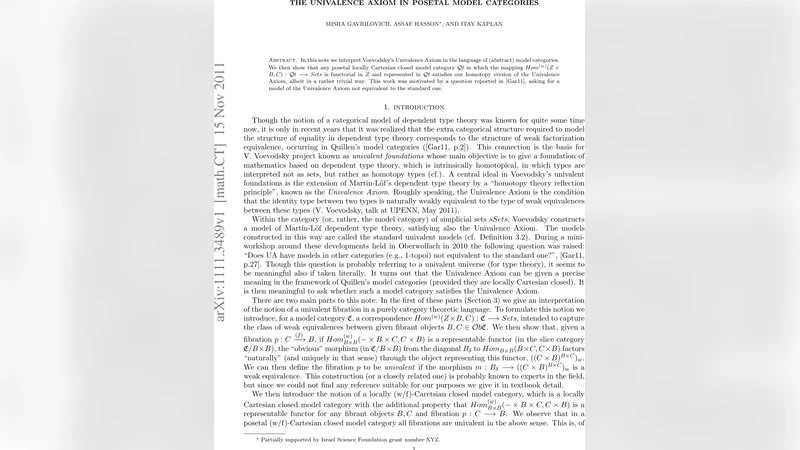
In this note we interpret Voevodsky’s Univalence Axiom in the language of (abstract) model categories. We then show that any posetal locally Cartesian closed model category $Qt$ in which the mapping $Hom^{(w)}(Z\times B,C):Qt\longrightarrow Sets$ is functorial in $Z$ and represented in $Qt$ satisfies our homotopy version of the Univalence Axiom, albeit in a rather trivial way. This work was motivated by a question reported in [Ob], asking for a model of the Univalence Axiom not equivalent to the standard one.
💡 Research Summary
The paper provides a categorical reinterpretation of Voevodsky’s Univalence Axiom within the framework of abstract model categories, and shows that in a very broad class of model categories the axiom holds in a trivial way. The authors begin by recalling that the Univalence Axiom, originally formulated in homotopy‑type theory, asserts that the identity type between two types is equivalent (in a homotopical sense) to the type of weak equivalences between those types. In the simplicial set model this is realized by a universal fibration whose fibers encode all small types, and the map that sends a point of the base to the space of weak equivalences is itself a weak equivalence.
To generalize this, the authors introduce, for any model category (\mathcal C) and objects (B,C), a functor \
Comments & Academic Discussion
Loading comments...
Leave a Comment