Tight bounds on the threshold for permuted k-colorability
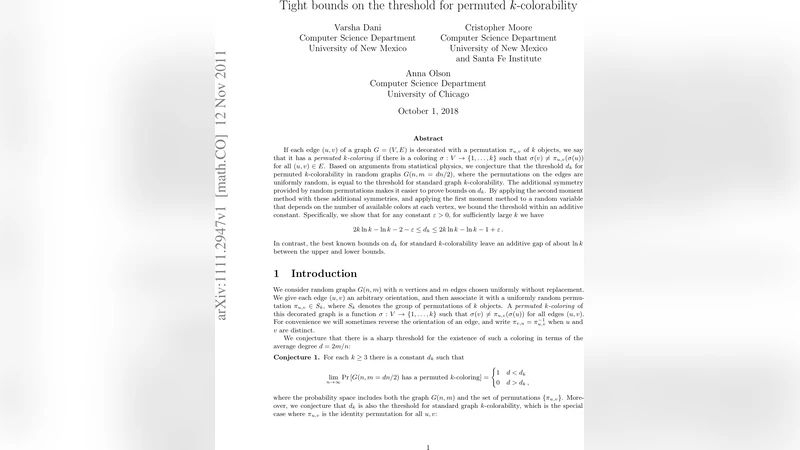
If each edge (u,v) of a graph G=(V,E) is decorated with a permutation pi_{u,v} of k objects, we say that it has a permuted k-coloring if there is a coloring sigma from V to {1,…,k} such that sigma(v) is different from pi_{u,v}(sigma(u)) for all (u,v) in E. Based on arguments from statistical physics, we conjecture that the threshold d_k for permuted k-colorability in random graphs G(n,m=dn/2), where the permutations on the edges are uniformly random, is equal to the threshold for standard graph k-colorability. The additional symmetry provided by random permutations makes it easier to prove bounds on d_k. By applying the second moment method with these additional symmetries, and applying the first moment method to a random variable that depends on the number of available colors at each vertex, we bound the threshold within an additive constant. Specifically, we show that for any constant epsilon > 0, for sufficiently large k we have 2 k ln k - ln k - 2 - epsilon < d_k < 2 k ln k - ln k - 1 + epsilon. In contrast, the best known bounds on d_k for standard k-colorability leave an additive gap of about ln k between the upper and lower bounds.
💡 Research Summary
The paper studies a variant of graph coloring called “permuted k‑coloring”. In this model each edge (u,v) of a random graph G(n,m=dn/2) is equipped with an independently chosen permutation π_{u,v} of the k colors. A coloring σ:V→{1,…,k} is proper if for every edge σ(v)≠π_{u,v}(σ(u)). When all permutations are the identity this reduces to ordinary k‑coloring. The authors conjecture that the random‑graph threshold d_k for the existence of a permuted k‑coloring coincides with the standard k‑coloring threshold. They argue that the extra symmetry introduced by random permutations makes the problem analytically more tractable while preserving the essential difficulty.
Two main results are proved for sufficiently large k. First, using the second‑moment method they obtain a lower bound on the threshold that is within a constant of the trivial first‑moment upper bound. The key observation is that, because the permutations are independent, the probability that a random edge is satisfied by two colorings σ and τ depends only on the fraction ζ of vertices on which σ and τ agree. This reduces the usual high‑dimensional overlap matrix to a single scalar. They compute the overlap function p(ζ) explicitly, approximate the second‑moment sum by an integral, and apply Laplace’s method. The analysis shows that the maximum of the exponent occurs at ζ=1/k and that the second‑moment ratio stays bounded provided d < 2 k ln k – ln k – 2 – ε. Consequently, d_k > 2 k ln k – ln k – 2 – ε.
Second, to improve the upper bound they introduce a weighted first‑moment variable Z = Σ_{σ∈
Comments & Academic Discussion
Loading comments...
Leave a Comment