The Vela and Geminga pulsars in the mid-infrared
The Vela and Geminga pulsars are rotation powered neutron stars, which have been identified in various spectral domains, from the near-infrared to hard $\gamma$-rays. In the near-infrared they exhibit tentative emission excesses, as compared to the optical range. To check whether these features are real, we analysed archival mid-infrared broadband images obtained with the Spitzer Space Telescope in the 3.6–160 $\mu$m range and compared them with the data in other spectral domains. In the 3.6 and 5.8 $\mu$m bands we detected at $\sim$ (4–5)$\sigma$ significance level a point-like object, that is likely to be the counterpart of the Vela pulsar. Its position coincides with the pulsar at < 0.4 arcsec 1$\sigma$-accuracy level. Combining the measured fluxes with the available multiwavelength spectrum of the pulsar shows a steep flux increase towards the infrared, confirming the reality of the near-infrared excess reported early, and, hence, the reality of the suggested mid-infrared pulsar identification. Geminga is also identified, but only at a marginal 2$\sigma$ detection level in one 3.6 $\mu$m band. This needs a farther confirmation by deeper observations, while the estimated flux is also compatible with the near-infrared Geminga excess. The detection of the infrared excess is in contrast to the Crab pulsar, where it is absent, but is similar to the two magnetars, 4U 0142+61 and 1E 2259+586, showing similar features. We discuss X-ray irradiated fall-back discs around the pulsars, unresolved pulsar nebula structures, and pulsar magnetospheres as possible origins of the excesses. We note also possible infrared signatures of an extended tail behind Geminga and of the Vela plerion radio lobes.
💡 Research Summary
The authors present the first systematic search for mid‑infrared (mid‑IR) counterparts of the middle‑aged rotation‑powered pulsars Vela (PSR B0833‑45) and Geminga (PSR J0633+1746) using archival Spitzer Space Telescope data. Both objects had previously shown tentative near‑infrared (near‑IR) flux excesses relative to their optical spectra, but the reality of these excesses was uncertain. To test this, the team retrieved IRAC (3.6, 4.5, 5.8, 8 µm) and MIPS (24, 70, 160 µm) images, focusing on the observations with the longest integration times (AOR 11542784 for Vela and AOR 19037696/19037952 for Geminga). They processed the post‑BCD mosaics, re‑generated mosaics with MOPEX at both the nominal and half‑pixel scales, and carefully examined bad‑pixel masks and artefacts (stray light, muxbleed, muxstripe) to ensure genuine detections.
In the Vela field, a point‑like source is detected at 3.6 µm and 5.8 µm with significance levels of ≈4σ and ≈5σ, respectively. The measured position (RA = 08ʰ 35ᵐ 20ˢ.635 ± 0ˢ.042, Dec = ‑45° 10′ 35″.48 ± 0″.45, J2000) agrees with the radio/optical pulsar coordinates within 0.4″ (1σ), which matches the Spitzer astrometric accuracy. The source is also visible as a bright pixel in the 24 µm image, although longer‑wavelength detections are absent. Combining these fluxes with existing near‑IR (J, H) measurements yields a spectral energy distribution (SED) that rises steeply toward longer wavelengths, confirming the previously reported near‑IR excess and extending it into the mid‑IR regime.
Geminga shows a marginal detection at 3.6 µm in both deep AORs, each at roughly 2σ significance. No counterpart is seen at 4.5 µm or 5.8 µm, and the 3.6 µm signal is affected by background fluctuations and instrumental artefacts, so only an upper limit can be robustly quoted for the other bands. Nevertheless, the measured 3.6 µm flux is consistent with the near‑IR excess reported for Geminga, suggesting that a similar infrared component may be present.
The authors compare these results with the multi‑wavelength spectra of the two pulsars. Both exhibit non‑thermal power‑law (PL) emission in the optical and X‑ray bands, with a spectral break between them. The newly identified IR excess cannot be explained by a simple extrapolation of the PL component, indicating an additional emission component. Three possible origins are discussed:
-
X‑ray‑irradiated fallback disks: Material left over from the supernova explosion could form a dusty disk around the neutron star; X‑ray heating would cause the disk to radiate in the IR, similar to the disks inferred around the anomalous X‑ray pulsars 4U 0142+61 and 1E 2259+586.
-
Unresolved pulsar wind nebula (PWN) structures: Small‑scale features such as Vela’s inner jet, arc, or Geminga’s bow‑shock tail could contain relativistic particles that emit synchrotron radiation extending into the mid‑IR.
-
Magnetospheric emission: Direct synchrotron or curvature radiation from particles within the pulsar’s magnetosphere could produce an IR component distinct from the optical/X‑ray PL.
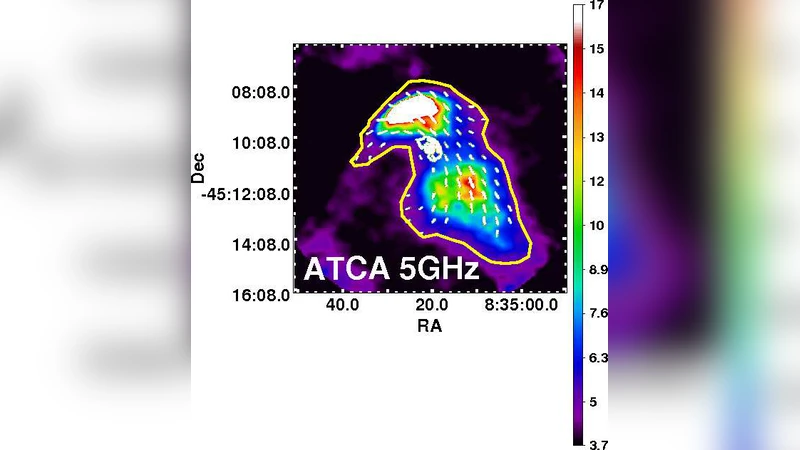
The detection of an IR excess in Vela and Geminga contrasts with the Crab pulsar, which shows no such excess, and aligns them more closely with the magnetars mentioned above. The paper also notes possible IR signatures of Vela’s extended plerion radio lobes and Geminga’s high‑energy tail, hinting at larger‑scale structures contributing to the IR flux.
In conclusion, the study confirms that Vela possesses a genuine mid‑IR counterpart with a steeply rising SED, and provides tentative evidence for a similar counterpart to Geminga. The IR excesses likely arise from either fallback disks, unresolved PWN features, or magnetospheric processes. Future high‑resolution, deep IR observations with facilities such as JWST or ELT will be essential to discriminate among these scenarios, resolve any disk or nebular structures, and deepen our understanding of how pulsar age, magnetic field, and environment shape infrared emission.
Comments & Academic Discussion
Loading comments...
Leave a Comment