Anomalous diffusion. A competition between the very large jumps in physical and operational times
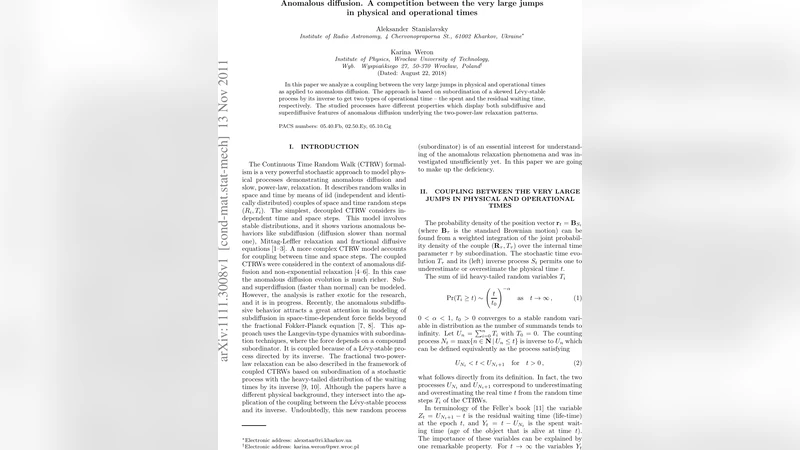
In this paper we analyze a coupling between the very large jumps in physical and operational times as applied to anomalous diffusion. The approach is based on subordination of a skewed Levy-stable process by its inverse to get two types of operational time - the spent and the residual waiting time, respectively. The studied processes have different properties which display both subdiffusive and superdiffusive features of anomalous diffusion underlying the two-power-law relaxation patterns.
💡 Research Summary
The paper investigates a novel stochastic framework that couples the extremely large jumps occurring in both physical time and operational (internal) time, aiming to provide a unified description of anomalous diffusion and two‑power‑law relaxation phenomena. Starting from the continuous‑time random walk (CTRW) formalism, the authors consider waiting times (T_i) that follow a heavy‑tailed Lévy‑stable distribution with exponent (0<\alpha<1). The cumulative sum (U_n=\sum_{i=0}^{n}T_i) and its inverse counting process (N_t=\max{n:U_n\le t}) give rise to two natural operational times: the spent waiting time (Y_t=t-U_{N_t}) and the residual waiting time (Z_t=U_{N_t+1}-t). When the tail of the waiting‑time distribution is sufficiently heavy, the normalized variables (Y_t/t) and (Z_t/t) converge to distinct limit laws: a beta‑type density supported on ((0,1)) for (Y_t/t) (finite moments) and a heavy‑tailed density on ((1,\infty)) for (Z_t/t) (divergent first moment). These two quantities correspond respectively to under‑estimation and over‑estimation of the physical clock by the internal clock.
The authors then introduce a compound subordination scheme. They take an inverse Lévy‑stable process (S_\alpha(t)) (the “inverse subordinator”) and subordinate it further by another Lévy‑stable process with exponent (\gamma) ((0<\gamma<1)), which models a heavy‑tailed distribution of cluster sizes. This yields two coupled operational times:
- Undershooting subordinator (Z_U^{\alpha,\gamma}(t)=X_\gamma^{U}
Comments & Academic Discussion
Loading comments...
Leave a Comment