A Comprehensive Study of Commonly Practiced Heavy and Light Weight Software Methodologies
Software has been playing a key role in the development of modern society. Software industry has an option to choose suitable methodology/process model for its current needs to provide solutions to give problems. Though some companies have their own customized methodology for developing their software but majority agrees that software methodologies fall under two categories that are heavyweight and lightweight. Heavyweight methodologies (Waterfall Model, Spiral Model) are also known as the traditional methodologies, and their focuses are detailed documentation, inclusive planning, and extroverted design. Lightweight methodologies (XP, SCRUM) are, referred as agile methodologies. Light weight methodologies focused mainly on short iterative cycles, and rely on the knowledge within a team. The aim of this paper is to describe the characteristics of popular heavyweight and lightweight methodologies that are widely practiced in software industries. We have discussed the strengths and weakness of the selected models. Further we have discussed the strengths and weakness between the two opponent methodologies and some criteria is also illustrated that help project managers for the selection of suitable model for their projects.
💡 Research Summary
The paper provides a comprehensive survey of software development process models, categorizing them into heavyweight (traditional) and lightweight (agile) families, describing representative methods, analyzing their strengths and weaknesses, and offering a decision‑making framework for selecting an appropriate methodology for a given project.
The introduction outlines the software development life‑cycle (SDLC) and notes the plethora of existing models, positioning heavyweight and lightweight as the two broad categories.
Section 2 focuses on heavyweight methodologies. The Spiral model is presented as a risk‑driven iterative framework suitable for large, high‑budget, high‑risk projects where requirements are uncertain; its four phases (objective setting, risk assessment, development/validation, planning) are explained, along with its limitations (complexity, unsuitability for small projects). The Rational Unified Process (RUP) is described as a commercial, iterative framework with four phases (Inception, Elaboration, Construction, Transition) and six best‑practice guidelines (iterative development, requirements management, component‑based architecture, visual modeling, quality verification, change control). RUP’s strengths (structured governance, suitability for large, distributed systems) and drawbacks (high tool cost, steep learning curve) are discussed. The Incremental model is portrayed as an evolution of Waterfall that delivers functional increments early, reducing time‑to‑market and risk, but it requires well‑defined initial requirements and careful planning of delivery increments. Component‑Based Development (CBD) is examined as a reuse‑oriented approach that assembles pre‑built components, offering cost and time savings, easier maintenance, and risk mitigation; however, challenges include component discovery, integration complexity, and limited applicability to cutting‑edge technologies. A comparative table summarizes each heavyweight method’s advantages (early verification, iterative efficiency, reuse, etc.) and disadvantages (complexity, poor fit for small projects, tool dependence, etc.).
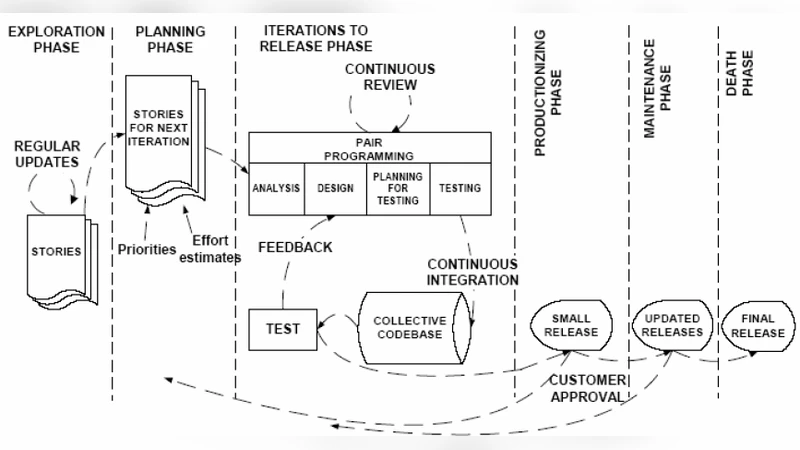
Section 3 addresses lightweight methodologies, rooted in the Agile Manifesto. The paper lists the core Agile principles (face‑to‑face communication, customer collaboration, responding to change, etc.) and then details two major Agile frameworks. Extreme Programming (XP) is explained with its practices: short releases, planning by user stories, metaphor, simple design, refactoring, pair programming, collective code ownership, continuous integration, a 40‑hour work week, on‑site customer, and coding standards. XP is suitable for small teams with highly skilled developers but depends heavily on continuous customer involvement. Scrum is described as a sprint‑based framework (1–4‑week sprints) with fixed sprint length, backlog grooming, sprint planning, daily stand‑ups, sprint review, and retrospective. Scrum provides predictability and transparency but can suffer if sprint planning is inadequate. The Prototype model is also covered as a lightweight technique for early requirement validation, useful when requirements are vague, yet it risks turning a prototype into a poorly designed final system.
Section 4 compares heavyweight and lightweight models across dimensions such as project size, risk exposure, change management, documentation needs, team expertise, and tooling. The authors argue that the two families are not mutually exclusive; a hybrid approach—using heavyweight techniques for early risk analysis and architecture, then switching to agile practices for implementation—can leverage the strengths of both.
Section 5 proposes a selection framework. Decision criteria include project scale, risk level, requirement clarity, customer involvement, schedule and budget constraints, desired product quality, team skill set, and available tools. The paper presents a matrix mapping these factors to the most suitable methodology (e.g., large, high‑risk, documentation‑heavy projects → heavyweight; rapidly changing, customer‑centric, small‑to‑medium projects → lightweight).
The conclusion reiterates that both heavyweight and lightweight methodologies have valuable attributes, and the optimal strategy often involves tailoring or combining them to fit the specific context. The authors acknowledge limitations such as the lack of empirical case studies and quantitative evaluation, suggesting future work to validate the proposed selection criteria in real‑world settings.
Overall, the paper serves as a useful reference for project managers and software engineers seeking to understand the trade‑offs between traditional and agile process models and to make informed methodological choices.
Comments & Academic Discussion
Loading comments...
Leave a Comment