Evolution of spatially embedded branching trees with interacting nodes
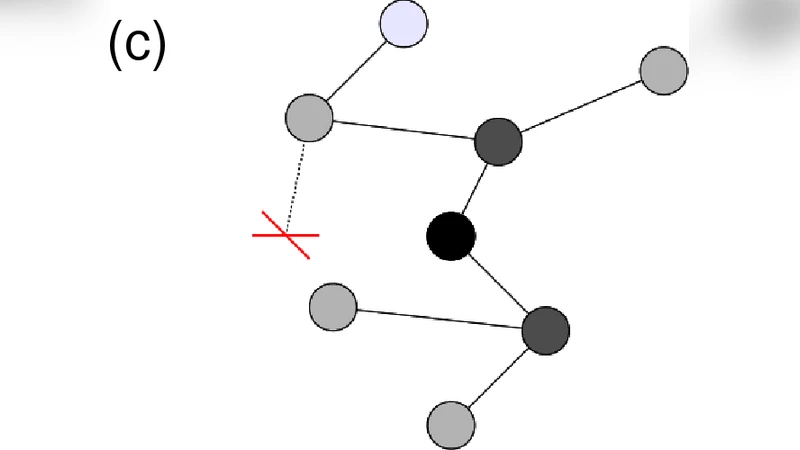
We study the evolution of branching trees embedded in Euclidean spaces with suppressed branching of spatially close nodes. This cooperative branching process accounts for the effect of overcrowding of nodes in the embedding space and mimics the evolution of life processes (the so-called “tree of life”) in which a new level of complexity emerges as a short transition followed by a long period of gradual evolution or even complete extinction. We consider the models of branching trees in which each new node can produce up to two twigs within a unit distance from the node in the Euclidean space, but this branching is suppressed if the newborn node is closer than at distance $a$ from one of the previous generation nodes. This results in an explosive (exponential) growth in the initial period, and, after some crossover time $t_x \sim \ln(1/a)$ for small $a$, in a slow (power-law) growth. This special point is also a transition from “small” to “large words” in terms of network science. We show that if the space is restricted, then this evolution may end by extinction.
💡 Research Summary
The paper introduces a spatially embedded branching‑tree model in which each node can attempt to create up to two offspring within a unit Euclidean distance. A new offspring is rejected if it would lie closer than a prescribed distance a to any node of the previous generation (or, in a variant, to any existing node). This “overcrowding suppression” mimics spatial competition among species or agents.
Two growth regimes emerge. In the early stage, the distance constraint is rarely violated, so the number of nodes N(t) grows exponentially, N(t)≈2^t. As the tree expands, the probability of violating the distance rule increases, leading to a crossover at a characteristic time tₓ. By equating the exponential and power‑law estimates (2^{tₓ}≈(tₓ/a)^D) the authors obtain tₓ≈(D/ln 2)·ln(1/a). Numerical simulations for D=1 confirm tₓ≈1.46 ln(1/a), showing excellent agreement with the analytical prediction.
After tₓ the growth slows to a power‑law. If only the previous generation imposes the distance rule, the total number of nodes scales as N_tot(t)∼(t/a)^D, and the number of nodes added in each generation behaves as N(t)∼t^{D‑1}/a^D (for D=1, N(t)∼1/a). In the more restrictive variant where all existing nodes enforce the rule, the total population still follows N_tot∼(t/a)^D, but the generation size quickly saturates at a constant N_max≈c/a, because the available “fertile” space becomes exhausted.
The authors also explore finite‑size effects by confining the tree to a hyper‑cube of linear size L. In this case the population cannot exceed a value proportional to L/a. Moreover, stochastic fluctuations can drive all nodes into a small region, after which no further branching is possible, leading to complete extinction. By scanning the (a, L) plane they identify a boundary L(a)≈k a that separates regimes where extinction occurs within 10^5 generations from those where the tree persists. Longer observation times shift the boundary upward, suggesting that for any finite L and non‑zero a extinction is inevitable in the infinite‑time limit.
Spatial distribution of nodes is examined as well. In an unbounded domain, the density profile of the tree’s generations forms a triangular shape that expands linearly with time, reflecting the constant speed of the frontier. When the full‑population suppression rule is applied, the distribution eventually becomes uniform because the constraint forces new nodes to appear wherever space is available. In a bounded domain the distribution converges to uniformity regardless of the rule.
Overall, the study demonstrates that a simple distance‑based suppression mechanism can generate a rich set of dynamical behaviors: an initial exponential “small‑world” phase, a crossover to a “large‑world” power‑law regime, saturation at a finite size, and possible extinction when space is limited. These findings provide a tractable framework for understanding spatial competition in evolutionary biology, ecological colonization, and the growth of spatial networks.
Comments & Academic Discussion
Loading comments...
Leave a Comment