Rainbow connections for planar graphs and line graphs
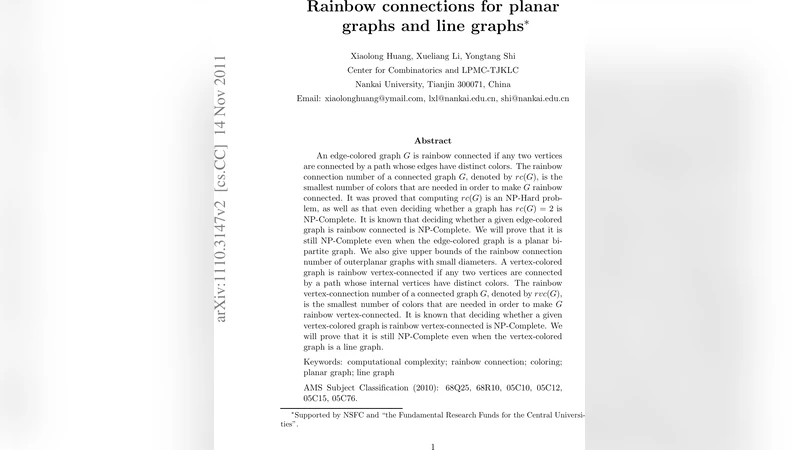
An edge-colored graph $G$ is rainbow connected if any two vertices are connected by a path whose edges have distinct colors. The rainbow connection number of a connected graph $G$, denoted by $rc(G)$, is the smallest number of colors that are needed in order to make $G$ rainbow connected. It was proved that computing $rc(G)$ is an NP-Hard problem, as well as that even deciding whether a graph has $rc(G)=2$ is NP-Complete. It is known that deciding whether a given edge-colored graph is rainbow connected is NP-Complete. We will prove that it is still NP-Complete even when the edge-colored graph is a planar bipartite graph. We also give upper bounds of the rainbow connection number of outerplanar graphs with small diameters. A vertex-colored graph is rainbow vertex-connected if any two vertices are connected by a path whose internal vertices have distinct colors. The rainbow vertex-connection number of a connected graph $G$, denoted by $rvc(G)$, is the smallest number of colors that are needed in order to make $G$ rainbow vertex-connected. It is known that deciding whether a given vertex-colored graph is rainbow vertex-connected is NP-Complete. We will prove that it is still NP-Complete even when the vertex-colored graph is a line graph.
💡 Research Summary
The paper investigates the computational complexity of two closely related problems in graph theory: rainbow connection (rc) and rainbow vertex‑connection (rvc). A rainbow‑connected edge‑colored graph is one in which every pair of vertices is linked by a path whose edges all have distinct colors; the minimum number of colors needed for such a coloring is the rainbow connection number rc(G). Analogously, a vertex‑colored graph is rainbow vertex‑connected if every pair of vertices can be joined by a path whose internal vertices receive pairwise distinct colors, and the smallest number of colors required is denoted rvc(G).
The authors first review known results: computing rc(G) is NP‑hard, deciding whether rc(G)=2 is NP‑complete, and even checking whether a given edge‑coloring makes a graph rainbow‑connected is NP‑complete. Similar hardness holds for rvc(G). Their contribution is to tighten these hardness results for two restricted families of graphs—planar bipartite graphs and line graphs—while also providing new upper bounds for the rainbow connection number of outerplanar graphs with small diameter.
1. NP‑completeness for planar edge‑colored graphs
The paper builds on two lemmas. Lemma 1 (from prior work) states that checking rainbow connectivity of an arbitrary edge‑colored graph is NP‑complete. Lemma 2 shows the same for bipartite edge‑colored graphs. To extend the hardness to planar graphs, the authors construct a polynomial‑time reduction that replaces each crossing in a planar drawing of the input graph with a 3 × 3 grid gadget consisting of nine new vertices and fourteen new edges. The original edge colors are transferred to specific edges of the gadget, while five fresh colors are introduced for the remaining edges. This transformation preserves planarity and ensures that the original graph is rainbow‑connected under its coloring if and only if the transformed planar graph is rainbow‑connected under the new coloring. Because the number of crossings is at most O(n²), the reduction runs in polynomial time. Consequently, deciding rainbow connectivity for a planar edge‑colored graph is NP‑complete.
2. Direct corollary for planar bipartite graphs
By subdividing each edge of the planar graph once (a standard technique that turns any graph into a bipartite one), the authors obtain a planar bipartite graph whose rainbow‑connectivity status mirrors that of the original planar graph. Hence the problem remains NP‑complete even when the input is restricted to planar bipartite graphs.
3. Upper bounds for outerplanar graphs
The paper then turns to a more constructive side, focusing on outerplanar graphs (planar graphs that admit an embedding where all vertices lie on the outer face). For bridgeless outerplanar graphs with diameter two, the authors prove rc(G) ≤ 3, and they show that the exact value is either 2 or 3. The proof distinguishes two cases: graphs with a cut‑vertex (where the cut‑vertex itself forms a dominating set, yielding rc ≤ 3) and 2‑connected graphs. In the latter case, the outer face is a Hamiltonian cycle; the presence or absence of chords determines the structure. If there are no chords, the graph is a short cycle (≤ 5 vertices) and rc ≤ 3. If chords exist, a careful analysis of the possible placements shows that the graph either reduces to a fan‑type structure or contains a small cycle that again forces rc ≤ 3.
For bridgeless outerplanar graphs with diameter three, the authors establish rc(G) ≤ 6, using a similar domination‑set argument (Lemma 4) that reduces the problem to a smaller induced subgraph plus at most three extra colors. These bounds improve upon the general result that any bridgeless graph of diameter two has rc ≤ 5, showing that the outerplanar restriction yields tighter limits.
4. NP‑completeness for rainbow vertex‑connection in line graphs
The final major contribution concerns line graphs. Given an arbitrary edge‑colored graph G, its line graph L(G) has a vertex for each edge of G, and two vertices of L(G) are adjacent precisely when the corresponding edges of G share an endpoint. The authors devise a polynomial reduction that maps a rainbow‑connectivity instance on G to a rainbow‑vertex‑connectivity instance on L(G). Specifically, they treat the edge colors of G as vertex colors of L(G) and add a small gadget to enforce that any rainbow vertex‑path in L(G) corresponds to a rainbow edge‑path in G. Because checking rainbow vertex‑connectivity of a vertex‑colored graph is already known to be NP‑complete, this reduction shows that the problem remains NP‑complete even when the underlying graph is a line graph.
5. Significance
Overall, the paper demonstrates that the intrinsic difficulty of rainbow connection problems persists under strong structural constraints such as planarity, bipartiteness, and the line‑graph transformation. The results close a gap in the literature by confirming that even highly restricted graph families do not admit polynomial‑time algorithms for these problems (unless P = NP). Moreover, the constructive upper bounds for outerplanar graphs provide useful insights for network design scenarios where the underlying topology is planar and the diameter is small; in such cases, a relatively modest number of distinct “passwords” (colors) suffices to guarantee secure, pairwise‑disjoint communication paths.
In summary, the paper makes two complementary advances: (i) it extends NP‑completeness of rainbow connectivity to planar bipartite graphs and of rainbow vertex‑connectivity to line graphs, and (ii) it supplies tight upper bounds for the rainbow connection number of outerplanar graphs with diameters two and three. These contributions deepen our understanding of the interplay between graph structure and the combinatorial complexity of rainbow connectivity.
Comments & Academic Discussion
Loading comments...
Leave a Comment