Temporal motifs in time-dependent networks
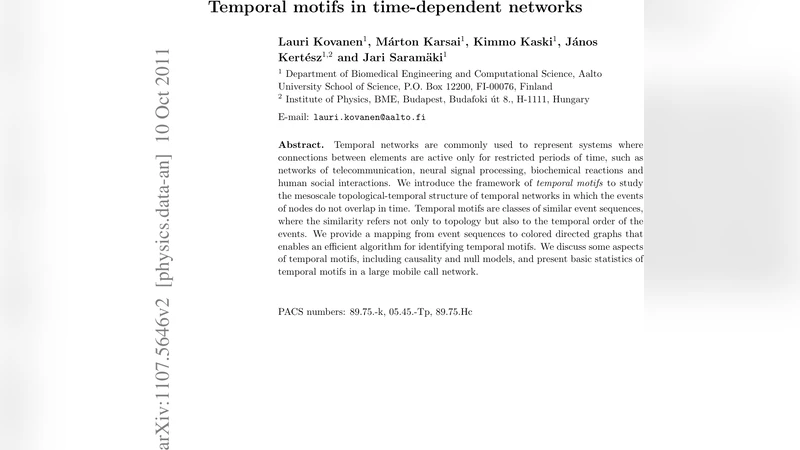
Temporal networks are commonly used to represent systems where connections between elements are active only for restricted periods of time, such as networks of telecommunication, neural signal processing, biochemical reactions and human social interactions. We introduce the framework of temporal motifs to study the mesoscale topological-temporal structure of temporal networks in which the events of nodes do not overlap in time. Temporal motifs are classes of similar event sequences, where the similarity refers not only to topology but also to the temporal order of the events. We provide a mapping from event sequences to colored directed graphs that enables an efficient algorithm for identifying temporal motifs. We discuss some aspects of temporal motifs, including causality and null models, and present basic statistics of temporal motifs in a large mobile call network.
💡 Research Summary
The paper introduces a novel framework called “temporal motifs” for analyzing time‑dependent networks in which connections (events) are active only during limited intervals and, crucially, a node cannot participate in overlapping events. Building on the well‑established concept of static network motifs, the authors first formalize the notion of Δt‑adjacency: two events are Δt‑adjacent if they share at least one node and the time gap between the end of the earlier event and the start of the later one does not exceed a user‑defined Δt. A set of events is Δt‑connected if every pair can be linked by a chain of Δt‑adjacent events. To avoid the combinatorial explosion that arises in structures such as n‑stars, the authors impose an additional constraint, defining “valid subgraphs” (denoted E*) as Δt‑connected sets that also contain all consecutive Δt‑connected events for each node. This ensures that each node’s involvement is represented without gaps, yielding a manageable number of subgraphs.
Temporal motifs are then defined as equivalence classes of valid subgraphs that are isomorphic both in topology and in the temporal order of their constituent events. The authors distinguish between strict temporal order (where the exact sequence of events must match) and a more relaxed “flow motif” notion, which only preserves the partial order necessary for maintaining the same set of time‑respecting paths (journeys) or information flows. To detect motifs efficiently, each event and each node is represented as a vertex in a colored directed graph: node‑vertices and event‑vertices receive distinct colors, and directed edges encode the temporal precedence among events. This transformation allows the use of existing graph‑isomorphism tools (e.g., the Bliss algorithm) to compute a canonical labeling for each subgraph, thereby grouping isomorphic subgraphs into the same motif class.
The detection algorithm proceeds in three stages: (i) identification of all maximal Δt‑connected subgraphs (Emax) by expanding forward and backward from each event; (ii) enumeration of all valid subgraphs within each Emax by constructing an auxiliary undirected graph G whose vertices correspond to events and whose edges represent Δt‑adjacency, then extracting all induced connected vertex sets that satisfy the consecutiveness condition; (iii) mapping each valid subgraph to its colored directed representation and obtaining its canonical form to assign it to a motif. The overall computational complexity is linear in the number of events for the maximal‑subgraph step and manageable for the enumeration step, making the method applicable to large empirical datasets.
To assess statistical significance, the authors propose null models based on randomizing event timestamps while preserving the underlying static topology, allowing comparison of observed motif frequencies against expectations under temporal randomness. They also discuss causal interpretation: motifs that appear significantly more often than in the null model may reflect underlying mechanisms that favor certain temporal interaction patterns.
The framework is applied to a large mobile‑call dataset from Finland, comprising millions of calls over one month. Using Δt = 10 minutes, the authors extract motifs of size three and four. The most prevalent motif corresponds to a simple chain A→B, B→C, C→D, indicating a sequential spread of information through four individuals. Star‑like motifs (one node contacting several others within Δt) are less common, reflecting the rarity of simultaneous multiple calls by a single user. The analysis of flow motifs shows that, for some subgraphs, the relative order of the last two events does not affect the possible information flow, highlighting the relevance of partial orders in capturing functional equivalence.
In summary, the paper provides a rigorous definition of temporal motifs, an efficient algorithmic pipeline for their detection, and a statistical framework for evaluating their significance. By integrating temporal ordering with topological structure, temporal motifs reveal mesoscopic patterns that are invisible to static motif analysis, offering new insights into the dynamics of communication, spreading processes, and potentially other domains such as neuronal activity or biochemical reaction networks. Future extensions could relax the non‑overlap assumption, incorporate event durations or weights, and apply the methodology to other time‑varying systems, thereby deepening our understanding of how temporal interaction patterns shape complex network behavior.
Comments & Academic Discussion
Loading comments...
Leave a Comment