Multiscale entanglement in ring polymers under spherical confinement
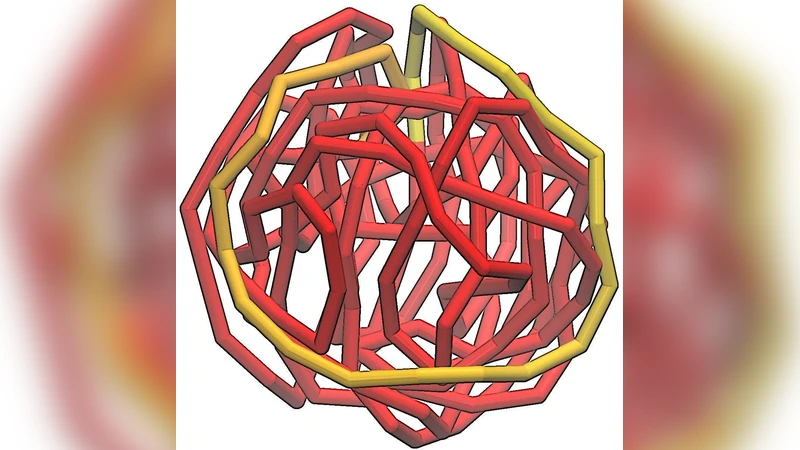
The interplay of geometrical and topological entanglement in semiflexible knotted polymer rings confined inside a spherical cavity is investigated using advanced numerical methods. By using stringent and robust algorithms for locating knots, we characterize how the knot length lk depends on the ring contour length, Lc and the radius of the confining sphere, Rc . In the no- and strong- confinement cases we observe weak knot localization and complete knot delocalization, respectively. We show that the complex interplay of lk, Lc and Rc that seamlessly bridges these two limits can be encompassed by a simple scaling argument based on deflection theory. The same argument is used to rationalize the multiscale character of the entanglement that emerges with increasing confinement.
💡 Research Summary
**
In this work the authors investigate how the length of a topologically entangled portion (the “knot length” (l_k)) of a semiflexible polymer ring depends on two external parameters: the total contour length of the ring, (L_c), and the radius of a spherical cavity, (R_c), that confines the ring. The polymer model is built from cylindrical segments of diameter (d=2.5) nm and axial length (b=10) nm, with a bending persistence length (l_p=50) nm, mimicking double‑stranded DNA on a coarse‑grained level. Rings containing (N=50)–(250) segments (i.e. (L_c=0.5)–(2.5) µm) are simulated under a wide range of confinement radii, from essentially unconfined ((R_c\to\infty)) down to strong three‑dimensional compression ((R_c\approx3b)).
Because compact configurations are entropically suppressed, ordinary Monte‑Carlo sampling would be inefficient. The authors therefore employ a biased Multiple‑Markov‑chain scheme with 24 replicas, each subject to a different confining field (p). Within each replica the chain evolves through crankshaft and hedgehog moves that preserve contour length but allow changes of topology. A Metropolis acceptance criterion incorporates a potential energy that penalizes self‑intersections and overly complex knots (more than eight minimal crossings). After production runs, a thermodynamic reweighting removes the bias, yielding canonical averages.
Knot identification is performed with the KNOTFIND algorithm. The “proper knotted arc” is defined as the shortest contiguous sub‑chain that (i) carries the full 3₁ topology while its complementary sub‑chain is unknotted, (ii) cannot be shortened without losing the 3₁ topology, and (iii) can be continuously extended to the whole ring without changing these topological properties. This robust definition works for all degrees of confinement, avoiding the need for ad‑hoc procedures used in earlier studies. In addition, the authors measure the length of the “shortest knotted arc” (l_s), which may be an ephemeral knot that disappears when the surrounding chain is included.
The main findings are as follows.
- Weak confinement (large (R_c)) – The average knot length scales sub‑linearly with the total contour length:
\
Comments & Academic Discussion
Loading comments...
Leave a Comment