Spatiotemporal evolution in a (2+1)-dimensional chemotaxis model
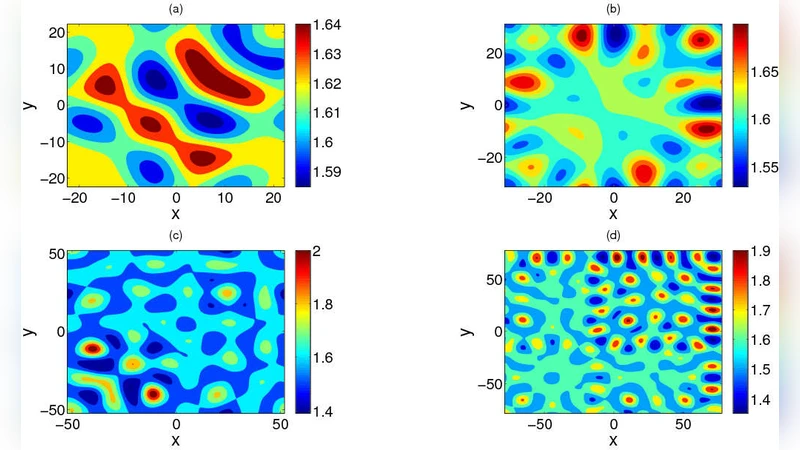
Simulations are performed to investigate the nonlinear dynamics of a (2+1)-dimensional chemotaxis model of Keller-Segel (KS) type with a logistic growth term. Because of its ability to display auto-aggregation, the KS model has been widely used to simulate self-organization in many biological systems. We show that the corresponding dynamics may lead to a steady-state, divergence in a finite time as well as the formation of spatiotemporal irregular patterns. The latter, in particular, appear to be chaotic in part of the range of bounded solutions, as demonstrated by the analysis of wavelet power spectra. Steady states are achieved with sufficiently large values of the chemotactic coefficient $(\chi)$ and/or with growth rates $r$ below a critical value $r_c$. For $r > r_c$, the solutions of the differential equations of the model diverge in a finite time. We also report on the pattern formation regime for different values of $\chi$, $r$ and the diffusion coefficient $D$.
💡 Research Summary
This paper investigates the nonlinear dynamics of a two‑dimensional Keller‑Segel chemotaxis model augmented with a logistic growth term, using extensive numerical simulations. The governing equations describe the evolution of cell density u(x,y,t) and chemoattractant concentration v(x,y,t):
∂ₜu = ∇·(D∇u – χ u∇v) + r u(1–u) ,
∂ₜv = ∇²v + u – v .
Here D is the diffusion (or motility) coefficient, χ the chemotactic sensitivity, and r the intrinsic growth rate. Linear stability analysis shows that the homogeneous steady state (u,v) = (1,1) becomes unstable when χ exceeds the threshold (√D + √r)²/2, and that unstable modes lie in a band of wave numbers k₁ < k < k₂, where k depends on the domain size and boundary conditions.
The authors perform simulations on a 200 × 200 grid with zero‑flux (Neumann) boundaries, a time step Δt = 0.001, and random perturbations of amplitude ≈0.01 around the steady state. By varying the three key parameters (χ, D, r) they identify three distinct regimes:
-
Steady‑state convergence – For sufficiently large χ and growth rates r below a critical value r_c (≈ 2 in the studied parameter set), the system initially follows the linear instability, then settles into a spatially patterned but temporally stationary configuration. The pattern consists of a superposition of modes whose wave numbers lie within the unstable band. Increasing the domain size (i.e., decreasing the fundamental wave number) activates more modes, leading to richer structures.
-
Finite‑time blow‑up – When r exceeds r_c, the logistic term dominates diffusion and chemotaxis, causing both u and v to diverge in finite time. The blow‑up time shortens as r grows; for example, with D = 0.1, χ = 6, r = 4 the solution blows up at t ≈ 34, whereas r = 3 yields blow‑up near t ≈ 52. This behavior reflects a wave‑collapse phenomenon typical of higher‑dimensional Keller‑Segel systems.
-
Spatiotemporal chaos – In the bounded‑solution regime (r ≤ r_c) and for larger domains or specific χ–D combinations, nonlinear interactions among many unstable modes generate irregular, time‑varying patterns. The authors employ continuous wavelet transforms to compute power spectra of the density field. The spectra display broadband energy distribution that evolves with time, confirming chaotic dynamics. Notably, increasing χ widens the unstable k‑band, reducing the number of active modes and making patterns more regular, whereas increasing D narrows the unstable band, forcing higher‑k modes to participate and thereby enhancing chaotic behavior.
Figures illustrate these findings: Fig. 2 shows the transition from near‑steady to patterned states for r = 1 and r = 1.5; Fig. 3 demonstrates how enlarging the domain leads to pattern fragmentation; Fig. 4 presents wavelet spectra indicating chaos; Fig. 5 documents finite‑time blow‑up for r > r_c; Fig. 6 compares the effect of raising χ versus raising D; Fig. 7 provides contour plots of wavelet power over long integration times, highlighting sustained chaotic activity.
The study concludes that the (2+1)‑dimensional Keller‑Segel model with logistic growth exhibits a rich tapestry of dynamics: steady‑state patterns, finite‑time singularities, and genuine spatiotemporal chaos, depending on the balance among diffusion, chemotaxis, and growth. These results extend previous one‑dimensional analyses and suggest that similar mechanisms could underlie complex biological phenomena such as bacterial aggregation, tumor invasion, and tissue morphogenesis, where chemotactic signaling and proliferation coexist. The authors propose further analytical work to quantify the transition to blow‑up and to characterize the chaotic attractor in higher dimensions.
Comments & Academic Discussion
Loading comments...
Leave a Comment