Due to the increase of interest in Augmented Reality (AR), the potential uses of AR are increasing also. It can benefit the user in various fields such as education, business, medicine, and other. Augmented Reality supports the real environment with synthetic environment to give more details and meaning to the objects in the real word. AR refers to a situation in which the goal is to supplement a user's perception of the real-world through the addition of virtual objects. This paper is an attempt to make a survey of web-based Augmented Reality applications and make a comparison among them.
Deep Dive into A Survey on Web-based AR Applications.
Due to the increase of interest in Augmented Reality (AR), the potential uses of AR are increasing also. It can benefit the user in various fields such as education, business, medicine, and other. Augmented Reality supports the real environment with synthetic environment to give more details and meaning to the objects in the real word. AR refers to a situation in which the goal is to supplement a user’s perception of the real-world through the addition of virtual objects. This paper is an attempt to make a survey of web-based Augmented Reality applications and make a comparison among them.
Augmented Reality (AR) refers to a situation in which the goal is to supplement a user's perception of the real-world through the addition of virtual objects [1]. Due to the increase of interest in Augmented Reality, the potential uses of AR are increasing also. AR can benefit the user in various fields such as education, business, medicine, and other. The concept of enhancing persons perception of reality dates back to the 13th century when Roger Bacon made the first recorded comment on the use of eye glasses, for optical purposes. In 1665, an experimental scientist Robert Hooke introduced an idea of augmented senses in his book Micrographia. Ever since fiction writers, military industry and lately academic and commercial researchers have paved the road for augmented reality with an increasing effort.
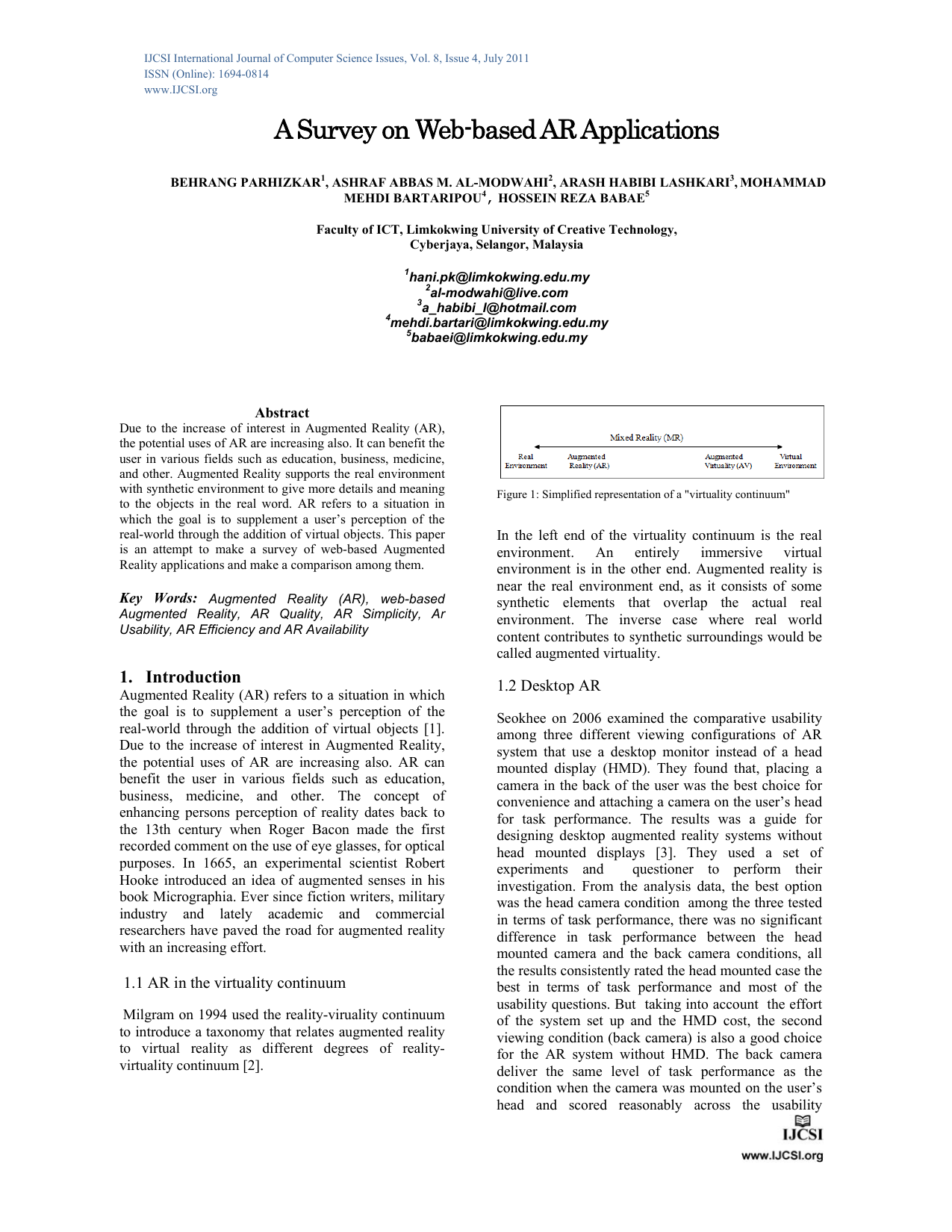
Milgram on 1994 used the reality-viruality continuum to introduce a taxonomy that relates augmented reality to virtual reality as different degrees of realityvirtuality continuum [2]. In the left end of the virtuality continuum is the real environment. An entirely immersive virtual environment is in the other end. Augmented reality is near the real environment end, as it consists of some synthetic elements that overlap the actual real environment. The inverse case where real world content contributes to synthetic surroundings would be called augmented virtuality.
Seokhee on 2006 examined the comparative usability among three different viewing configurations of AR system that use a desktop monitor instead of a head mounted display (HMD). They found that, placing a camera in the back of the user was the best choice for convenience and attaching a camera on the user’s head for task performance. The results was a guide for designing desktop augmented reality systems without head mounted displays [3]. They used a set of experiments and questioner to perform their investigation. From the analysis data, the best option was the head camera condition among the three tested in terms of task performance, there was no significant difference in task performance between the head mounted camera and the back camera conditions, all the results consistently rated the head mounted case the best in terms of task performance and most of the usability questions. But taking into account the effort of the system set up and the HMD cost, the second viewing condition (back camera) is also a good choice for the AR system without HMD. The back camera deliver the same level of task performance as the condition when the camera was mounted on the user’s head and scored reasonably across the usability questions. The term “Desktop AR” is in fact more commonly used to indicate that the desktop is used as the interaction space. In short, the viewing condition depend on the purpose of the AR system itself.
Anders Henrysson on 2005 described how mobile phones are an ideal platform for augmented reality and how they can also be used to support face to face collaborative AR gaming.They create a custom port of the ARToolkit library to the Symbian mobile phone operating system and then developed a sample collaborative AR game based on this. They also provide general design guidelines that could be useful for mobile AR applications developers [4]. After two experiments applied to the sample collaborative AR game and surveys . They found that, subjects would often grasp the cell phone with both hands and start intently at the screen while playing, never looking across the table at thier partner. Although they were collaborating in a face to face setting the focus of their attention was on the small screen. They also found that, each of the three conditions provides less visual information about the player’s partner.These results show that users do feel that multi-sensory output is indeed important in face to face AR gaming. They almost unanimously rated the condition which provided the most sensory output (audio, visual, haptic) as easiest to work in and also as the most enjoyable.
(Jens de Smit, 2010) indicated how AR applications use some parts of web infrastructure standards and how they use some proprietary technologies as well becuase the suite of web standards doesn’t offer everything that is required to build AR applications.He discussed what would be required to be able to build web-based AR applictions and how to prepare the suite of web standards for future developments in ubiquitous computing technology [5]. Jens provides examples to show how some devices such as iPhone and Android used web technology in their native applications.AR browsers Layar and Wikitude use JSON and XML respectively to transport thier store and exchange points of interest (POls).Flash and other web plug-in also used for the web-based AR desktop applications. (Mohit Virmani et al., 2010) described how epipolar geometry, homography and fundametal matrix estimaiton can be used to rebuild the gap between AR and the web. Also they present some of the potential problem
…(Full text truncated)…
This content is AI-processed based on ArXiv data.