Towards a theory of modelling with Boolean automata networks - I. Theorisation and observations
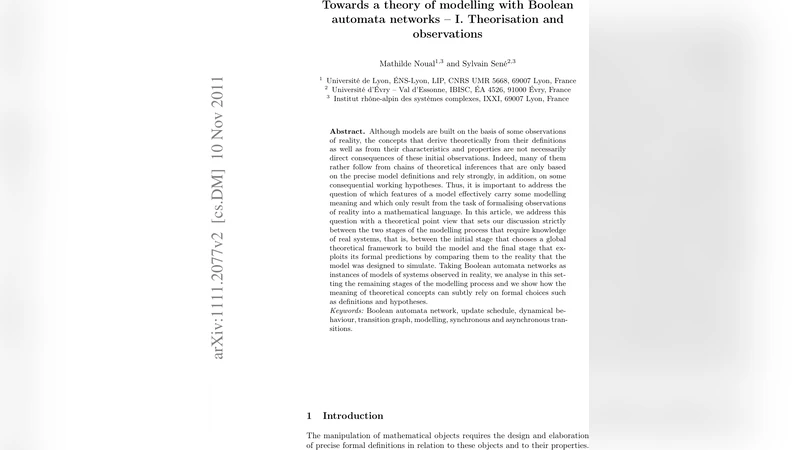
Although models are built on the basis of some observations of reality, the concepts that derive theoretically from their definitions as well as from their characteristics and properties are not necessarily direct consequences of these initial observations. Indeed, many of them rather follow from chains of theoretical inferences that are only based on the precise model definitions and rely strongly, in addition, on some consequential working hypotheses. Thus, it is important to address the question of which features of a model effectively carry some modelling meaning and which only result from the task of formalising observations of reality into a mathematical language. In this article, we address this question with a theoretical point view that sets our discussion strictly between the two stages of the modelling process that require knowledge of real systems, that is, between the initial stage that chooses a global theoretical framework to build the model and the final stage that exploits its formal predictions by comparing them to the reality that the model was designed to simulate. Taking Boolean automata networks as instances of models of systems observed in reality, we analyse in this setting the remaining stages of the modelling process and we show how the meaning of theoretical concepts can subtly rely on formal choices such as definitions and hypotheses.
💡 Research Summary
The paper investigates how the formal choices made during the modelling of real systems with Boolean automata networks (BANs) shape the meaning and interpretability of the resulting models. The authors distinguish three stages of modelling: (1) the selection of a theoretical framework, (2) the “theorisation” stage where the framework is completed with definitions, hypotheses and correspondences to the target class of real systems, and (3) the exploitation stage where model predictions are compared with empirical observations. Their focus is on the middle stage, which is often overlooked but crucial because it determines how observations are translated into abstract entities and how abstract predictions are mapped back onto reality.
In Section 2 the authors lay out the basic components of a BAN. A network of size n consists of n Boolean automata, each taking values in B = {0, 1}. The interaction structure is captured by a directed graph G = (V, A) where an arc (j, i) indicates that the state of automaton j may influence the update of automaton i. However, the graph alone does not specify the nature of the influence nor the conditions under which it is activated. These are encoded by local transition functions f_i : Bⁿ → B. The authors formalise the relationship between the graph and the functions: an arc (j, i) belongs to A if and only if there exists a configuration x such that changing the state of j in x alters the output of f_i.
Section 3 addresses the modelling of time and causality. Two kinds of elementary events are defined: atomic updates (the update of a single automaton) and non‑atomic updates (simultaneous updates of a set W ⊆ V). Correspondingly, they distinguish asynchronous transitions (atomic) and synchronous transitions (non‑atomic). The authors introduce the update functions F_i and F_W that map a configuration x to the configuration obtained after applying the respective updates. They show that the same overall state change can be realised by different sequences of elementary transitions, and that certain transitions are impossible because they would require contradictory updates of the same automaton. This analysis highlights that the nature of observed transitions (whether they are elementary, synchronous, or asynchronous) is essential information that must be inferred or assumed in order to reconstruct causal mechanisms from data.
In Section 4 the paper turns to “effective modelling”, i.e., the practical task of inferring a BAN from observed state sequences. The authors argue that empirical data usually consist only of configurations (or sequences thereof) because the underlying events are unobservable. Consequently, any reconstruction of the transition functions f_i requires additional hypotheses: a choice of update schedule (synchronous vs. asynchronous), assumptions about which transitions are admissible, and possibly prior knowledge of the interaction graph. They illustrate, with concrete examples, how different hypotheses lead to different inferred causal structures even when the observed state trajectories are identical. This underscores the necessity of making modelling assumptions explicit and of testing their robustness.
Section 5 synthesises the discussion, emphasizing that the meaning of theoretical concepts in BAN modelling is not intrinsic but heavily dependent on the formal definitions and working hypotheses introduced during the theorisation stage. While Boolean models are a drastic simplification—reducing each component to a binary switch—they can still provide reliable qualitative insights into global causal relationships, especially when more detailed multi‑state or stochastic models are unavailable or unnecessary. However, the authors caution that the validity of such insights hinges on the appropriateness of the underlying assumptions, and they advocate for a systematic validation loop where assumptions are revisited as more data become available.
Overall, the paper contributes a meta‑theoretical perspective on modelling with Boolean automata networks. It clarifies how choices concerning state representation, transition functions, update schedules, and the interpretation of observed transitions directly affect the epistemic content of the model. By making these dependencies explicit, the authors provide a methodological roadmap that can be applied not only to BANs but to any formal modelling endeavour that seeks to bridge abstract mathematical structures with empirical reality.
Comments & Academic Discussion
Loading comments...
Leave a Comment