📝 Original Info
- Title: Multi and Independent Block Approach in Public Cluster
- ArXiv ID: 0708.3446
- Date: 2011-11-10
- Authors: ** Z. Akbar, L.T. Handoko Group for Theoretical and Computational Physics, Research Center for Physics, Indonesian Institute of Sciences (LIPI), Serpong, Indonesia **
📝 Abstract
We present extended multi block approach in the LIPI Public Cluster. The multi block approach enables a cluster to be divided into several independent blocks which run jobs owned by different users simultaneously. Previously, we have maintained the blocks using single master node for all blocks due to efficiency and resource limitations. Following recent advancements and expansion of node\'s number, we have modified the multi block approach with multiple master nodes, each of them is responsible for a single block. We argue that this approach improves the overall performance significantly, for especially data intensive computational works.
💡 Deep Analysis
Deep Dive into Multi and Independent Block Approach in Public Cluster.
We present extended multi block approach in the LIPI Public Cluster. The multi block approach enables a cluster to be divided into several independent blocks which run jobs owned by different users simultaneously. Previously, we have maintained the blocks using single master node for all blocks due to efficiency and resource limitations. Following recent advancements and expansion of node's number, we have modified the multi block approach with multiple master nodes, each of them is responsible for a single block. We argue that this approach improves the overall performance significantly, for especially data intensive computational works.
📄 Full Content
MULTI AND INDEPENDENT BLOCK APPROACH IN PUBLIC CLUSTER
Z. Akbar and L.T. Handoko
Group for Theoretical and Computational Physic, Research Center for Physics, Indonesian Institute of Sciences, Kompleks
Puspiptek Serpong, Tangerang 15310, Indonesia
zaenal@teori.fisika.lipi.go.id
ABSTRACT
We present extended multi block approach in the LIPI
Public Cluster. The multi block approach enables a cluster
to be divided into several independent blocks which run
jobs owned by different users simultaneously. Previously,
we have maintained the blocks using single master node for
all blocks due to efficiency and resource limitations.
Following recent advancements and expansion of node's
number, we have modified the multi block approach with
multiple master nodes, each of them is responsible for a
single block. We argue that this approach improves the
overall performance significantly, for especially data
intensive computational works.
Keywords : cluster computer, resource allocation, multi
block approach
1
INTRODUCTION
LIPI Public Cluster (LPC) is globally a unique
infrastructure due to its openness [1,2,3]. This nature leads
to some innovations on cluster architecture, especially so
called multi block approach to enable multiple blocks of
small cluster running simultaneously without any
interruption among each other [4].
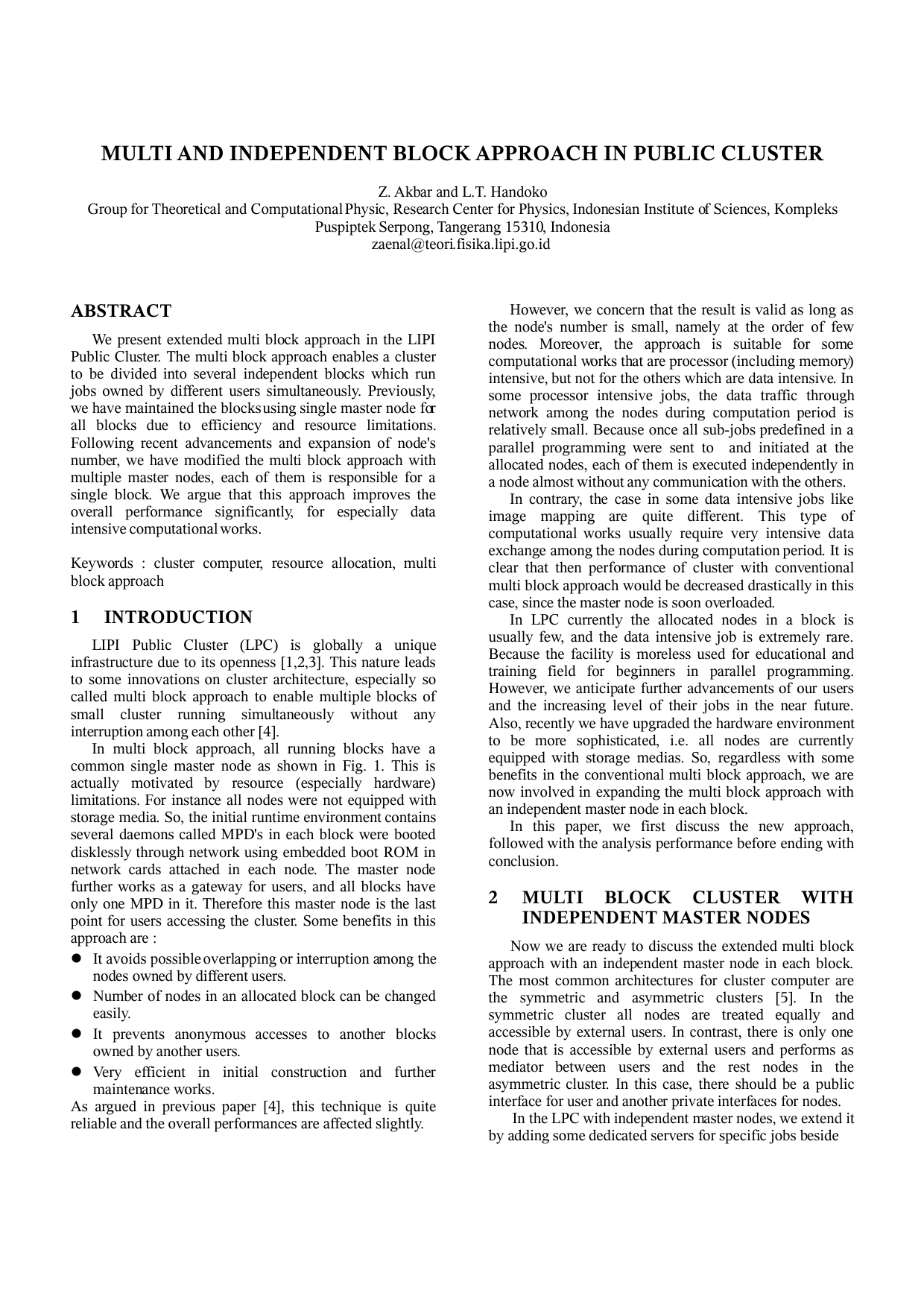
In multi block approach, all running blocks have a
common single master node as shown in Fig. 1. This is
actually motivated by resource (especially hardware)
limitations. For instance all nodes were not equipped with
storage media. So, the initial runtime environment contains
several daemons called MPD's in each block were booted
disklessly through network using embedded boot ROM in
network cards attached in each node. The master node
further works as a gateway for users, and all blocks have
only one MPD in it. Therefore this master node is the last
point for users accessing the cluster. Some benefits in this
approach are :
It avoids possible overlapping or interruption among the
nodes owned by different users.
Number of nodes in an allocated block can be changed
easily.
It prevents anonymous accesses to another blocks
owned by another users.
Very efficient in initial construction and further
maintenance works.
As argued in previous paper [4], this technique is quite
reliable and the overall performances are affected slightly.
However, we concern that the result is valid as long as
the node's number is small, namely at the order of few
nodes. Moreover, the approach is suitable for some
computational works that are processor (including memory)
intensive, but not for the others which are data intensive. In
some processor intensive jobs, the data traffic through
network among the nodes during computation period is
relatively small. Because once all sub-jobs predefined in a
parallel programming were sent to and initiated at the
allocated nodes, each of them is executed independently in
a node almost without any communication with the others.
In contrary, the case in some data intensive jobs like
image mapping are quite different. This type of
computational works usually require very intensive data
exchange among the nodes during computation period. It is
clear that then performance of cluster with conventional
multi block approach would be decreased drastically in this
case, since the master node is soon overloaded.
In LPC currently the allocated nodes in a block is
usually few, and the data intensive job is extremely rare.
Because the facility is moreless used for educational and
training field for beginners in parallel programming.
However, we anticipate further advancements of our users
and the increasing level of their jobs in the near future.
Also, recently we have upgraded the hardware environment
to be more sophisticated, i.e. all nodes are currently
equipped with storage medias. So, regardless with some
benefits in the conventional multi block approach, we are
now involved in expanding the multi block approach with
an independent master node in each block.
In this paper, we first discuss the new approach,
followed with the analysis performance before ending with
conclusion.
2
MULTI BLOCK CLUSTER WITH
INDEPENDENT MASTER NODES
Now we are ready to discuss the extended multi block
approach with an independent master node in each block.
The most common architectures for cluster computer are
the symmetric and asymmetric clusters [5]. In the
symmetric cluster all nodes are treated equally and
accessible by external users. In contrast, there is only one
node that is accessible by external users and performs as
mediator between users and the rest nodes in the
asymmetric cluster. In this case, there should be a public
interface for user and another private interfaces for nodes.
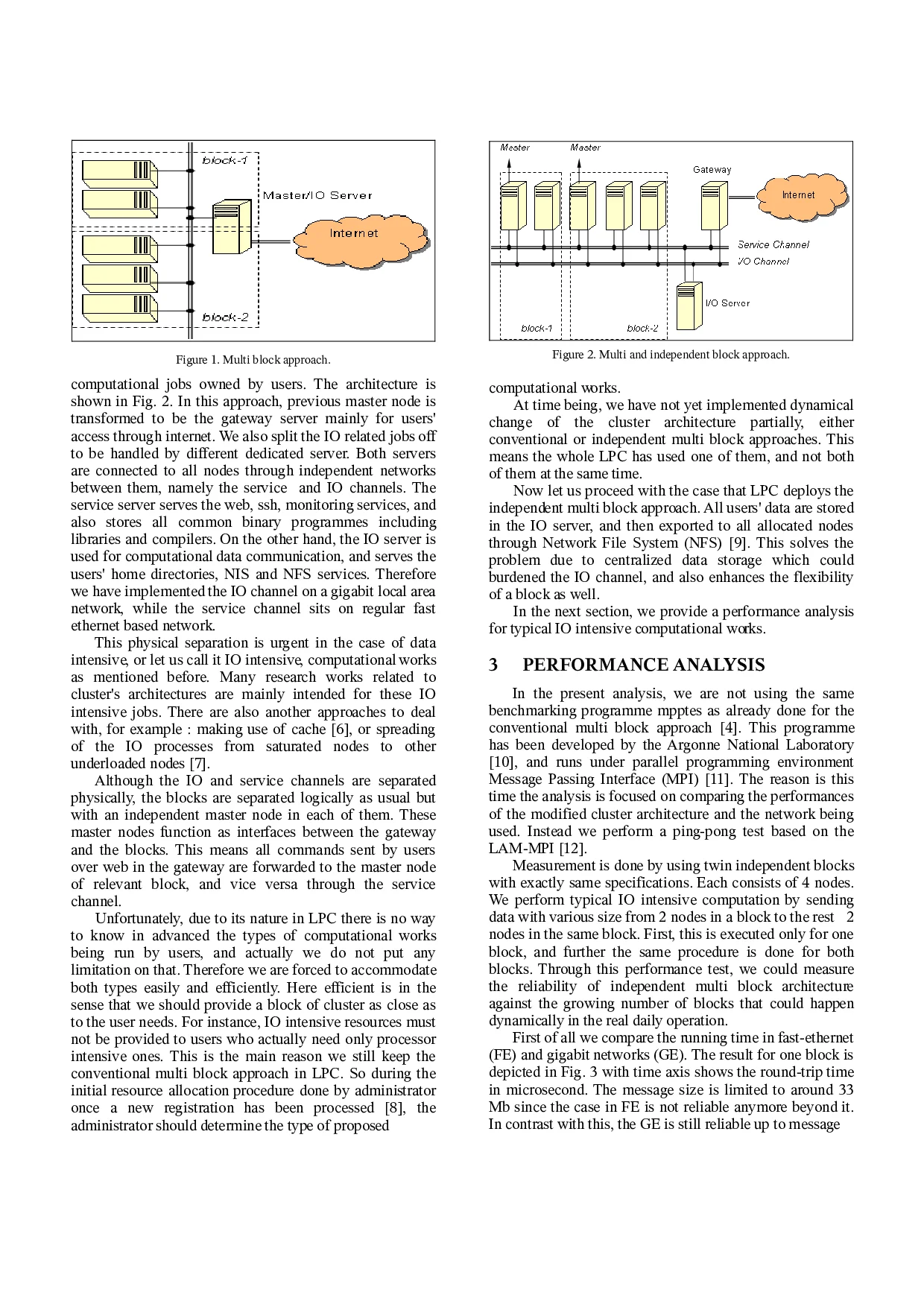
In the LPC with independent master nodes, we
…(Full text truncated)…
📸 Image Gallery
Reference
This content is AI-processed based on ArXiv data.