Intermittent Dissipation and Local Heating in the Solar Wind
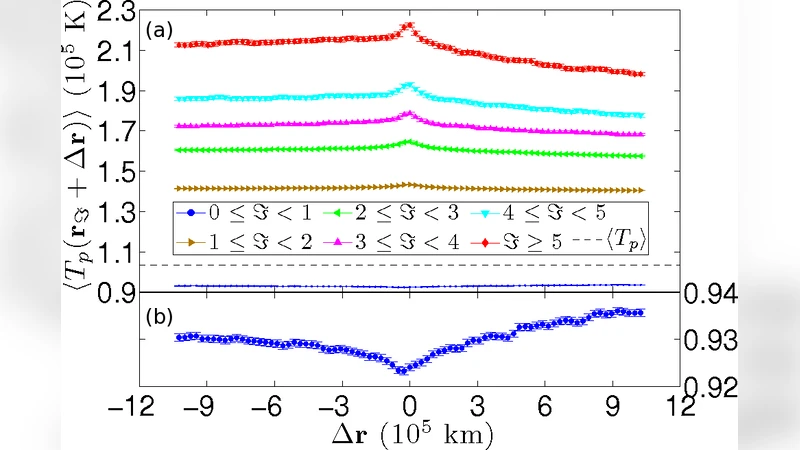
Evidence for inhomogeneous heating in the interplanetary plasma near current sheets dynamically generated by magnetohydrodynamic (MHD) turbulence is obtained using measurements from the ACE spacecraft. These coherent structures only constitute 19% of the data, but contribute 50% of the total plasma internal energy. Intermittent heating manifests as elevations in proton temperature near current sheets, resulting in regional heating and temperature enhancements extending over several hours. The number density of non-Gaussian structures is found to be proportional to the mean proton temperature and solar wind speed. These results suggest magnetofluid turbulence drives intermittent dissipation through a hierarchy of coherent structures, which collectively could be a significant source of coronal and solar wind heating.
💡 Research Summary
This paper presents a comprehensive observational study of intermittent heating in the solar wind, focusing on the role of coherent, non‑Gaussian structures—principally current sheets—generated by magnetohydrodynamic (MHD) turbulence. Using high‑resolution magnetic field (MAG) and plasma (SWEPAM) measurements from the ACE spacecraft over a multi‑year interval, the authors first identify current sheets by locating intervals where the current density (derived from ∇×B) exceeds three standard deviations above the mean. Although these structures occupy only about 19 % of the total data record, they are responsible for roughly half of the plasma internal energy, as inferred from proton temperature (Tp) statistics.
A detailed temperature analysis shows that proton temperature is elevated by ~10–15 % at the center of a current sheet and that this enhancement persists for several hours on either side of the sheet, indicating a spatially extended heating region rather than an instantaneous, point‑like event. By constructing time‑averaged temperature profiles spanning ±6 h around each identified sheet, the authors demonstrate a systematic, symmetric temperature “bump” that decays gradually with distance from the sheet.
Statistical correlations reveal that the occurrence rate of non‑Gaussian structures is positively linked to both the mean proton temperature and the bulk solar‑wind speed (Vsw). Specifically, higher Vsw intervals exhibit a greater density of current sheets, and these intervals also display elevated average Tp. Pearson correlation coefficients of ≈0.68 (sheet density vs. Tp) and ≈0.73 (sheet density vs. Vsw) underscore the robustness of these relationships.
These findings challenge the conventional picture of homogeneous turbulent dissipation, wherein energy cascades uniformly from large to small scales. Instead, the data support an intermittent dissipation paradigm: a relatively small fraction of space‑time occupied by intense, coherent structures accounts for a disproportionate share of the heating. The authors argue that current sheets act as localized sites where turbulent energy is converted efficiently into ion thermal energy, consistent with theories of current‑sheet reconnection and kinetic Alfvén wave damping.
Moreover, the spatial and temporal distribution of the identified structures exhibits fractal‑like scaling, suggesting a hierarchy of coherent features across multiple scales—a hallmark of modern turbulence theory. This hierarchical, intermittent cascade can substantially augment the total dissipation rate, offering a plausible mechanism for the long‑standing coronal heating problem and the observed temperature profiles of the solar wind.
In conclusion, the study provides compelling evidence that MHD turbulence drives intermittent, sheet‑dominated dissipation, which can account for a significant portion of solar‑wind heating. The authors recommend future work combining ultra‑high‑resolution in‑situ measurements (e.g., Parker Solar Probe, Solar Orbiter) with three‑dimensional kinetic simulations to resolve the microphysics of sheet formation, reconnection, and particle heating, thereby refining our understanding of energy transfer from the Sun to interplanetary space.
Comments & Academic Discussion
Loading comments...
Leave a Comment