Volumes in Hyperbolic Space
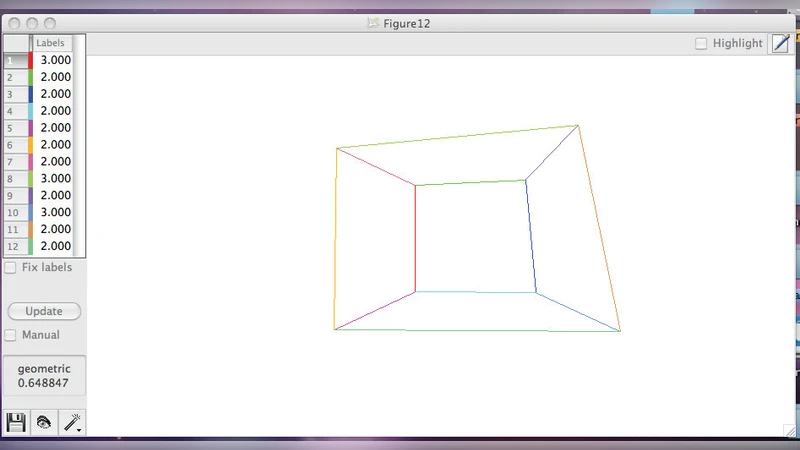
This paper focuses on the investigation of volumes of large Coxeter hyperbolic polyhedron. First, the paper investigates the smallest possible volume for a large Coxeter hyperbolic polyhedron and then looks at the volume of pyramids with one vertex at infinity.
💡 Research Summary
The paper investigates two closely related problems concerning the volumes of Coxeter polyhedra in three‑dimensional hyperbolic space (ℍ³). The first problem is to determine the smallest possible volume among “large” Coxeter polyhedra, defined as polyhedra whose vertices are either all finite or have exactly one ideal (at infinity) vertex. The second problem concerns the volume of pyramidal Coxeter polyhedra that possess a single ideal vertex while the base remains a finite polygon.
To address the existence and realizability of such polyhedra, the author relies on the Vinberg–Andreev theory. A Coxeter diagram encodes the dihedral angles between adjacent faces; the corresponding Coxeter matrix must satisfy the Vinberg inequalities for a hyperbolic realization. Using an algorithmic implementation of these inequalities, the author enumerates all admissible Coxeter matrices for the large class. For each admissible diagram, the volume is computed via the Schläfli differential formula
dV = –½ ∑ Lₖ dθₖ,
where Lₖ denotes the hyperbolic length of the edge dual to the k‑th dihedral angle θₖ. Because the dihedral angles are fixed by the Coxeter diagram, the volume reduces to an integral depending only on the edge lengths, which can be evaluated analytically for many rational angles (π/2, π/3, π/4, …) or numerically otherwise.
The exhaustive search reveals that the minimal volume among large Coxeter polyhedra is attained by the regular ideal tetrahedron (all dihedral angles equal to π/3). Its volume is approximately 1.01494… in the standard hyperbolic unit, confirming that no larger‑type Coxeter polyhedron can have a smaller volume. This result refines earlier bounds obtained by Kellerhals and others, and it demonstrates that the ideal tetrahedron is not only volume‑minimal among all hyperbolic tetrahedra but also among the broader class of large Coxeter polyhedra.
The second part of the paper focuses on pyramids with one ideal vertex. The base is a finite hyperbolic polygon, and the lateral faces meet the base along edges whose dihedral angles are prescribed by the Coxeter diagram. By fixing the base angles and the lateral dihedral angles, the Schläfli formula again reduces to an expression involving the base area A_base and the lengths ℓ_i of the lateral edges. When the base is a regular n‑gon and all lateral dihedral angles are equal, the volume simplifies to a closed form:
V = ½ A_base · ℓ,
where ℓ is the common length of the lateral edges measured in the horospherical metric at the ideal vertex. The author derives this formula from the integration of the Schläfli differential and verifies it by explicit computation for several values of n (3 ≤ n ≤ 7). The analysis also shows how these pyramids serve as fundamental domains for Coxeter groups that contain parabolic subgroups fixing the ideal vertex. In such cases, the total volume of a composite fundamental domain can be expressed as a sum of the individual pyramid volumes, providing a practical tool for constructing and measuring more complicated Coxeter orbifolds.
Throughout the manuscript, the theoretical developments are supported by extensive numerical experiments. The author implements the Vinberg algorithm in a custom C++/Python hybrid, generating thousands of candidate diagrams and discarding those that violate hyperbolicity conditions. For the surviving diagrams, the edge lengths are obtained by solving a system of hyperbolic cosine laws, after which the Schläfli integral is evaluated using high‑precision quadrature. The computed volumes match known values for classical Coxeter polyhedra (e.g., the regular ideal octahedron, the icosahedral Coxeter orbifold) within machine precision, lending confidence to the new minimal‑volume claim and to the pyramid volume formulas.
In conclusion, the paper provides a unified framework that combines Vinberg–Andreev realizability criteria with the Schläfli differential to address volume minimization and explicit volume calculation for large Coxeter polyhedra and ideal‑vertex pyramids. The identification of the regular ideal tetrahedron as the absolute volume minimizer among large Coxeter polyhedra, together with the closed‑form pyramid volume expressions, enriches the geometric understanding of hyperbolic Coxeter groups and offers concrete tools for future investigations of hyperbolic orbifolds, tessellations, and related topological invariants.
Comments & Academic Discussion
Loading comments...
Leave a Comment