Contributions from the Cherenkov Telescope Array (CTA) Consortium to the ICRC 2011
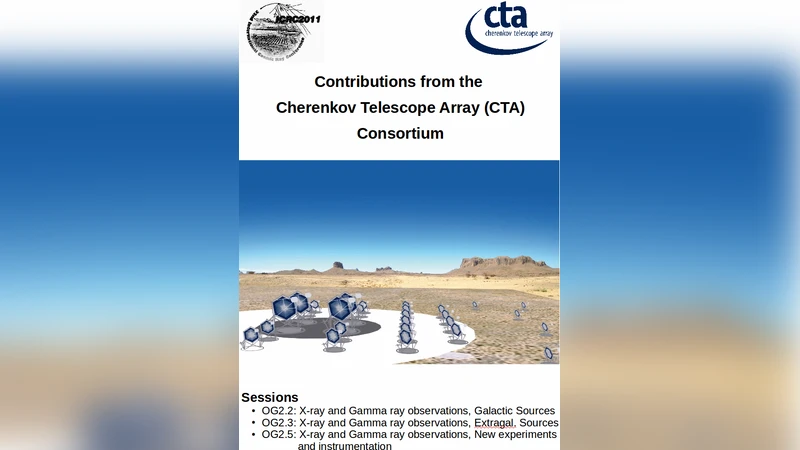
The Cherenkov Telescope Array (CTA) is a project for the construction of a next generation VHE gamma ray observatory with full sky coverage. Its aim is improving by about one order of magnitude the sensitivity of the existing installations, covering about 5 decades in energy (from few tens of GeV to above a hundred TeV) and having enhanced angular and energy resolutions. During 2010 the project became a truly global endeavour carried out by a consortium of about 750 collaborators from Europe, Asia, Africa and the North and South Americas. Also during 2010 the CTA project completed its Design Study phase and started a Preparatory Phase that is expected to extend for three years and should lead to the starting of the construction of CTA. An overview of the CTA Consortium activities project will be given.
💡 Research Summary
The paper provides a comprehensive overview of the Cherenkov Telescope Array (CTA) project as presented at the 2011 International Cosmic Ray Conference. CTA is envisioned as the next‑generation very‑high‑energy (VHE) gamma‑ray observatory, covering an unprecedented energy range from a few tens of GeV up to and beyond 100 TeV. Its primary performance goals are a ten‑fold improvement in sensitivity over current instruments (reaching roughly 1 milliCrab at ∼1 TeV), angular resolution of a few arc‑minutes, a wide field of view (5–10° depending on telescope type), and full‑sky coverage through two sites (a Southern array optimized for Galactic sources and a Northern array optimized for extragalactic work).
To achieve these goals, CTA adopts a mixed‑size array concept comprising three telescope classes: Small‑Size Telescopes (SST, 5–7 m diameter) for the highest energies, Medium‑Size Telescopes (MST, 10–13 m) for the core 100 GeV–10 TeV band, and Large‑Size Telescopes (LST, 20–25 m) for the lowest energies. The SSTs will be deployed in large numbers over ∼10 km² with very wide fields of view (7–10°) and coarse pixelisation, enabling stereoscopic detection of sparse air‑shower signals at >10 TeV. The MSTs will occupy ∼1 km², providing a dense sampling of “golden events” that improve reconstruction accuracy. The LSTs will sit at the centre of each array, featuring high‑efficiency photon detectors, finer pixelisation (∼0.1°), and a moderate field of view (4–6°) to push the threshold down to ∼10 GeV. An additional dual‑mirror Schwarzschild‑Couder design (SC‑MST) is under study, primarily by the US group, as a possible upgrade to the MST sub‑array.
During the Design Study phase (completed mid‑2010), a multi‑dimensional optimisation was performed, balancing performance metrics against cost, reliability, and lifetime (∼30 years). Monte‑Carlo simulations of many candidate layouts guided the selection of telescope numbers, spacing, mirror area, camera pixel size, trigger and read‑out speeds. The resulting configuration meets the sensitivity curve shown in the paper while staying within the projected budget (≈100 M€ for the Southern site, ≈50 M€ for the Northern site).
The consortium has grown from a European initiative to a truly global collaboration of roughly 800 scientists and engineers from 140 institutions across 25 countries. In 2010 the project entered a three‑year EU‑funded Preparatory Phase, aimed at delivering a complete construction plan, detailed technical designs, and a governance structure by the end of 2013. The construction schedule envisages partial operation by 2015–2016, with full deployment of both arrays by 2018.
The Preparatory Phase is organised into more than 30 work packages (WPs). Science‑related WPs include the LINK package, which establishes connections with particle physicists, astrophysicists, and astroparticle communities, and the Monte‑Carlo (MC) group, which continues performance simulations and provides input for reconstruction algorithms. Technical WPs are grouped by telescope class: SST‑STR, MST‑STR, LST‑STR, and SCT‑STR (for the Schwarzschild‑Couder design), each responsible for structural, mirror, drive, and control system engineering. The TEL (telescope structures) and MIR (mirrors) packages, initiated during the Design Study, continue to refine mirror production techniques, coatings, reflectivity measurements, and accelerated ageing tests. Camera development is split between FPI (focal‑plane instrumentation) and ELEC (electronics). FPI defines photon‑sensor choices (e.g., SiPM, MAPMT), light guides, power and cooling, and quality‑control procedures for mass production. ELEC designs trigger, digitisation, and read‑out electronics, seeking cost‑effective solutions applicable across telescope types and evaluating inter‑telescope trigger schemes. Subsequent CAM packages (SST‑CAM, MST‑CAM, LST‑CAM, SCT‑CAM) inherit these concepts for the specific camera prototypes.
A distinctive feature of CTA is its “open observatory” model. Unlike current IACT facilities, CTA will operate as a user‑facility, granting observing time to the broader scientific community through proposal calls, similar to traditional optical or radio observatories. This model is expected to broaden the scientific impact, enabling large‑scale surveys, rapid response to transient alerts, and coordinated multi‑wavelength campaigns with space‑based instruments such as Fermi‑LAT.
In summary, the paper documents that CTA has completed its conceptual design and is now in a focused preparatory stage, with detailed engineering, prototyping, and scientific planning underway. The consortium’s coordinated effort across hardware development, simulation, and community engagement positions CTA to become the premier VHE gamma‑ray facility, delivering an order‑of‑magnitude sensitivity boost, unprecedented energy coverage, and a transformative open‑access platform for high‑energy astrophysics and fundamental physics research.
Comments & Academic Discussion
Loading comments...
Leave a Comment