Swayed by Friends or by the Crowd?
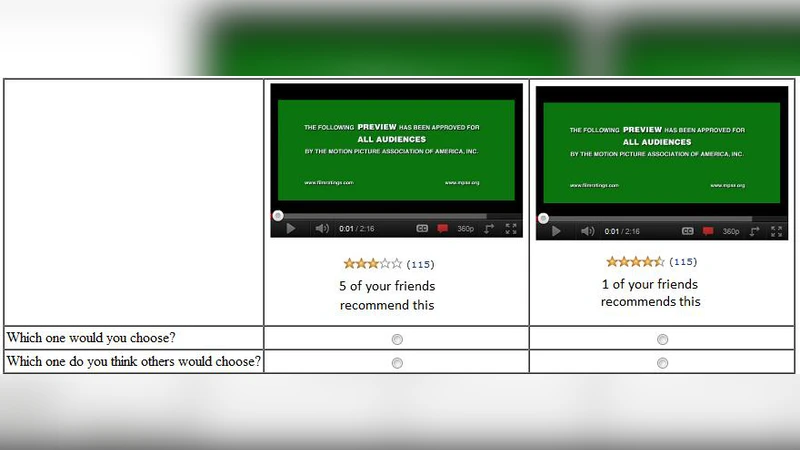
We have conducted three empirical studies of the effects of friend recommendations and general ratings on how online users make choices. These two components of social influence were investigated through user studies on Mechanical Turk. We find that for a user deciding between two choices an additional rating star has a much larger effect than an additional friend’s recommendation on the probability of selecting an item. Equally important, negative opinions from friends are more influential than positive opinions, and people exhibit more random behavior in their choices when the decision involves less cost and risk. Our results can be generalized across different demographics, implying that individuals trade off recommendations from friends and ratings in a similar fashion.
💡 Research Summary
The paper investigates how two prevalent sources of social influence—friends’ recommendations and the aggregate ratings of the general public—affect online users’ binary choices. The authors conducted three controlled experiments on Amazon Mechanical Turk, each gathering 350 valid responses. Study 1 examined hotel‑booking decisions when friends gave positive recommendations; Study 2 used the same hotel scenario but with friends expressing negative opinions; Study 3 considered a low‑risk decision (watching a movie trailer) with positive friend recommendations.
In every trial participants were shown two alternatives that differed in (i) average star rating (1–5) derived from many prior customers and (ii) the number of friends who either recommended or criticized the option. Participants chose the option they would personally select; a second “what do you think others would choose?” question was included only to reduce reactivity and to award bonuses, not for analysis.
The authors modeled the probability of selecting option 1 with a logistic regression using the differences in stars (S₁–S₂) and friends (F₁–F₂) as predictors:
P(choose 1) = logit(α_s·(S₁–S₂) + α_f·(F₁–F₂)).
Results from Study 1 (positive friend opinions) yielded α_s = 0.735 (p < 0.001) and α_f = 0.205 (p < 0.001). Interpreting the coefficients as odds ratios, a one‑point increase in star difference multiplies the odds of choosing the higher‑rated option by exp(0.735) ≈ 2.07 (a 107 % increase), whereas an additional friend recommendation raises the odds by exp(0.205) ≈ 1.22 (a 22 % increase). The model’s pseudo‑R² of 0.95 indicates an excellent fit, and leave‑one‑out cross‑validation produced an average absolute prediction error of only 0.021.
Study 2 (negative friend opinions) showed a similar magnitude for the star coefficient but a larger absolute value for the friend coefficient, confirming that negative friend feedback exerts a stronger influence than positive feedback. Study 3 (low‑risk movie‑trailer choice) displayed reduced coefficients for both predictors, especially for friends, suggesting that when the decision involves little cost or risk, users rely less on social cues and behave more randomly.
Demographic variables (gender, age, education) were collected but not entered into the main model; analyses revealed no significant interaction with the primary coefficients, indicating that the observed patterns hold across diverse user groups.
Beyond static choice modeling, the authors simulated market‑share dynamics where the two sources of influence evolve over time. Simulations demonstrated that higher variability in star ratings leads to greater volatility in market outcomes, while increased selectivity in following friends’ recommendations amplifies inequality (i.e., a few items capture a disproportionate share). This extends prior work that considered only a single source of social influence (e.g., the number of prior adopters) by incorporating both friend and public signals.
Practical implications are clear. Platforms that display both friend activity and aggregate ratings can prioritize star information, as it has a substantially larger impact on user selection. Moreover, highlighting negative friend opinions (or at least flagging them) could be more persuasive than emphasizing positive endorsements. In low‑stakes contexts, overloading users with social information may be counter‑productive, increasing randomness rather than guiding decisions. Finally, because the weighting of these cues appears consistent across demographic segments, designers can apply a relatively simple, unified weighting scheme rather than tailoring extensively for each user subgroup.
In sum, the study quantifies the relative power of friend recommendations versus public ratings, uncovers the asymmetry between positive and negative friend feedback, and shows how risk level modulates reliance on social cues. These findings provide actionable guidance for recommender systems, social search, advertising targeting, and any online service that blends personal network signals with crowd‑sourced evaluations.
Comments & Academic Discussion
Loading comments...
Leave a Comment