A Framework for Optimization under Limited Information
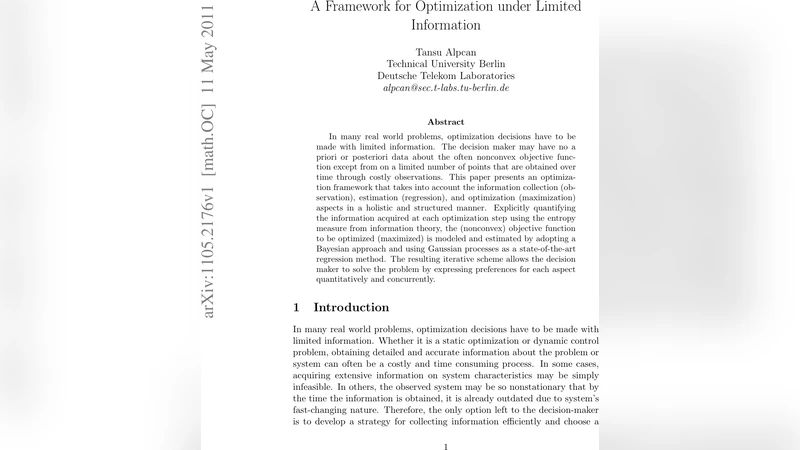
In many real world problems, optimization decisions have to be made with limited information. The decision maker may have no a priori or posteriori data about the often nonconvex objective function except from on a limited number of points that are obtained over time through costly observations. This paper presents an optimization framework that takes into account the information collection (observation), estimation (regression), and optimization (maximization) aspects in a holistic and structured manner. Explicitly quantifying the information acquired at each optimization step using the entropy measure from information theory, the (nonconvex) objective function to be optimized (maximized) is modeled and estimated by adopting a Bayesian approach and using Gaussian processes as a state-of-the-art regression method. The resulting iterative scheme allows the decision maker to solve the problem by expressing preferences for each aspect quantitatively and concurrently.
💡 Research Summary
The paper addresses a pervasive challenge in real‑world optimization: decisions must often be made with only a few costly observations of an unknown, possibly non‑convex objective function. The authors propose a unified framework that simultaneously treats information acquisition, function estimation, and decision making as interrelated components. The core idea is to model the unknown objective (f) with a Bayesian surrogate (\hat f) and to quantify the value of each observation using Shannon entropy. By doing so, the framework turns the problem into a multi‑objective meta‑optimization that balances three orthogonal goals: (1) maximize the surrogate’s prediction of the true objective, (2) minimize a risk or loss measuring the discrepancy between (\hat f) and the actual observations, and (3) maximize the information gain (I(\hat f,\Omega_n)) obtained from the set of observations (\Omega_n).
The authors formalize the setting on a compact, convex subset (X\subset\mathbb{R}^d) and assume (f) is Lipschitz‑continuous. Observations are limited either by a fixed budget (N) or by a more general cost function (c_o(x)) with total budget (C). The basic search problem (Problem 1) asks for the best strategy to select (N) points that maximizes (f) given these constraints. The authors argue that naïve random search or simple gradient‑based heuristics waste valuable information, especially when data are scarce.
Problem 2 extends this by introducing a surrogate model (\hat f) built from a prior class (\mathcal{F}) and the observed data. The three objectives become a multi‑objective optimization problem: (i) exploit (\hat f) to locate the maximum of (f), (ii) reduce the expected loss (R(f,\hat f)) (e.g., mean‑squared error) over the observed points, and (iii) increase the entropy‑based information measure (I(\hat f,\Omega_n)). Because the objectives are largely independent, the framework can employ weighted sums, Pareto front construction, or other multi‑criteria techniques to trade off exploration (information gain) against exploitation (objective maximization) and robustness (estimation error).
Gaussian Processes (GPs) are chosen as the regression tool for (\hat f). GPs provide a non‑parametric Bayesian model defined by a mean function (set to zero for simplicity) and a covariance kernel (Q(x,\tilde x)). The authors adopt the standard radial‑basis function kernel (Q(x,\tilde x)=\exp(-\frac{1}{2}|x-\tilde x|^2)) and incorporate observation noise as an additive diagonal term (\sigma^2 I). This yields closed‑form posterior mean and variance expressions, enabling analytic computation of both the predictive distribution and the information gain (which reduces to the reduction in posterior entropy). The GP’s ability to naturally handle noisy observations and to provide uncertainty estimates makes it ideal for the proposed information‑driven acquisition function.
The iterative algorithm proceeds as follows: (1) initialize with a prior GP (no data), (2) select the next query point by solving the multi‑objective acquisition problem (balancing predicted improvement, risk reduction, and entropy gain), (3) evaluate the true objective at that point (incurring cost), (4) update the GP posterior with the new datum, and (5) repeat until the observation budget is exhausted. When observation costs vary with location, the framework can incorporate a distance‑based cost term (c_o(x_n,x_{n-1})), leading to location‑aware exploration strategies relevant for mobile sensing, robotic inspection, or network‑wide resource allocation.
The paper also discusses three fundamental trade‑offs (Table 1): exploration vs. exploitation, observation vs. computation, and robustness vs. optimization. It emphasizes that in many practical settings observation is far more expensive than computation, justifying the heavy use of sophisticated surrogate models even when data are scarce. Moreover, the computational burden of GP inference ((O(M^3)) with (M) observations) is not prohibitive because the framework deliberately limits (M).
Finally, the authors illustrate the broad applicability of the framework: decentralized resource allocation in communication networks, security‑related decision making where adversaries hide information, and biological systems where agents operate with limited local knowledge. By integrating information theory, Bayesian learning, and multi‑objective optimization, the paper offers a principled, flexible methodology for decision making under severe information constraints.
Comments & Academic Discussion
Loading comments...
Leave a Comment