Curved Koszul duality theory
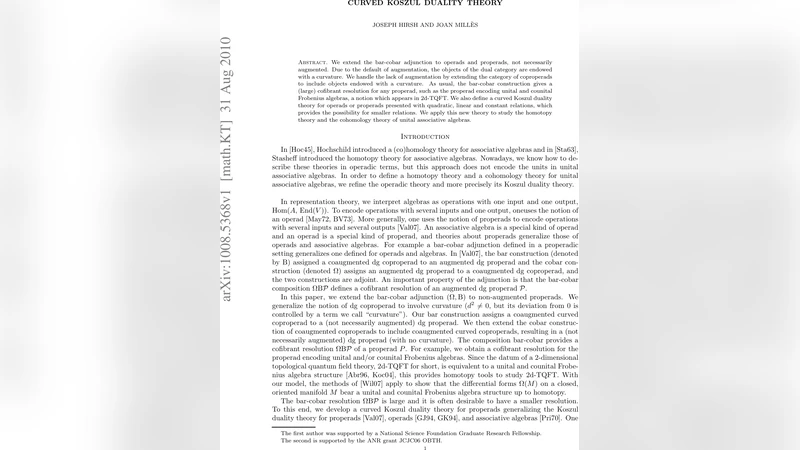
We extend the bar-cobar adjunction to operads and properads, not necessarily augmented. Due to the default of augmentation, the objects of the dual category are endowed with a curvature. We handle the lack of augmentation by extending the category of coproperads to include objects endowed with a curvature. As usual, the bar-cobar construction gives a (large) cofibrant resolution for any properad, such as the properad encoding unital and counital Frobenius algebras, a notion which appears in 2d-TQFT. We also define a curved Koszul duality theory for operads or properads presented with quadratic, linear and constant relations, which provides the possibility for smaller relations. We apply this new theory to study the homotopy theory and the cohomology theory of unital associative algebras.
💡 Research Summary
The paper tackles a fundamental limitation of the classical bar‑cobar adjunction, namely its reliance on the existence of an augmentation for operads and properads. When an augmentation is absent, the dual objects acquire a curvature term, which the authors treat systematically by enlarging the category of coproperads to include “curved coproperads”. A curved coproperad is a coproperad equipped with a degree‑2 curvature element θ satisfying a curvature equation dθ + θ ⋆ θ = 0, where d is the internal differential and ⋆ denotes the coproduct.
With this enlarged category, the authors extend the bar‑cobar adjunction: the bar construction sends any (possibly non‑augmented) operad or properad O to a curved coproperad B(O), while the cobar construction sends a curved coproperad C to an operad Ω(C). The resulting bar‑cobar composites BΩ(C) and ΩB(O) contain curvature contributions, yet they remain adjoint and provide cofibrant replacements in an appropriate model structure on curved coproperads. The authors prove that for every properad P, the natural map ΩB(P) → P is a cofibrant replacement, giving a (generally large) cofibrant resolution even for structures that cannot be augmented, such as the properad governing unital and counital Frobenius algebras that appear in two‑dimensional topological quantum field theory (2d‑TQFT).
Beyond the existence of resolutions, the paper develops a curved Koszul duality theory for operads and properads presented by quadratic, linear, and constant (QLC) relations. Classical Koszul duality deals only with purely quadratic relations; the QLC framework allows the inclusion of linear and constant terms, which are essential for encoding units, counits, or curvature. For a QLC presentation O = Free(V)/(R) the authors construct a curved Koszul complex (sV, d, θ), where sV is the suspension of generators, d encodes the linear part of the relations, and θ encodes the constant part (the curvature). They introduce a “curved Koszul condition” that guarantees the curved Koszul complex is a cofibrant resolution of O. When the condition holds, the curved Koszul complex coincides with the bar‑cobar resolution ΩB(O), but it is often dramatically smaller and more manageable.
The theory is illustrated with two central examples. First, the operad governing unital associative algebras is shown to admit a QLC presentation whose curved Koszul complex reproduces the classical Hochschild complex together with an extra curvature term accounting for the unit. This yields a unified description of the homotopy theory (A∞‑structures) and cohomology (a curved version of Hochschild cohomology) of unital associative algebras. Second, the properad encoding Frobenius algebras with both unit and counit is treated. Because such a properad cannot be augmented, the traditional Koszul machinery fails; however, the curved Koszul duality provides a small, explicit resolution, thereby opening the way to study homotopy‑invariant structures in 2d‑TQFT.
The paper also discusses the model categorical aspects of curved coproperads. A Quillen model structure is established where weak equivalences are quasi‑isomorphisms of underlying chain complexes, fibrations are surjections, and cofibrations are defined via the left lifting property. Within this framework, the bar‑cobar adjunction becomes a Quillen equivalence between operads (or properads) and curved coproperads, confirming that curvature does not obstruct homotopical control.
Finally, the authors explore the implications for deformation theory. The curved Koszul complex carries a natural differential graded Lie algebra structure; Maurer‑Cartan elements correspond to curved A∞‑ or L∞‑structures on a given algebra, and the curvature term modifies the usual Maurer‑Cartan equation by an additive constant. This leads to a curved Hochschild cohomology governing deformations of unital algebras, and suggests a broader program for studying deformations of algebraic structures that inherently possess units or counits.
In summary, the work extends bar‑cobar duality to non‑augmented contexts by introducing curvature, builds a robust model structure for curved coproperads, and establishes a curved Koszul duality that handles quadratic‑linear‑constant presentations. The theory unifies and simplifies the homotopy and cohomology analysis of unital associative algebras and Frobenius properads, and opens new avenues for homotopical algebra, deformation theory, and topological quantum field theory where curvature and units are unavoidable.
Comments & Academic Discussion
Loading comments...
Leave a Comment