Judgment
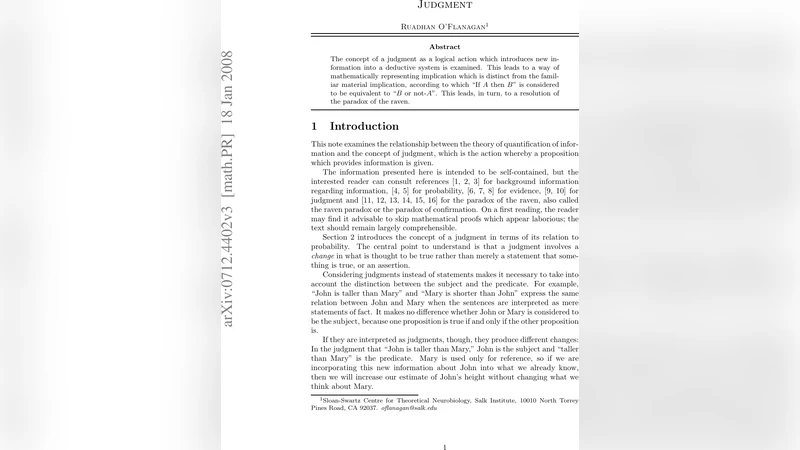
The concept of a judgment as a logical action which introduces new information into a deductive system is examined. This leads to a way of mathematically representing implication which is distinct from the familiar material implication, according to which “If A then B” is considered to be equivalent to “B or not-A”. This leads, in turn, to a resolution of the paradox of the raven.
💡 Research Summary
The paper re‑examines the notion of a “judgment” as a logical act that introduces new information into a deductive system, and from this perspective proposes a novel mathematical representation of implication that differs fundamentally from the familiar material implication. In classical propositional logic the conditional “If A then B” is treated as material implication, formally equivalent to “¬A ∨ B”. This equivalence, while convenient for truth‑functional semantics, allows a false antecedent to make the conditional true regardless of the consequent, leading to counter‑intuitive results such as the raven paradox.
The author begins by formalising a judgment as an operation that expands the current set of premises Γ with a newly asserted proposition A. Symbolically, a judgment transforms Γ into Γ ∪ {A}. This operation is not merely a rule of inference; it is an act of information injection that changes the epistemic state of the system. By treating judgments as primitive actions, the paper separates the dynamic process of adding knowledge from the static truth‑functional evaluation of formulas.
Building on this foundation, a new implication operator “⇒” is defined. The statement A ⇒ B means that whenever A is judged (i.e., whenever A becomes provable from the current premises), B must also become provable. Formally:
A ⇒ B ⇔ ∀Γ ( Γ ⊢ A ⇒ Γ ⊢ B ).
Here “⊢” denotes provability within the underlying deductive system. Unlike material implication, which is satisfied whenever A is false, the judgment‑based implication requires a genuine inferential link: B follows only if A is actually established. This captures the causal or explanatory intuition that many philosophers and scientists associate with “if‑then” statements.
The paper then applies this framework to the raven paradox. The paradox arises from the material‑implication equivalence between “All ravens are black” (∀x (Raven(x) → Black(x))) and its contrapositive “All non‑black things are non‑ravens” (∀x (¬Black(x) → ¬Raven(x))). Under material implication, observing a single non‑black non‑raven (e.g., a green apple) counts as confirming evidence for the original universal claim, which seems absurd.
In the judgment‑based system, however, the observation “¬Black(a) → ¬Raven(a)” is not a new judgment that strengthens the original universal claim; it is merely a side observation that does not affect the set of judgments concerning ravens. The conditional derived from the contrapositive does not introduce a new premise about ravens; therefore it does not increase the evidential support for “All ravens are black.” Consequently, the paradox dissolves: only direct judgments about ravens (e.g., observing a black raven) contribute to the confirmation of the universal statement.
The author argues that this approach restores the intuitive notion that evidence must be relevant to the hypothesis it supports. By distinguishing judgments (acts of adding premises) from mere logical consequences, the new implication avoids the “any true statement follows from a false antecedent” problem inherent in material implication.
Beyond the raven paradox, the paper suggests broader implications for logic, philosophy of science, and artificial intelligence. A judgment‑centric view of implication aligns more closely with scientific reasoning, where hypotheses are tested by adding new data and checking whether they entail further predictions. In AI, reasoning systems that track judgments explicitly could better manage knowledge updates, avoid spurious inferences, and maintain a clearer provenance of derived conclusions.
In conclusion, the paper proposes a redefinition of implication grounded in the act of judgment, demonstrates how this resolves a classic paradox, and highlights the potential for more faithful modeling of real‑world inference. Future work is invited to extend the judgment‑based framework to other logical systems, explore its computational properties, and integrate it into practical reasoning architectures.
Comments & Academic Discussion
Loading comments...
Leave a Comment