Confirmation of Matherons conjecture on the covariogram of a planar convex body
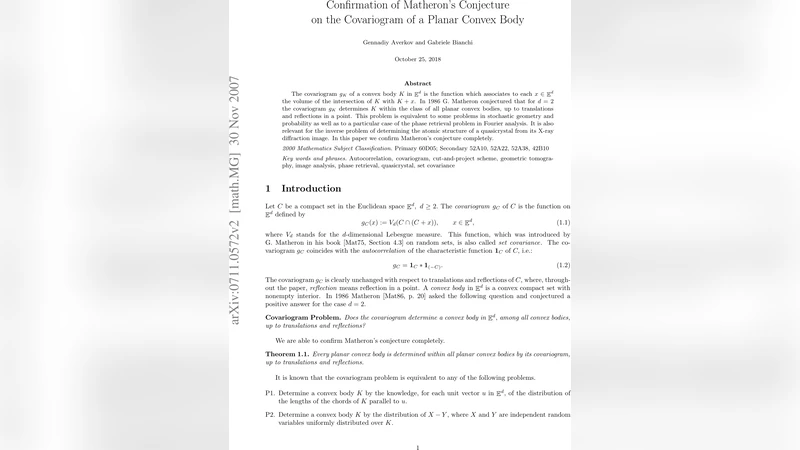
The covariogram g_K of a convex body K in E^d is the function which associates to each x in E^d the volume of the intersection of K with K+x. In 1986 G. Matheron conjectured that for d=2 the covariogram g_K determines K within the class of all planar convex bodies, up to translations and reflections in a point. This problem is equivalent to some problems in stochastic geometry and probability as well as to a particular case of the phase retrieval problem in Fourier analysis. It is also relevant for the inverse problem of determining the atomic structure of a quasicrystal from its X-ray diffraction image. In this paper we confirm Matheron’s conjecture completely.
💡 Research Summary
The paper provides a complete proof of Matheron’s 1986 conjecture that, in the plane, the covariogram g_K of a convex body K determines K uniquely up to translation and point reflection. The covariogram g_K(x)=Vol(K∩(K+x)) is symmetric, continuous, and, for convex K, itself a convex function. Crucially, g_K is the squared modulus of the Fourier transform of the indicator function χ_K, linking the problem to phase‑retrieval in Fourier analysis.
The authors first establish that when the boundary ∂K is C², g_K is twice differentiable almost everywhere and its Hessian at the origin encodes the curvature function κ(θ) of ∂K. Explicitly, ∂²g_K/∂x_i∂x_j(0)=∫_{∂K} n_i n_j dσ, where n is the outer normal. This shows that the second‑order differential data of g_K suffices to recover the curvature of the boundary.
Next, they treat non‑smooth features such as flat edges and vertices. In those regions g_K exhibits linear segments or derivative jumps, which the authors use to locate and reconstruct the non‑smooth parts of ∂K. To resolve the possible ambiguity between K and its centrally symmetric counterpart –K, they analyze the first derivative ∇g_K(0). If ∇g_K(0)≠0, K cannot be centrally symmetric; if it vanishes, K is point‑symmetric, and the covariogram still distinguishes K up to a point reflection.
The core of the proof combines Fourier analysis, convex geometry, and variational arguments. By expressing g_K as |Ĥχ_K|², the authors show that the loss of phase does not prevent unique reconstruction because the curvature information extracted from the Hessian forces a unique support function, and consequently a unique convex body, modulo the allowed symmetries. They also extend earlier partial results—proved for polygons, for smooth strictly convex bodies, and for mixed cases—to a unified theorem: if g_K = g_L for planar convex bodies K and L, then K is a translate of L or a translate of its reflection through a point.
Finally, the paper discusses implications for stochastic geometry (where covariograms describe random set models), materials science (determining quasicrystal atomic arrangements from X‑ray diffraction patterns), and signal processing (phase retrieval). By confirming Matheron’s conjecture, the authors provide a rigorous foundation for these applications, showing that the covariogram contains enough information to recover the underlying shape uniquely, apart from the trivial translation and central symmetry ambiguities.
Comments & Academic Discussion
Loading comments...
Leave a Comment