Non-rational configurations, polytopes, and surfaces
It is an amazing and a bit counter-intuitive discovery by Micha Perles from the sixties that there are ``non-rational polytopes'': combinatorial types of convex polytopes that cannot be realized with rational vertex coordinates. We describe a simpl…
Authors: ** Günter M. Ziegler (주요 저자) *감사의 글에 언급된 협력·조언자*: Volker Kaibel, Nikolaus Witte, John M. Sullivan
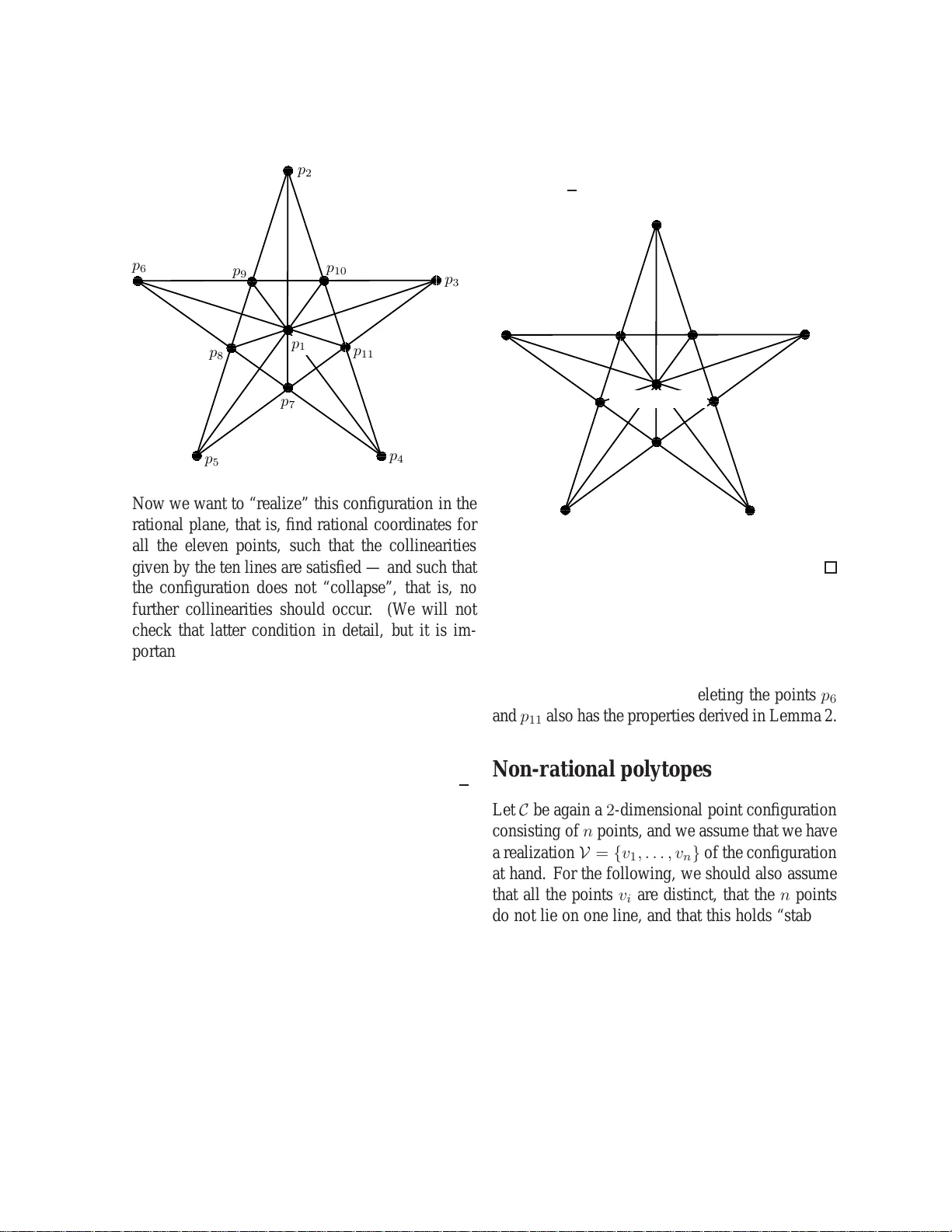
Non-ratio nal configura tions, polytopes, and surfaces G ¨ unter M. Ziegler Inst. Mathematics, MA 6-2, TU Berlin D-10623 Berlin, Germany ziegler@ma th.tu- berlin.de October 24, 2007; re vised November 16, 2007 dedica ted to Micha Perles The tw o mos t inte resting “pla tonic solids”, the reg - ular dodec ahedron and the re gular icosahe dron, necess arily hav e irratio nal verte x coor d inates . Indeed , they in v ol ve reg ular pen tagons , as f aces ( in the dodec ahedron ), or gi ven by the fiv e neig hbors of any verte x (for the icosahedr on); and a regu lar pentag on cannot be realize d with rational coordi- nates, since th e diagon als in tersect each o ther in the ratio τ : 1 kno wn as th e “gol den sect ion” [7, p. 30], where τ = 1 2 (1 + √ 5) . Ho wev er , the dodec ahedron and the icosa hedron can be realized with rational coordinates if we do not req uire them to be precis ely regu lar: If yo u pertur b the ver tices of a regular icosahed ron “just a bit” into rationa l position, then taking the con- ve x hull will yield a ration al polyt ope that is com- binato rially equivalen t to the re gular icos ahedro n. Similarly , by perturb ing the face t planes of a reg- ular dodecah edron a bit w e obtain a dodecah edron with ration al coordin ates. Indeed , ev ery combinat orial typ e of 3 -dimensio nal polyto pe ca n be realized with ration al coordinate s. For simplicial polytopes such as the icosahedr on, where all faces are triangl es, this can be achie ved by perturbing verte x coordinate s. For simple poly- topes such as the dodecah edron, where all ver - tices ha ve degree three, we can pertu rb the planes spann ed by faces into rational positi on (that is, un- til the planes hav e equatio ns with rational coef fi- cients ). For the case of general 3-polyt opes, which may be neither simple nor simplicial, the result is not ob viou s, bu t we get it as an easy con sequen ce of Steinit z’ s proof for his (dee p) theorem [29, 30] [33, Lect . 4] th at e ver y 3-co nnecte d planar gra ph is the graph of a con ve x polytope. In vie w o f this, it is a surprisin g and perhaps counte r -intuiti ve disco ve ry , made by Micha P er - les in the sixties, that in hig h dimensions there are inherently non-ra tional combinatori al types of polyto pes: Specifically , Perles con structe d an 8 - dimensio nal poly tope with 12 ver tices that can be 1 realize d with v ertex co ordina tes in Q [ √ 5] , b ut not with rational coor dinates . His construc tion was gi ven in terms of “Gale diagrams” , w hich he in- troduc ed and de velo ped into a po werful tool for the ana lysis of polyto pes with “fe w verti ces”, that is, d -dimension al polytopes with d + b v ertices for small b . 1 Gale diagrams are a duality theory: They in volv e the passag e to a space of complementa ry dimen- sion (for a d -polytope with n vert ices one arri ves at an in vestigati on in R n − d − 1 ), and so the poly- topes pro duced by P erles’ con structio n are hard to “visualize ”. Ho wev er , it was later foun d that non-ra tional polyto pes may be genera ted from pla- nar (non-rat ional) incidenc e configurat ions in a number of diffe rent way s, the simpl est of w hich are “La wrence e xtensio ns”. These were di scov - ered and used, b ut not published , in 1980 by Jim Lawrence , then at the Uni versity o f K entuck y; the y first appeared in pri nt in a pape r by Bille ra & Mun - son [2] on oriented m atroids . Lawrence ext ension s may be des cribed via two du alizatio n proce sses, b ut two dualiz ations ar e as good as none: and so w e arri ve at a “direc t” construction in primal space . . . As you will see belo w , gra nted tha t non -rationa l point configuration s in the plane exi st (which we will see), Lawrence extens ions are almost tri vial to perfor m, and quite easy to analy ze. One m ight try to attrib ute all this to the fact that “high- dimensio nal geometry is weird”. H o wev er , althou gh there is some truth to thi s claim, the fa ct that non- rationa l planar inciden ce configurat ions lead to non-r ational geometri c structures may also be seen in other instance s. So, we sketc h a con- structi on by Ulrich B rehm, announced in 1997 [5] b ut not yet published in full, yet, which shows that there are ge ometric objects in R 3 (namely , cer - tain polyhedral surfac es) th at are intrinsicall y non- ration al. Construc ting instan ces of non-rat ional polytop es, or of no n-ration al surface s, is not hard with the techni ques w e ha ve at hand . Since the analys is and proofs become quite easy if we work w ith homoge- neous coordi nates (that is, in project i ve geometry) , we will revie w this to ol first; n ote that it is not u sed in the const ruction s. Much harder work — bot h in the careful statement of the results, and in th e proof s of the theorems — is needed if one is striv ing for so-called uni versality theore ms; these say that the configura tion spaces of vario us geometric objects “are arbitrarily wild”. W e will hav e a brie f disc ussion later in this paper , before we end with major open probl ems. Acknowledgeme nts. Thanks to V olker Kaib el for th e discussion s an d jo int drafts on the path to this article, to Nik olaus W itte for many comments and some of the pictures, to John M. Sulliv an and Pete r M cMullen for careful and insigh tful readings, to Ravi V akil and Michael Kleber for their en- courag ement and guid ance on the way to wards pub lica- tion in th e Math. Intelligencer , and in particular to Ul- rich Brehm for his per mission to rep ort about h is math - ematics “to be published ”. Homogeneous coordinates and pr ojective transf ormations An abstra ct configur ation is gi ven by a set { p 1 , . . . , p n } of n elements (“point s”) and by a list which says which triples of points shoul d be collin ear (and that the others shouldn ’ t). A r eal- izatio n of th e con figuration is giv en by n point s w 1 = ( x 1 , y 1 ) , . . . , w n = ( x n , y n ) ∈ R 2 that satisfy the co ndition s, under the correspon- dence p i ↔ w i : The points w i , w j , and w k should be co llinear e xactly if this ha d b een di ctated for p i , p j , p k . “Being collinear” is a linear alge- bra condi tion for w i , w j , w k : The points w i , w j , and w k need to lie on a lin e, tha t is, be af finely depen dent . Equi v alentl y , the vectors (1 , x i , y i ) , (1 , x j , y j ) , (1 , x k , y k ) ∈ R 3 need to be lin early depen dent , that is, hav e determina nt zero. Ever y realiza tion by point s w i in R 2 corres ponds to a re- alizati on by ve ctors v i := (1 , x i , y i ) in R 3 . These coordi nates with a first coord inate 1 prepen ded are referre d to as homo gene ous coor dinates . All of what follo ws in this paper could in princip le be disc ussed (and compute d) in affine coordinates 1 Micha Perles, a professor of mathematics at Hebrew Univ ersi ty in Jerusalem who just retired, i s a remarkable mathemati- cian who has published very little, but contributed a number of brilliant ideas, concepts, and proofs. Hi s theory of Gale diagrams, as well as his construction of non-rational polytopes, were first published in the 1967 first edition of Branko Gr ¨ unbaum’ s book “Con vex Polytopes” [10]. (See [21] or [1, Chap. 13] for another gem.) 2 — it would just be muc h more complicated. A key observ ation is now that linear indepe ndence is not affec ted if we replace any one of the vec tors v i ∈ R 3 by a non-ze ro m ultiple . Here are four funda mental facts. • Any r ealizati on by points w i ∈ R 2 and specified af finely dependent triples yields a realiza tion by vec tors v i ∈ R 3 with specified linearly depen- dent triples: just pass to homoge neous coordi - nates. • Con ver sely , any “linear” realiza tion by vecto rs v i ∈ R 3 can be con vert ed into an “af fi ne” re- alizati on by points in R 2 , by dehomog enization : Find a pl ane at + bx + cy = 1 that is not p arallel to an y one of the vecto rs, and rescale the v ectors to lie on the plane. (That is, find a linear func- tion ℓ ( t, x, y ) = at + bx + cy that does not vanish on an y one of th e vect ors, and then repla ce v i by 1 ℓ ( v i ) v i .) • In ver tible linear transformatio ns on R 3 cor - respon d to pr ojectiv e trans formation s in the plane R 2 . • Any four vectors v 1 , v 2 , v 3 , v 4 ∈ R 3 such that no three of them are linear ly dependen t form a pr ojective basis : There is a unique projecti ve transfo rmation that maps them to e 1 , e 2 , e 3 , and e 1 + e 2 + e 3 , that is, a line ar transformati on that maps them to non-ze ro multiples of these four vec tors. In deed, if v 4 = α 1 v 1 + α 2 v 2 + α 3 v 3 with nonze ro α i , then conside r { α 1 v 1 , α 2 v 2 , α 3 v 3 } as a basis and let the linear transformati on map α i v i to e i . Clearly , the concepts of homogeniza tion, deho- mogeniz ation, projecti ve transformati ons, an d pro- jecti ve bases work analogo usly also for highe r di- mension s. It’ s elementary real linear algebra. For the study of con ve x pol ytopes it is also advan - tageou s to treat them in homoge nous coordi nates. Ho wev er , here con ve xity is important, and thus we ha ve to insi st on the use of po sitive rat her th an non- zero coef ficients/multipl es thr oughou t. P C P t = 1 In this setting, homog enization is the passage from a d -d imension al con vex poly tope P ⊂ R d with n vertices to a ( d + 1) -d imension al pointed con- ve x polyhedra l cone C P ⊂ R d +1 with n extre me rays. More generally , any k -dimensiona l face of P corres ponds to a non-empty ( k + 1) -dimens ional face of the cone C P , and is thus suppo rted by a linear hyperpla ne throug h the origin, which is the ape x of C P . Dehomogen ization allo w s us to pass back from any ( d + 1) -dimensiona l pointed poly- hedral cone to a d -polytope . Moreo ver , rational d - polyto pes corr espond to rational ( d + 1) -con es, and con ver sely(!). (S ee e.g. [33, Sect. 2.6] for a more detaile d discussion.) Non-rational configurations The insight that there are “abstract” combin atorial incide nce configuration s that m ay be geometri zed with real, bu t not w ith rational coordinate s is rooted deep in the history of projecti ve ge ometry . (A rea- son for this is tha t additio n and multiplica tion can be modelled by incidence co nfiguratio ns, via the v on Staudt constru ctions [31, 2. Heft, 1857]; thus, polyn omial equati ons can be encode d into point configura tions. This mechanis m was stud ied al- ready v ery early in the framewo rk of matroid the- ory , sta rting with MacLane’ s fundament al 1936 pa- per [16], [15, pp. 147-151], where an elev en-po int exa mple was desc ribed. See Kun g [15, Sect. II.1] for details an d fur ther re ference s.) A s sugges ted by Perles, let us look more closely at the regular pen- tagon. Example 1 . The e xtended pen tago n configur a- tion C 11 is an abstract con figuratio n on e le ven points p 1 , . . . , p 11 : Its col linear tri ples { p 1 , p 2 , p 7 } , { p 1 , p 3 , p 8 } , . . . may be r ead off from t he collin ear - ities among the fiv e vertices of a regul ar pentago n, the fiv e in tersecti on points of its diago nals, and the center . The re are ten lines that contain more than two of these points: T he five diagona ls of the pen- tagon contai n four points each, while the fiv e lines of symmetry contain three. 3 000 000 000 000 000 111 111 111 111 111 000 000 000 000 000 111 111 111 111 111 000 000 000 000 000 111 111 111 111 111 000 000 000 000 000 111 111 111 111 111 000 000 000 000 000 111 111 111 111 111 000 000 000 000 000 111 111 111 111 111 000 000 000 000 000 111 111 111 111 111 000 000 000 000 000 111 111 111 111 111 000 000 000 000 000 111 111 111 111 111 000 000 000 000 000 111 111 111 111 111 000 000 000 000 000 111 111 111 111 111 p 2 p 3 p 4 p 5 p 7 p 8 p 9 p 10 p 11 p 6 p 1 No w w e want to “realize” this configurati on in the ration al plane, th at is, find rational coo rdinate s for all the ele ve n points, such tha t the collineari ties gi ven by the ten lines are satisfied — and such that the configur ation does not “collapse” , that is, no furthe r colline arities should occur . (W e will no t check that latter condi tion in detail, bu t it is im- portan t: In vie w of th e ne xt le mma check t hat th ere are rational coordi nates for the elev en points that satisfy all ten collinearit ies, for example giv en by ele ve n distinct points on one line, or with the elev en points placed at the ver tices of a triangle .) Lemma 2. The elev en-poin t configur ation of Ex- ample 1 c an be r ealiz ed with coor dinates in Q [ √ 5] , b ut not with ratio nal coor dinates. Pr oof. The calculatio n for this lemma is m ost eas- ily don e in terms of homog eneous coordinates. In a vector realizatio n v 1 , . . . , v 11 ∈ R 3 , no three of the four vector s v 1 , v 2 , v 9 , v 10 can be copla- nar: These four vectors for m a proj ecti ve basis. Thus we can assume that they ha ve, for examp le, the coord inates v 1 = (1 , 0 , − 1) , v 2 = (1 , 0 , 1) , v 9 = (1 , − 1 , 0) , and v 10 = (1 , 1 , 0) . Furth ermore, v 3 will ha ve homogene ous coordina tes (1 , a, 0) for some parameter a ∈ R \{− 1 , +1 } that we need to determine. No w it is easy (e xer cise!) to de- ri ve coordin ates for the oth er vect ors and equa- tions for the lines th ey span, for example in the order ℓ 1 : x 2 = 0 , ℓ 2 : x 1 = 0 , ℓ 3 , ℓ 4 , ℓ 5 , ℓ 6 , v 4 = (0 , 1 , − 1) , v 5 , ℓ 7 , and then v 7 = (1 , 0 , − a ) , v 8 = (1 − a, 2 a, 1 + a ) . Finally , the condi tion that v 4 , v 7 and v 8 need to be linearl y dependen t leads to the determinant equation a 2 − 4 a − 1 = 0 , that is, a = 2 ± √ 5 . 000 000 000 000 000 111 111 111 111 111 000 000 000 000 000 111 111 111 111 111 000 000 000 000 000 111 111 111 111 111 000 000 000 000 000 111 111 111 111 111 000 000 000 000 000 111 111 111 111 111 000 000 000 000 000 111 111 111 111 111 000 000 000 000 000 111 111 111 111 111 000 000 000 000 000 111 111 111 111 111 000 000 000 000 000 111 111 111 111 111 000 000 000 000 000 111 111 111 111 111 000 000 000 000 000 111 111 111 111 111 ℓ 7 (1 , − 1 , 0) (1 , 1 , 0) (1 , a, 0) v 2 = (1 , 0 , 1) v 3 = v 4 v 5 v 7 v 8 v 9 = v 10 = v 11 v 6 ℓ 1 ℓ 3 ℓ 4 v 1 = (1 , 0 , − 1) ℓ 2 ℓ 5 ℓ 6 ℓ 7 Y ou should do this computation yourself. T o com- pare result s, use the labels in our figure. The ele ven- point “ex tended pentagon” ex ample is not minimal, as you are in vited to fi nd out in the course of your computat ion. Optimizatio n Exer cise. Sho w that the nine-po int configura tion obtained fro m deleti ng the p oints p 6 and p 11 also has the properties deri ved in Lemma 2. Non-rational polytopes Let C be aga in a 2 -dimensiona l point configuratio n consis ting of n points, an d we assume that we ha ve a realiza tion V = { v 1 , . . . , v n } of the configuratio n at hand. For the followin g, we should also assume that all the points v i are distinc t, that the n points do not lie on one line, and that this holds “stably” : If we de lete any one of the poi nts, then the others should not lie on a line. If v ∈ V is any point in the configuration , a Lawr ence ex tension is performed on v by replac- ing v by two new points ¯ v and ¯ ¯ v on a line through v that uses a ne w dimensio n. T hat is, v , ¯ v and ¯ ¯ v are to lie in this o rder on a line ℓ that intersec ts the affine span of C only in v . T hus by this ad- dition of two new points ¯ v and ¯ ¯ v and deletion of the “old” point v , the dimension of a configuratio n goes up by one, and so does the number of points. W e will iterate this, applying Lawrence extension s 4 to all points in the configuration C , one after the other . ¯ ¯ v V ¯ v v Definition 3. The Lawre nce lifting Λ V of an n - point configuration V is obtaine d by successi vely applyi ng Lawrence exte nsions to all the n points of V . Thus th e Lawre nce liftin g of a 2 - dimensio nal n -point configur ation V is a (2 + n ) -dimensiona l configura tion that consists of 2 n points . Lawrence has observ ed that this simple construc- tion ha s a number of remarkable properties . First, the order in which the L awrenc e extensio ns are per - formed does no t matter , since th ey use ind epende nt “ne w ” direction s. This may also be seen from a coordi nate repres entatio n: If the n points of V are gi ven by ( x i 1 , x i 2 ) ∈ R 2 , then Λ V is gi ve n by the ro ws of the 2 n × (2 + n ) matrix ¯ v 1 ¯ v 2 . . . ¯ v n ¯ ¯ v 1 ¯ ¯ v 2 . . . ¯ ¯ v n := x 1 1 x 1 2 1 x 2 1 x 2 2 1 . . . . . . x n 1 x n 2 1 x 1 1 x 1 2 2 x 2 1 x 2 2 2 . . . . . . x n 1 x n 2 2 . Here ¯ v i and ¯ ¯ v i arise by lifting v i into a new i -th directi on; the specific va lues 1 and 2 for the “lift- ing heig hts” are not important, other positi ve v alues would gi ve equi valen t configurati ons. Next, the points ¯ v 1 , . . . , ¯ v n , ¯ ¯ v 1 , . . . , ¯ ¯ v n of Λ V are in co n vex position, so the y are the vertic es of a polyto pe. Moreo ve r , for each i the pair of ver - tices ¯ v i , ¯ ¯ v i forms an e dge of this polyto pe con v Λ V . Indeed , it suf fi ces to verify the last claim: From no w on, let us den ote the coor dinates on R 2+ n by ( x 1 , x 2 , y 1 , . . . , y n ) . Among the points of Λ V , the points ¯ v i and ¯ ¯ v i minimize the li near functional ( y 1 + · · · + y n ) − y i , w hich sums all “ne w v ariable s” exc ept for the i th one. Thus e i = [ ¯ v i , ¯ ¯ v i ] is an edge of Λ V , and its endpo ints are vert ices. Definition 4. The L awr ence polytope of the real- ized configurati on V ⊂ R 2 is the con vex hull of its Lawrence lift ing, L ( V ) := conv Λ V ⊂ R 2+ n . The vertice s not on e i , i.e. the s et Λ V \ { ¯ v , ¯ ¯ v } , form the vertex set of a facet F i of the polytope L ( V ) : This is si nce th ey all min imize th e l inear fun ctional y i , and span a Lawrence polyt ope of dimen sion 1 + n . Finally , let ℓ be any line of the ori ginal 2 - dimensio nal configurat ion, which contai ns the points v i ( i ∈ I 0 ), and has the po ints v j ( j ∈ I − ) on one side, and the points v k ( k ∈ I + ) on the other side, f or a partition I 0 ∪ I − ∪ I + = [ n ] . Then there is a fa cet F ℓ of L ( V ) with ve rtex set V ( F ℓ ) = ¯ v j : j ∈ I − ∪ ¯ v i , ¯ ¯ v i : i ∈ I 0 ∪ ¯ ¯ v k : k ∈ I + . T o see this, let l ( x 1 , x 2 ) = ax 1 + bx 2 + c be a linear functi on that is zero on v i ( i ∈ I 0 ), negati ve on v j ( j ∈ I − ), and positi ve on v k ( k ∈ I + ). From this we can easily write do wn a funct ional ¯ l ( x 1 , x 2 , y 1 , . . . , y n ) := l ( x 1 , x 2 ) + α 1 y 1 + · · · + α n y n that is zero on the purport ed vertice s o f F ℓ , and pos- iti ve on all other v ertices of L ( V ) : By ju st plugging in, you are led to set α j := 0 for j ∈ I 0 , − l ( x j 1 , x j 2 ) for j ∈ I − , − 1 2 l ( x j 1 , x j 2 ) for j ∈ I + . Finally , we check that the face F ℓ indeed has di- mension 1 + n , so it defines a facet of L ( V ) . Clearly if a configuration V has rational coordi- nates then so do the Lawren ce lifting Λ V (see the matrix ab ov e) and the Lawrence polytop e L ( V ) . Lawrence ’ s remarkabl e observ ation was that the con ver se is true as well. Theor em 5 (Lawrenc e) . Any r ealiz ation of the Lawr ence polytope L ( V ) encodes a r ealizat ion of V . Thus, if L ( V ) ha s rational coor dina tes, then so does V . 5 Pr oof. Let P ⊂ R 2+ n be a poly tope w ith the co m- binato rial type of L ( V ) . Somehow we h a ve to start with P and “construct” V from it. For this we h omogeni ze, and let C P ⊂ R 3+ n be the polyh edral cone spanned by P . Let H i ⊂ R 3+ n be the linear hyperpla nes spanned by the n face ts F i ⊂ P discussed abov e. The intersect ion R := H 1 ∩ · · · ∩ H n of these facets is a 3 -dimen sional linear subsp ace of R 3+ n : Indeed the intersec tion of n hy perplan es has co-di mension at most n , and the co-dimen sion canno t be smaller than n since for each H i there are vertic es that are not contai ned in H i , b ut in all the other hyperp lanes H j (namely ¯ v i and ¯ ¯ v i ). The subsp ace R is the spa ce where w e will constr uct a vec tor represen tation of V . Let E i ⊂ R 3+ n be the 2 -dimension al linear sub- space that is spanned by the edge e i (that is, by ¯ v i and ¯ ¯ v i ). No w e i is containe d in F j for a ll j 6 = i , b ut not in F i ; thus E i is contain ed in H j for all j 6 = i , b ut not in H i . So if we intersect R with E i , we get a linear spac e R ∩ E i = H i ∩ E i =: V i that is 1 -dimension al. (The interse ction of a 2 -dimens ional subspace with a hyperp lane that doesn ’t con tain it is al ways 1 -dimensional . That’ s the beauty of working in vecto r spaces, i.e. w ith homogen ization !) Let v i ∈ V i ⊂ R be a no n-zero vec tor . W e claim that v 1 , . . . , v n ∈ R giv e a vector r epr esenta tion of V in R . For this, consider a line ℓ of the configuration V . The corres pondin g facet F ℓ ⊂ P (as described abo ve) contain s the edges e i for i ∈ I 0 , b ut not the edges e j for j ∈ I − ∪ I + . Thus if w e intersect the hyperplan e H ℓ ⊂ R 2+ n with R we get a 2 - dimensio nal intersecti on that contain s v i ( i ∈ I 0 ), b ut not v j ( j ∈ I − ∪ I + ) — otherwise H ℓ would contai n v j as well as one of ¯ v j and ¯ ¯ v j , b ut not the other one, which is impossibl e. This completes the proof of the claim and of the theore m. Cor ollary 6. T he Lawren ce polytope L ( V 11 ) de- rived fr om the e xtende d p enta gon c onfigur ation is a 13 -dimen sional non-r ationa l poly tope with 22 ver - tices: It ca n be r ealized with verte x coor dinates in Q [ √ 5] , b ut not with coor dinates in Q . Optimizatio n Exer cise . Construct a non-ra tional polyto pe with fewer verti ces, and of smaller dimen- sion. As a co nseque nce of Richter -Gebert’ s wor k [23] we kno w th at there are ev en 4 -dimensio nal non- ration al pol ytopes . Richter -Gebert’ s smallest ex- ample has 33 vert ices. Non-rational surfaces A polyh edra l surfac e Σ ⊂ R 3 is compose d from con ve x polygons (trian gles, quadrilate rals, etc.), which are required to intersect nicely (that is, in a common edge, a vertex , or not at all), and such that the un ion of all polygons is homeomorphic to a closed surf ace (a sphere, a torus, etc.). The basic “ga dget” that we can use to b uild inher- ently non-rational polyhed ral surf aces from non- ration al configura tions is the “T oblerone torus” — a polyhe dral nine-v erte x torus b uilt from nine quadri lateral faces. As an abstract configuratio n, this is the surface that you get from a 3 × 3 squa re by identify ing the points on opposi te edges. 1 1 4 7 1 1 4 7 2 3 3 2 5 6 8 9 Y ou migh t think of such a torus as a polyhedr al surf ace as bu ilt in 3 -spa ce from three T oblerone R (Swiss choco late) boxe s, which are long thin trian- gular prisms; think of the triang les at the ends as tilted (which is true for the cho colate ba rs, b ut not for their box es). 6 The ke y obse rv ation in this conte xt is this: Lemma 7 (Simutis [28, Thm. 6, p. 43] [9] [25 ]) . If you rea lize the tobler one torus in R 3 with one quadr ilater al m issing , then if the eight r ealized quadr ilater als ar e flat and con vex, then th e missing quadr ilater al is necessarily flat, and it is necessar - ily con vex. The missing face o f such a n eig ht-quad rilatera l T o- bleron e torus m ay be prescribed to be any gi ven con ve x flat quadrilatera l in 3 -spa ce: By proje cti ve transfo rmations on 3 -space, an y con vex flat q uadri- lateral can be mapped to an y other one. No w conside r the follo wing plan ar 9 - point config- uratio n: It consists of three black con vex quadri- lateral s adih , bf id , cgf e , and three grey shaded quadri laterals bdhi , bf g e , and cegi . P S f r a g r e p l a c e m e n t s a b c d e f g h i Think of this configuratio n as lying in a plan e H , and using projecti ve transfor mations in 3 -space glue three toblerone tori w ith their missing face s onto the three black quadrilate rals, in such a way that the three tori all come to lie on one side of the plane H . T ake three more T oblero ne to ri an d glue them with their missing faces onto the shaded grey quadri laterals , on the o ther side of H . What you get is a partial polyhed ral surf ace S 48 , consis ting o f 6 · 8 = 48 con vex quadrilatera ls. It has 9 + 6 · 5 = 39 ve rtices, among them the nin e spe- cial ones which are labelled a, b, . . . , i . It could be complete d into a close d polyhe dral surf ace by us- ing additio nal triangles and quadrilatera ls, b ut let’ s not do that for no w . Lemma 8 (Brehm) . In an y r ealization of the par - tial surfac e S 48 , the 9 special vertices a, b, . . . , i lie in a plan e. Pr oof. Indeed , by Lemma 7 the six quadr ilaterals are planar . It is easy to se e that thu s a, h, d, b, i, f lie in one plane, and c, e, f , g , b, i lie in one plane. Both planes contain b, f , i , and since they cannot be colli near , the two planes coincid e. Next, says Brehm, take three copies of the partial surf ace S 48 , and ide ntify th em in th eir co pies of th e ver tices a j , b j , c j , (for j = 1 , 2 , 3 ). T his yields an- other partial surface S 144 , consistin g of 3 · 48 = 144 quadri laterals and 3 + 3 · 36 = 111 vert ices. Lemma 9 (Brehm) . In any re alizatio n of the par - tial surface S 144 , the thr ee specia l vertices a, b, c lie on a line . Pr oof. Indeed , we kno w of three planes tha t the three vert ices lie on. T wo of these might coincide , where one 9 -point configurat ion coul d lie in th e up- per halfplane, and on e in the lower half-plane, bu t the third configration the n needs a dif ferent plane. Thus the three special vertices lie in the intersec tion of two plan es. From this it is qu ite easy to co me up w ith, and to prov e, Brehm’ s theorem: T here are non-rational polyh edral surfaces! Theor em 10 (Brehm 1997/ 2007 [5, 6]) . Glueing a co py of the partial surf ace S 144 into ea ch of the collin ear triples of the 11 -p oint penta gon configu- rat ion yields a partia l surface that may be r ealized in R 3 with flat con vex quad rilater als. It may be completed into a closed , embedded poly- hedr al surfac e in R 3 consis ting of quadr ilater als and triangles , all of whose verte x coor dinates lie in Q [ √ 5] . However , the partial surfa ce (and hence the com- pleted surfa ce) does not have any rationa l re aliza- tion. Indeed , L emma 9 represents already a major step on the wa y to Brehm’ s uni versality theorem for polyh edral surfaces. A glimpse of uni versality Follo wing vene rable tradit ions for exa mple from Algebrai c Geometry (where one speaks of “mod- uli sp aces”) it is natur al and pro fitable to study not only special realization s for discrete- geometric structu res such as configur ations, polyt opes or polyh edral surface s, but also the space of all cor - r ect c oor dinatizat ions , up to affine transformatio ns, 7 which is kno wn as the rea lization space of the structu re. Why is this set a “space ”, w hat is its struc ture? If we consider a planar n -poin t configuratio n C , then a rea lizatio n is gi ven by an o rdered set of v ec- tors w 1 , . . . , w n , which form the ro ws of a matrix W ∈ R n × 2 . Thu s a certain subset of the vector space R n × 2 of all 2 × n matrices correspo nds to “corre ct” realizations W of “our” configuration C . In all three cases (configu rations , poly topes, sur - face s) the set of correct realizat ions is a semi- alg ebra ic set (more precisely , a primary semi- algebr aic set defined ov er Z ): It can be described as the so lution set of a fi nite sys tem of polyno - mial equations and strict inequaliti es in the coor - dinate s, w ith integral coef fi cients. For example, in the case of configurations we speci fy for e ve ry triple v i , v j , v k that det( v i , v j , v k ) 2 should be ei- ther zero or to be positi ve, which amounts to a bi- quadra tic equa tion resp. st rict inequality in the co- ordina tes of w i , w j and w k . Any affine coordinat e transf ormation correspon ds to a column operation on the matrix M ∈ R n × 2 . So the real ization space can be desc ribed as a quotie nt of the set o f al l r ealizati on matrices b y the acti on of the group of affine transforma tions. From this point of vie w , it is not ob vious that the realization spac e is a semi-algebraic set. If, howe ver , equi v alently we fix an affine basis (which in the plane means: fix the coor dinates for three non-co llinear points to be th e vert ices of a sp ecified triangl e), then this be- comes clear . Pro position 11 (see Gr ¨ unbau m [10]) . The r ealiza - tion space of any configur ation, polytope or poly- hedr al surface is a semi-alg ebr aic set. Semi-algeb raic sets can be compli cated: They can • be empty , e.g. { x ∈ R : x 2 < 0 } , • be dis connec ted, e.g. { x ∈ R : x 2 > 1 } , • cont ain only irrationa l poin ts, { x ∈ R : x 2 = 5 } , etc. Indeed, this can easily be streng thened : Semi- algebr aic sets hav e quite arbi trary homotop y types, singul arities, or need points from larg e ex tension fields of Q . But can rea lization spaces for combinatorial struc- tures be so compli cated and “wild”? It is a simple ex ercise to see that the realizat ion space for a con ve x k -gon P ⊂ R 2 has a very simple structu re (equi va lent to R 2 k − 6 ). Moreo ver , Steinitz [29, 30] prov ed in 1910 that the realization space for ev ery 3 -dimensi onal polytope is equiv alent to R e − 6 , wher e e is the nu mber of edg es of P . In par - ticular , it contains ratio nal poin ts. A similar result was also stated for general polyto pes [24] — bu t it is not true. A un iver sality theor em now mandates tha t the re al- ization spaces for certain combinat orial structures are a s wild/compli cated/in teresting/strange as arbi- trary semi-alg ebraic sets. A bluep rint is the uni versality theorem for orient ed matroids by Nikola i Mn ¨ ev , from which he also de- ri ved a univ ersality theore m for d -polyto pes with d + 4 v ertices: Theor em 12 (Mn ¨ ev 1986 [17 , 18]) . F or every semi-alg ebraic set S ⊂ R N ther e is for some d > 2 a d -p olytope P ⊂ R d with d + 4 vertices whose r e- alizat ion space R ( P ) is “stab ly equivalent” to S . Such a result of course implies that there are non - ration al polytopes, that there are polyto pes that ha ve realization s that cannot be deformed into each other (countere xamples to the “isotop y con- jecture ”), etc. (Here we conside r the realizatio n space of the who le polyt ope, not only of it s bound- ary , that is, we are consid ering con vex realiz ations only .) T o prov e suc h a resu lt, a fi rst step is to find planar configura tions that enco de general po lynomial sys- tems; the startin g point for this are the “vo n Staudt constr uctions ” [31, 2. Heft] from the 19th century , which encode addition and multiplicat ion into in- cidenc e configurati ons. This produce s systemati- cally examples such as the pentagon configuration that we discusse d. Then one has to sho w that all real pol ynomial syste ms can be bro ught into a suit- able “st andard form” (c ompare Shor [27]), de velop a suitable concept of “s tably equi v alent” (compare Richter -Gebert [23]), and then go on. In the last 20 years a number of substan tial uni ver - sality theor ems hav e been obtained, each of them techni cal, each of them a consider able achie ve- ment. The most remarkable ones I kno w of to- day are the univ ersalit y the orem for 4 -dimensiona l polyto pes by Richter -Gebert [23] (see also G ¨ unzel [11]), a univ ersal ity for simplicial polytopes by Jaggi et al. [12], uni vers ality theorems for planar mechanic al linkages by Jorda n & Steiner [13] and 8 Kapov ich & Millson [14], and the uni ver sality the- orem for po lyhedra l surfac es by Brehm (to be pub- lished [6]). F our pr oblems In the last forty yea rs, ther e h av e been fanta stic dis- cov eries in the construc tion of non-r ational exam- ples, i n the st udy of rational reali zations , and in t he de ve lopment of univ ersality theo rems. Howe ver , great challeng es remain — we take the oppo rtunity to close here with naming four . Small coordinates Accordin g to S teinitz , ev ery 3 -dimens ional po ly- tope can be reali zed w ith rational, and thus also with inte gral verte x coordinat es. Ho wev er , are there small integral coordina tes? Can eve ry 3 - polyto pe with n vertices be realize d w ith coordi- nates in { 0 , 1 , 2 , . . . , p ( n ) } , for some polyno mial p ( n ) ? Currently , onl y exponen tial upp er bounds like p ( n ) ≤ 533 n 2 are kno wn, due to Onn & Sturm- fels [19], Richter -Gebert [23, p. 143], and finally Rib ´ o Mor & Rote, see [22, Chap. 6]. The bipyramidal 720-cell It may well be th at non-ration al polytopes occur “in nat ure”. A good candidat e is the “first tru nca- tion” of the regu lar 600 -cell, ob tained as the con vex hull of the mid points of the ed ges of the 600 -cell, which has 600 regula r octahed ra and 120 icosahe- dra as f acets. This polytope was appare ntly alread y studie d by Th. Gosset in 18 97; it appears with no- tation 3 3 , 5 in Coxeter [7, p . 162]. Its dual, whic h has 720 pentagona l bipyr amids as fac ets, is the 4 -dimens ional bipyr amidal 720-ce ll of Ge v ay [8] [20]. It is neit her simple nor simplicial. Does this polytope (equi valent ly: its dual) hav e a realiza tion w ith ratio nal coordi nates? Non-rational cubical polytopes As ar gued above , it is easy to see that all type s of simplicia l d -dimen sional polyto pes can be realized with ratio nal coord inates: “Just per turb the vertex coordi nates”. For cubic al polytopes , all of whose face s a re combina torial cubes , the re is no s uch sim- ple argu ment. Indeed, it is a long-stan ding open proble m whether e ver y cubical polytope has a ra- tional realizatio n. T his is tr ue for d = 3 , as a spe- cial case of S teinitz’ s results. But ho w about cu- bical poly topes of dimension 4 ? The boundar y of such a polytope consi sts of combinat orial 3 -cubes; its combinato rics is closely related with that of im- mersed cubic al surfaces [26]. On the other hand, if we impose the condition that the cubes in the boundary hav e to be af fine cubes — so al l 2 -fac es are centra lly symmetric — th en there are easy non-ratio nal exampl es, namely the zono- topes as sociate d to no n-ratio nal configuration s [33, Lect. 7]. Univer sality for simplicial 4-polytopes There are uni versal ity theorems for simpli cial d - dimensio nal polytope s w ith d + 4 vertices, and for 4 -dimens ional po lytopes . But how about uni ver sal- ity for simplic ial 4 -dimens ional polytop es? The reali zation space for such a polytope is an open semi-a lgebrai c set, so it certainly conta ins ration al point s, and it cannot hav e singul arities. One spec ific “small” simplicia l 4 -polytope with 10 vertic es that has a combinatoria l symmetry , b ut no symmetric realization, was described by Boko wski, Ewald & Kleinschmidt in 1984 [3 ]; accord ing to Mn ¨ ev [17, p. 530] and Boko wski & Guedes de Oli veir a [4] this exampl e doe s not satisfy the isotop y conjecture , that is, the real- ization space is disconne cted for this example. Are there 4 -dimens ional simplicial polyt opes with more/arb itrarily complic ated homoto py types? Refer ences [1] M . A I G N E R A N D G . M . Z I E G L E R , Pr oofs fr om THE BOO K , Springer-V erlag , Heidelberg, third ed., 2004. [2] L . J . B I L L E R A A N D B . S . M U N S O N , P ola rity and inner pr o ducts in oriented matr oids , Eur opean J. Combi- natorics, 5 (198 4), pp. 29 3–308 . [3] J . B O K O W S K I , G . E W A L D , A N D P . K L E I N S C H M I D T , On co mbinato rial and affine auto morphisms o f poly- topes , Israel J. Math., 47 (1984 ), pp . 123–13 0. 9 [4] J . B O KO W S K I A N D A . G U E D E S D E O L I V E I R A , Simplicial con ve x 4 -p olytopes do not have the isotopy pr o p- erty , Portuga liae Math., 47 (1 990), pp. 309–318 . [5] U . B R E H M , A u niversality theor em for realization spa ces of ma ps . Abstracts for the Confe rences 2 0/1997 “Discrete Geometr y” and 3 9/1998 “Geometry”, Mathematisches F orschun gsinstitut Oberwolf ach. [6] , A universality theor em for r ealizatio n spaces of polyhedral map s . In preparation , 2007. [7] H . S . M . C O X E T E R , Regular P o lytopes , Macmillan, New Y ork 1963; second, corrected reprin t, Do ver , Ne w Y o rk 1973 . [8] G . G ´ E V AY , K epler hypersolids , in “In tuitiv e geometr y” (Szeged, 1991), Colloq. Math. Soc. J ´ anos Bolyai, vol. 63, North-Holland, Amsterdam, 1994, pp. 119–129. [9] P . G R I T Z M A N N , P olyed rische R ealisierungen geschlossener 2 - dimensiona ler Ma nnigfaltigkeiten im R 3 , PhD thesis, Univ . Siegen, 1980, 86 pages. [10] B . G R ¨ U N B AU M , Conve x Polytopes , Interscience, Lon don 19 67. Second e dition prepared by V . Kaibel, V . Klee and G. M. Ziegler , Graduate T exts in Mathematics 221, Springer , New Y or k, 2003. [11] H . G ¨ U N Z E L , On the universal partition theorem for 4 -p olytopes , Discrete Com put. Geometry , 19 (1998), pp. 521– 552. [12] B . J AG G I , P . M A N I - L E V I T S K A , B . S T U R M F E L S , A N D N . W H I T E , Uniform oriented matr oids without the isotopy pr o perty , Discrete Comput. Geometry , 4 (1989 ), pp. 97–1 00. [13] D . J O R DA N A N D M . S T E I N E R , Config uration spaces of mechanical linkages , Discrete Compu t. Geom etry , 22 (1999 ), pp. 297–315. [14] M . K A P O V I C H A N D J . J . M I L L S O N , Universality the or ems for config uration spaces of plan ar link ages , T opo logy , 41 (2002), pp. 1051–11 07. [15] J . P . S . K U N G , ed ., A Sour ce Book in Matr oid Theory , Birkh ¨ au ser , 198 6. [16] S . M AC L A N E , S ome interpretations of abstract linear algeb ra in terms o f pr ojec tive geometry , Am erican J. Math., 58 (193 6), pp. 236–240. [17] N . E . M N ¨ E V , The unive rsality the or ems on the classification pr ob lem o f configuration va rieties and c on- vex polytopes varieties , in T opolo gy an d Geometry — Rohlin Seminar, O. Y . V iro , ed ., Lectu re Notes in Mathematics 1346 , Springer , Berlin 198 8, pp. 527–544. [18] , The u niversality theorem on the oriented matr oid stratification of the space of r eal ma trices , in “Dis- crete and Computational Geo metry” (J. E. Go odman , R. Pollack, and W . Steiger , eds.), DIMAC S Serie s in Discrete Math. Theo r . Computer Science, v ol. 6, Amer . Math. Soc., 1991 , pp. 23 7–24 3. [19] S . O N N A N D B . S T U R M F E L S , A quantitative S teinitz’ the or em , Beitr ¨ ag e zu r Algeb ra und Geometr ie 35 (1994 ), pp. 125–129. [20] A . P A FF E N H O L Z A N D G . M . Z I E G L E R , The E t -construction for lattices, spher es and p olytopes , Discrete Comput. Geome try 32 (2004), pp. 60 1–624 . [21] M . A . P E R L E S , At most 2 d +1 neighbo rly simplices in E d , Annals of Dis crete Math., 20 (198 4), pp. 253–254. [22] A . R I B ´ O M O R , Rea lization and Cou nting Pr o blems for P lanar Structu r es: Trees and Linkages, P olytopes and P olyo minoes , PhD thesis, FU Berlin, 2005. 23+167 pages. [23] J . R I C H T E R - G E B E RT , Realization Spaces of P olytop es , Lectur e Notes in Mathematics 164 3, Springe r , 1996. [24] S . A . R O B E RT S O N , P olytopes and Sy mmetry , L ondon Math. Soc. Lectu re Note Series 9 0, Cambridge Uni- versity Press, Cambridge, 1984. [25] T. R ¨ O R I G , P ersonal communication . August 2007 . [26] A . S C H W A RT Z A N D G . M . Z I E G L E R , Construction techniqu es for cubical comp lexes, odd cubical 4 - polytopes, and pr escribed dual manifolds , Experim ental Math., 13 (20 04), pp. 385–413. [27] P . W . S H O R , Str etchability o f pseudoline s is N P -har d , in Ap plied Ge ometry and Discrete Math ematics — The V ictor Klee Festschrif t (P . Gritzm ann and B. Sturmf els, eds.), DIMA CS Series Discrete Math. Theo r . Computer Science 4, Amer . Math. Soc., 19 91, pp. 531–554 . [28] J . S I M U T I S , Geometric r ealizations of tor oid al maps , PhD thesis, UC Da vis, 1977, 85 pages. [29] E . S T E I N I T Z , Poly eder und Raumeinteilu ngen , in Encyklop ¨ ad ie der mathem atischen W issenschaften , mit Einschluss ihrer Anwen dunge n, Dritter Ban d: Geometrie, III.1.2., Heft 9, Kapitel III A B 12, W . F . Meyer and H. Mohr mann, eds., B . G. T eubner, Leipzig, 1922, pp. 1–139 . [30] E . S T E I N I T Z A N D H . R A D E M AC H E R , V orlesungen ¨ uber d ie The orie der P o lyeder , Spr inger-V er lag, Berlin, 1934. Reprin t, Springer-V er lag 1976 . [31] G . K . C . V O N S TAU D T , Beitr ¨ age zur Geometrie der Lage , V erlag von Bauer und Raspe, N ¨ urnberg, 1856– 1860. [32] H . W H I T N E Y , On the abstract pr operties of linear dependen ce , American J. Math., 57 (1935), pp. 509–533 . [33] G . M . Z I E G L E R , Lec tur es on Polytopes , Graduate T exts in Mathematics 1 52, Springe r , Ne w Y ork , 1995. Re vised editio n, 1998; se ven th updated printing 2007. 10
Original Paper
Loading high-quality paper...
Comments & Academic Discussion
Loading comments...
Leave a Comment