Stability domains of actin genes and genomic evolution
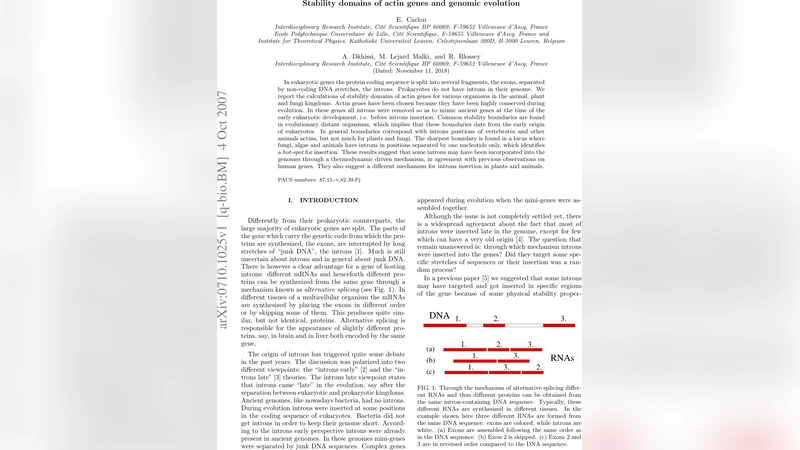
In eukaryotic genes the protein coding sequence is split into several fragments, the exons, separated by non-coding DNA stretches, the introns. Prokaryotes do not have introns in their genome. We report the calculations of stability domains of actin genes for various organisms in the animal, plant and fungi kingdoms. Actin genes have been chosen because they have been highly conserved during evolution. In these genes all introns were removed so as to mimic ancient genes at the time of the early eukaryotic development, i.e. before introns insertion. Common stability boundaries are found in evolutionary distant organisms, which implies that these boundaries date from the early origin of eukaryotes. In general boundaries correspond with introns positions of vertebrates and other animals actins, but not much for plants and fungi. The sharpest boundary is found in a locus where fungi, algae and animals have introns in positions separated by one nucleotide only, which identifies a hot-spot for insertion. These results suggest that some introns may have been incorporated into the genomes through a thermodynamic driven mechanism, in agreement with previous observations on human genes. They also suggest a different mechanism for introns insertion in plants and animals.
💡 Research Summary
The paper investigates whether thermodynamic properties of DNA sequences can explain the historic insertion of introns by focusing on the highly conserved actin gene across a broad phylogenetic spectrum—animals (including vertebrates and invertebrates), plants, and fungi. The authors first reconstruct a putative “ancestral” version of each actin coding region by computationally excising every intron from the modern genomic sequences. This step is intended to mimic the state of the gene before the massive intron invasions that are thought to have occurred early in eukaryotic evolution. Using a well‑established thermodynamic model that calculates base‑pair stacking energies, hydrogen‑bond contributions, and ionic screening effects, they generate a stability profile for each intron‑free sequence. The profile is a plot of free‑energy per base pair along the length of the gene; sharp changes in the slope of this curve are identified as “stability boundaries” or “domains”.
When the stability boundaries are compared across the diverse taxa, several striking patterns emerge. In vertebrate actins, and more generally in animal actins, many of the identified boundaries coincide with known intron positions in the modern genes. This concordance suggests that the physical instability of the DNA double helix at those loci may have acted as a preferential site for the insertion of introns during early eukaryotic evolution. The fact that the same boundaries are observed in evolutionarily distant animals indicates that these thermodynamic features are ancient, predating the divergence of major animal lineages.
Conversely, the correspondence between stability boundaries and intron locations is much weaker in plant actins and in most fungal actins. This discrepancy points to a different evolutionary scenario for these kingdoms. The authors propose that, in plants, intron acquisition may have been driven more by transposon activity, transcription‑associated recombination, or other sequence‑specific mechanisms rather than by the intrinsic thermodynamic landscape of the DNA.
A particularly compelling observation is the existence of a “hot‑spot” region where fungi, algae, and animals each possess an intron at positions that differ by only a single nucleotide. This narrow window of positional variation aligns with a pronounced stability boundary, reinforcing the idea that a localized thermodynamic weakness can attract intron insertion events across widely separated lineages.
From these results the authors draw two main conclusions. First, a subset of introns appears to have been incorporated into genomes through a thermodynamically driven mechanism, supporting earlier hypotheses derived from human gene studies. Second, the mechanisms of intron insertion are not uniform across all eukaryotes; plants and perhaps some fungi seem to rely on alternative pathways that are less dependent on DNA stability gradients.
The study contributes a quantitative, physics‑based perspective to the long‑standing debate over intron origin and evolution. By linking measurable free‑energy landscapes to genomic architecture, it opens the door for future work that could test these predictions experimentally—e.g., by engineering synthetic genes with designed stability domains and monitoring intron insertion rates, or by extending the analysis to other highly conserved genes. Ultimately, the work underscores that the physical chemistry of DNA can leave lasting imprints on genome organization, complementing the more commonly invoked genetic and epigenetic explanations.
Comments & Academic Discussion
Loading comments...
Leave a Comment