Shut up and calculate
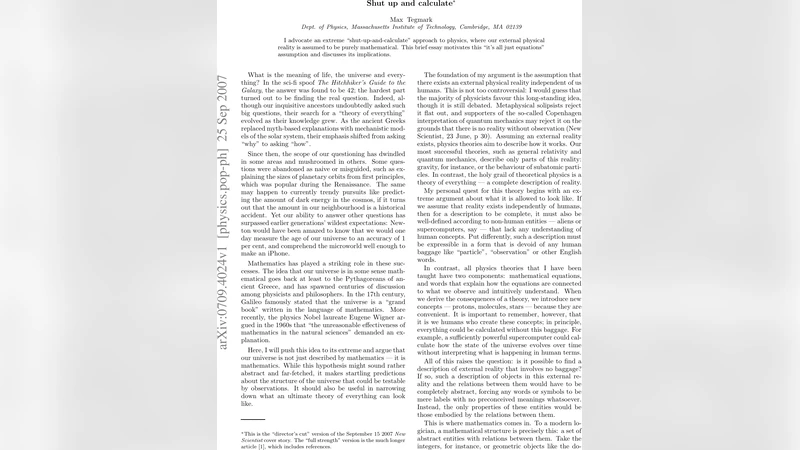
I advocate an extreme “shut-up-and-calculate” approach to physics, where our external physical reality is assumed to be purely mathematical. This brief essay motivates this “it’s all just equations” assumption and discusses its implications.
💡 Research Summary
The paper titled “Shut up and calculate” puts forward an extreme version of the well‑known pragmatic slogan that has guided much of modern quantum physics. Rather than merely urging physicists to set aside philosophical debates and focus on computational techniques, the author argues that the external physical world should be taken as a purely mathematical entity. In this view, reality is nothing more than a set of equations; the task of physics is to discover, manipulate, and solve those equations, while experimental data and observational verification become secondary, if not entirely dispensable.
The author begins by critiquing the traditional scientific method, which relies on a cyclic loop of observation, hypothesis formation, theoretical modeling, and experimental testing. He points out that every measurement is mediated by imperfect apparatuses and human perception, introducing systematic uncertainties that can never be fully eliminated. Consequently, the author claims that the empirical side of physics is a source of “noise” that distracts from the true aim: uncovering the underlying mathematical structure of the universe.
From this premise, the paper derives two major implications. First, the role of experiment is reduced to a diagnostic tool for technical failure rather than a decisive arbiter of theory. If a calculation predicts a result that differs from an experimental outcome, the discrepancy is attributed to flaws in the measurement process, not to a problem with the underlying equations. Second, the author envisions a future in which automated theorem provers, symbolic algebra systems, and machine‑learning‑driven equation generators replace human intuition as the primary engine of theoretical discovery. He cites recent advances in deep learning for symbolic integration and automated discovery of conservation laws as evidence that algorithmic exploration can outpace traditional, intuition‑driven research.
To support his thesis, the paper references the extraordinary predictive success of quantum electrodynamics (QED) and the Standard Model. The author notes that high‑order perturbative calculations, renormalization procedures, and intricate Feynman diagram summations have produced numerical predictions that agree with experiment to parts per billion. He interprets this as proof that a sufficiently sophisticated mathematical formalism can, on its own, capture all observable phenomena without recourse to philosophical interpretation.
The paper also addresses common objections. Critics argue that discarding falsifiability undermines the very foundation of science, and that an infinite landscape of mathematically consistent theories offers no guidance on which one corresponds to reality. The author counters by invoking a strong form of mathematical Platonism: the “correct” set of equations is the one that exists independently of human minds, and any apparent mismatch with experiment is merely a temporary limitation of our measurement technology. He therefore treats the problem of theory selection as a purely computational optimization task—searching the space of consistent equations for those that yield internally coherent, divergence‑free results.
In the concluding section, the author calls for a paradigm shift. He urges funding agencies, academic departments, and graduate programs to prioritize computational resources, algorithm development, and large‑scale symbolic computation over the construction of new experimental facilities. He predicts that the next generation of breakthroughs—whether in quantum gravity, dark matter, or the unification of forces—will emerge from massive, automated searches through the space of possible Lagrangians, rather than from clever new experimental designs.
Overall, the essay is a provocative manifesto that redefines physics as an exercise in pure mathematics, relegating empirical work to a peripheral status. While it offers an inspiring vision of a future dominated by AI‑driven theory generation, it also raises profound questions about the role of falsifiability, the epistemic status of mathematics, and the ethical implications of a science that could become detached from observable reality. The paper thus serves both as a rallying cry for computational maximalism and as a catalyst for renewed debate about what it means to do physics in the 21st century.
Comments & Academic Discussion
Loading comments...
Leave a Comment