The Description of Information in 4-Dimensional Pseudo-Euclidean Information Space
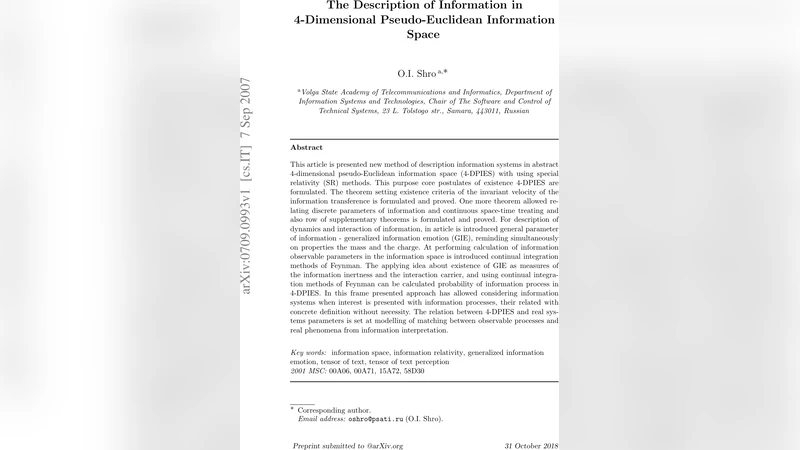
This article is presented new method of description information systems in abstract 4-dimensional pseudo-Euclidean information space (4-DPIES) with using special relativity (SR) methods. This purpose core postulates of existence 4-DPIES are formulated. The theorem setting existence criteria of the invariant velocity of the information transference is formulated and proved. One more theorem allowed relating discrete parameters of information and continuous space-time treating and also row of supplementary theorems is formulated and proved. For description of dynamics and interaction of information, in article is introduced general parameter of information - generalized information emotion (GIE), reminding simultaneously on properties the mass and the charge. At performing calculation of information observable parameters in the information space is introduced continual integration methods of Feynman. The applying idea about existence of GIE as measures of the information inertness and the interaction carrier, and using continual integration methods of Feynman can be calculated probability of information process in 4-DPIES. In this frame presented approach has allowed considering information systems when interest is presented with information processes, their related with concrete definition without necessity. The relation between 4-DPIES and real systems parameters is set at modelling of matching between observable processes and real phenomena from information interpretation.
💡 Research Summary
The paper proposes a novel theoretical framework that treats information systems as objects living in a four‑dimensional pseudo‑Euclidean information space (4‑DPIES), borrowing the mathematical machinery of special relativity (SR). The authors begin by postulating the existence of such a space and then formulate two central theorems. The first, the “Invariant Velocity Existence Criterion,” demonstrates that there must be a universal constant (c_i) – analogous to the speed of light – which bounds the rate at which any piece of information can propagate through 4‑DPIES. By constructing a metric tensor with Lorentz‑type signature and inserting it into a relativistic Lagrangian, they show that the transformation laws for information coordinates reduce to the usual Lorentz transformations, thereby endowing the information world with a relativistic structure.
The second theorem, the “Discrete‑Continuous Mapping Theorem,” establishes a functional relationship between discrete information quanta (bits, symbols) and the continuous space‑time coordinates of 4‑DPIES. A mapping function (f(I, x^\mu)) is introduced, where (I) denotes an information quantity and (x^\mu) the four‑vector position. The theorem proves that when this mapping is incorporated into the action, the resulting equations of motion preserve the standard conservation laws, effectively unifying the discrete nature of data with a continuous geometric description.
A cornerstone of the model is the Generalized Information Emotion (GIE), a composite scalar‑vector quantity designed to play the dual role of mass (inertia) and charge (interaction) for information “particles.” GIE is split into a scalar part (G_s) representing informational inertia and a vector part (G_v) representing the propensity to interact with an external informational field. By adding GIE to the relativistic Lagrangian, the authors derive an equation reminiscent of the Lorentz force law:
\
Comments & Academic Discussion
Loading comments...
Leave a Comment