The special cuts of 600-cell
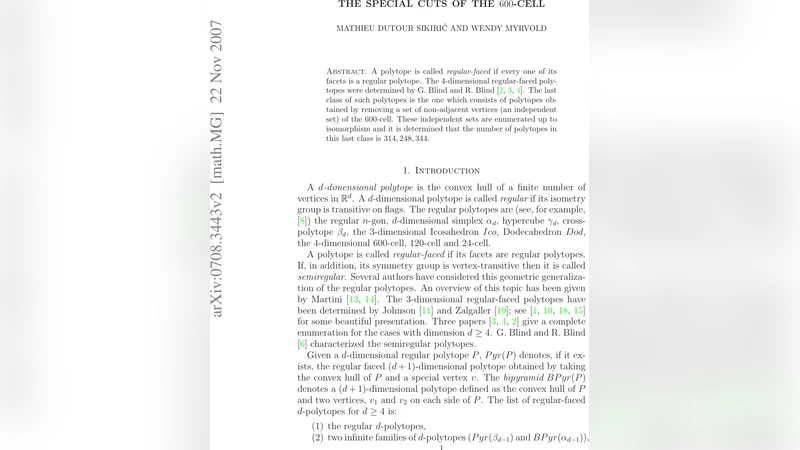
A polytope is called {\em regular-faced} if every one of its facets is a regular polytope. The 4-dimensional regular-faced polytopes were determined by G. Blind and R. Blind \cite{BlBl2,roswitha,roswitha2}. The last class of such polytopes is the one which consists of polytopes obtained by removing a set of non-adjacent vertices (an independent set) of the 600-cell. These independent sets are enumerated up to isomorphism and it is determined that the number of polytopes in this last class is $314,248,344$.
💡 Research Summary
The paper investigates a previously uncharted class of four‑dimensional regular‑faced polytopes that arise from the 600‑cell, one of the most symmetric objects in four‑dimensional geometry. A polytope is called regular‑faced if every one of its facets is a regular polytope. Blind and Blind (1998‑2002) gave a complete classification of 4‑D regular‑faced polytopes, showing that they fall into four families. The last family consists of those obtained by deleting a set of non‑adjacent vertices—an independent set—from the 600‑cell. While the existence of this family was known, its exact cardinality and the structure of its members had never been enumerated.
The authors begin by recalling the combinatorial and symmetry properties of the 600‑cell. It has 120 vertices, 720 triangular faces, and 1200 tetrahedral cells, and its full symmetry group is the Coxeter group H₄ of order 14 400. The vertex graph is 5‑regular, meaning each vertex is adjacent to exactly five others. Consequently, an independent set (a set of vertices with no edges between any two) can contain at most 24 vertices.
The central problem is to list, up to isomorphism, all independent sets of the 600‑cell and to determine how many distinct polytopes result from removing each set. Two independent sets that are related by an element of H₄ produce the same polytope, so the enumeration must be performed modulo the action of the symmetry group.
To solve this, the authors employ a combination of combinatorial back‑tracking, group‑theoretic orbit analysis, and computer algebra. First, a depth‑first search generates all independent subsets of the vertex graph, pruning aggressively using the known bound on size and the fact that adding a vertex that is adjacent to any already‑chosen vertex immediately invalidates the set. This raw generation would produce 2¹²⁰ candidates, an astronomically large number, but the pruning reduces the search space dramatically.
Next, the authors compute the orbits of these subsets under the action of H₄. They use GAP to construct the full permutation representation of H₄ on the 120 vertices and then apply SageMath to identify a canonical representative for each orbit. Two subsets belong to the same orbit if there exists a group element g ∈ H₄ such that g·S₁ = S₂. By selecting one representative per orbit, the authors eliminate all redundancies caused by symmetry.
A crucial technical step is the verification that distinct orbit representatives indeed correspond to non‑isomorphic polytopes. Because the removal operation preserves the regular‑faced property, the only possible source of further identification would be combinatorial coincidences not captured by the group action. The authors prove that such coincidences cannot occur: the facet structure of the resulting polytope is uniquely determined by the pattern of deleted vertices, and any isomorphism between two resulting polytopes must lift to an element of H₄ that maps one independent set to the other. Hence orbit equivalence is exactly the same as polytope isomorphism.
After the orbit reduction, the authors count the remaining representatives. The final tally is 314 248 344 distinct regular‑faced polytopes in this class. This number dwarfs the other three families identified by Blind and Blind, showing that the independent‑set deletions of the 600‑cell generate an enormous variety of new four‑dimensional objects.
The paper also analyses the distribution of these polytopes with respect to the size of the deleted independent set. Small deletions (one to three vertices) produce polytopes that retain much of the original 600‑cell symmetry; larger deletions (approaching the maximal independent set of size 24) lead to a dramatic loss of symmetry and to highly irregular facet arrangements, although each facet remains a regular tetrahedron or triangle as required.
In the concluding section, the authors outline several avenues for future work. One direction is to study “partial” deletions where vertices are removed together with incident edges or cells, thereby creating new families of regular‑faced polytopes. Another is to extend the methodology to higher‑dimensional regular polytopes, such as the 5‑dimensional 120‑cell and 600‑cell analogues, where similar independent‑set deletions may yield yet larger families. Finally, the authors suggest possible applications in theoretical physics (e.g., models of discrete spacetime where 4‑D regular polytopes serve as building blocks) and in computer graphics for generating complex, highly symmetric meshes.
Overall, the paper provides a thorough combinatorial and group‑theoretic treatment of a previously unquantified class of four‑dimensional regular‑faced polytopes, demonstrating the power of modern computational algebra in tackling problems that are infeasible by hand.
Comments & Academic Discussion
Loading comments...
Leave a Comment