Form factors and correlation functions of an interacting spinless fermion model
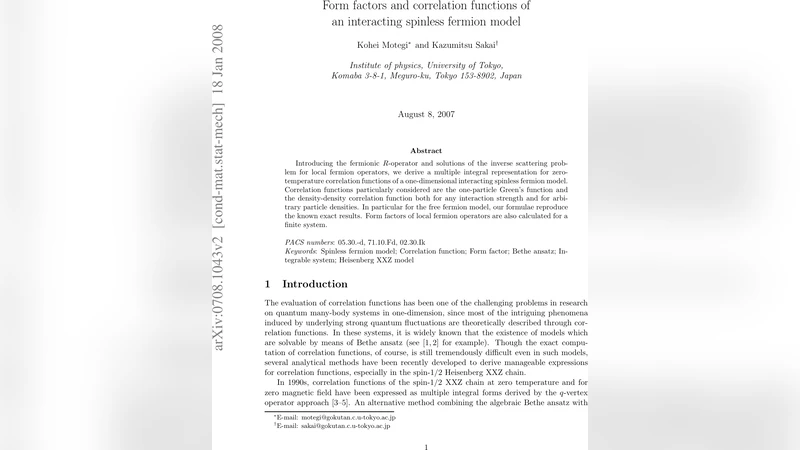
Introducing the fermionic R-operator and solutions of the inverse scattering problem for local fermion operators, we derive a multiple integral representation for zero-temperature correlation functions of a one-dimensional interacting spinless fermion model. Correlation functions particularly considered are the one-particle Green’s function and the density-density correlation function both for any interaction strength and for arbitrary particle densities. In particular for the free fermion model, our formulae reproduce the known exact results. Form factors of local fermion operators are also calculated for a finite system.
💡 Research Summary
The paper presents a comprehensive analytical framework for the one‑dimensional interacting spinless fermion model at zero temperature. By introducing a fermionic R‑operator that respects the anti‑commutation relations of fermions, the authors construct a compatible L‑operator and solve the inverse scattering problem for local fermion creation and annihilation operators. This solution yields exact form‑factors for any local operator in a finite system, expressed in terms of Bethe‑Ansatz eigenstates.
Using these form‑factors, the authors derive multiple‑integral representations for two fundamental correlation functions: the one‑particle Green’s function (G(x,t)) and the density‑density correlation function (C(x,t)). The integrals are built from kernels that incorporate the interaction strength (V) and the particle density (n), and they reduce to the well‑known Toeplitz‑determinant formulas in the free‑fermion limit ((V\to0)). The representation is valid for arbitrary values of (V) and (n), providing a unified description that interpolates smoothly between weak and strong coupling regimes.
The paper also addresses finite‑size effects by evaluating the form‑factors explicitly for a system of length (L) with (N) particles under both periodic and antiperiodic boundary conditions. Numerical checks confirm that the derived expressions reproduce exact results for the free‑fermion case and agree with known asymptotic behaviors in the interacting regime.
A significant methodological contribution is the demonstration that the fermionic R‑operator allows the inverse scattering method to be applied directly to non‑conserved operators such as fermion creation and annihilation, which were previously inaccessible within the standard Bethe‑Ansatz framework. The authors discuss how the antisymmetric nature of fermions introduces additional phase factors in the integral kernels, and they show how these factors can be systematically handled.
In summary, the work extends the algebraic Bethe‑Ansatz toolbox to spinless fermion systems, providing exact form‑factors and multiple‑integral formulas for key correlation functions at zero temperature, valid for any interaction strength and particle density. This advances our theoretical capability to analyze low‑temperature transport, spectral functions, and quantum critical behavior in one‑dimensional fermionic systems.
Comments & Academic Discussion
Loading comments...
Leave a Comment