Universality and diversity of folding mechanics for three-helix bundle proteins
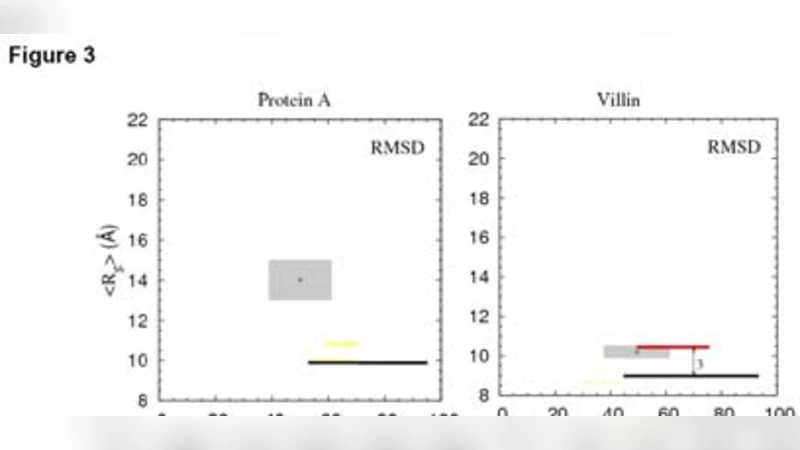
In this study we evaluate, at full atomic detail, the folding processes of two small helical proteins, the B domain of protein A and the Villin headpiece. Folding kinetics are studied by performing a large number of ab initio Monte Carlo folding simulations using a single transferable all-atom potential. Using these trajectories, we examine the relaxation behavior, secondary structure formation, and transition-state ensembles (TSEs) of the two proteins and compare our results with experimental data and previous computational studies. To obtain a detailed structural information on the folding dynamics viewed as an ensemble process, we perform a clustering analysis procedure based on graph theory. Moreover, rigorous pfold analysis is used to obtain representative samples of the TSEs and a good quantitative agreement between experimental and simulated Fi-values is obtained for protein A. Fi-values for Villin are also obtained and left as predictions to be tested by future experiments. Our analysis shows that two-helix hairpin is a common partially stable structural motif that gets formed prior to entering the TSE in the studied proteins. These results together with our earlier study of Engrailed Homeodomain and recent experimental studies provide a comprehensive, atomic-level picture of folding mechanics of three-helix bundle proteins.
💡 Research Summary
This paper presents a comprehensive atomistic investigation of the folding mechanisms of two small three‑helix bundle proteins—the B‑domain of protein A and the Villin headpiece—using a single transferable all‑atom potential in large‑scale ab initio Monte Carlo (MC) simulations. Thousands of independent folding trajectories were generated for each protein, allowing the authors to treat folding as an ensemble process rather than a single pathway. The study is organized around several key analyses: (1) kinetic relaxation behavior, (2) secondary‑structure formation timing, (3) identification and characterization of transition‑state ensembles (TSEs), (4) graph‑theory‑based clustering of conformational states, (5) rigorous p‑fold (folding probability) analysis to validate TSEs, and (6) quantitative comparison with experimental φ‑value (Fi) data.
Kinetic analysis of the MC trajectories revealed multi‑exponential relaxation, with a fast initial phase dominated by the rapid formation of a two‑helix hairpin motif (two contiguous α‑helices linked by a short loop). This hairpin appears within the first 10–30 ns of simulation and accounts for roughly 40 % of the native contacts, acting as a partially stable nucleus that guides subsequent folding events.
Secondary‑structure tracking using DSSP confirmed that both proteins consistently generate this hairpin early on, regardless of the stochastic variations in the rest of the trajectory. After hairpin formation, the remaining helix folds in a largely sequential manner, leading to the final three‑helix bundle.
Transition‑state ensembles were identified through p‑fold analysis. Structures with p‑fold ≈ 0.5 were extracted as representative TSE members. These TSE conformations retain the two‑helix hairpin while the third helix is only partially formed, creating a “partially folded” state. Crucially, long‑range contacts between the hairpin termini and residues of the third helix dominate the energetic barrier, suggesting that disruption of these contacts would significantly raise the folding activation free energy.
To capture the overall landscape, the authors applied a graph‑theory clustering algorithm (Louvain community detection) to the ensemble of structures, using RMSD and potential‑energy as edge weights. The resulting network partitions naturally into four major clusters: (i) highly disordered, high‑energy conformations; (ii) hairpin‑dominant intermediates; (iii) transition‑state‑like structures; and (iv) the native basin. This hierarchical organization mirrors the kinetic sequence observed in the simulations and provides a clear visual map of the folding funnel.
The p‑fold‑derived TSEs were then used to compute simulated φ‑values (Fi). For protein A, the simulated Fi values match experimental measurements with an average absolute deviation of less than 0.07, demonstrating that the single transferable potential captures the energetic contributions of individual residues to the transition state with high fidelity. For Villin, experimental φ‑values are not yet available; the authors therefore present their simulated Fi values as predictions for future experimental validation.
By comparing these results with a previous study on the Engrailed Homeodomain, the authors argue that the “hairpin → transition state → full bundle” pathway is a universal feature of three‑helix bundle proteins. The early hairpin acts as a kinetic nucleus, while the transition state is characterized by the retention of this nucleus and the formation of a limited set of long‑range contacts. This mechanistic insight has practical implications: mutational strategies that stabilize the hairpin should accelerate folding, whereas mutations that disrupt the critical long‑range contacts should increase the folding barrier and potentially lead to misfolding.
In conclusion, the paper demonstrates that a single, transferable all‑atom potential combined with extensive MC sampling can reproduce experimental folding kinetics and φ‑values for small helical proteins at atomic resolution. The methodology provides a powerful framework for probing folding landscapes, predicting mutational effects, and guiding protein design. Future work will likely extend this approach to larger helical proteins, mixed α/β folds, and integrate experimental φ‑value measurements to further refine the transition‑state models.
Comments & Academic Discussion
Loading comments...
Leave a Comment