How a protein searches for its specific site on DNA: the role of intersegment transfer
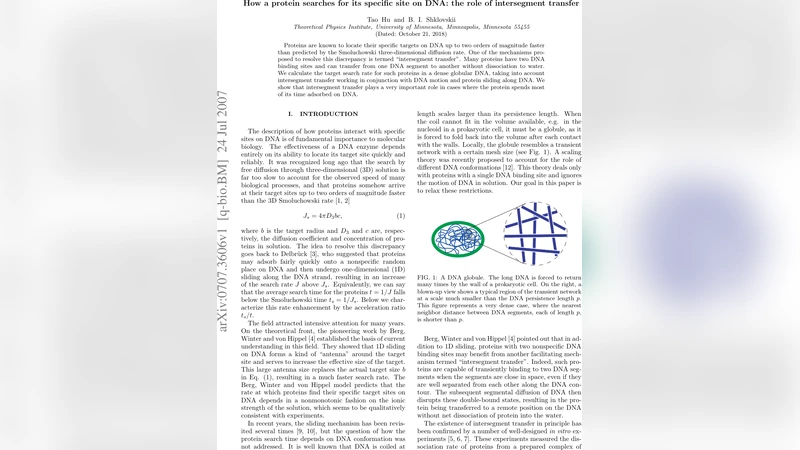
Proteins are known to locate their specific targets on DNA up to two orders of magnitude faster than predicted by the Smoluchowski three-dimensional diffusion rate. One of the mechanisms proposed to resolve this discrepancy is termed “intersegment transfer”. Many proteins have two DNA binding sites and can transfer from one DNA segment to another without dissociation to water. We calculate the target search rate for such proteins in a dense globular DNA, taking into account intersegment transfer working in conjunction with DNA motion and protein sliding along DNA. We show that intersegment transfer plays a very important role in cases where the protein spends most of its time adsorbed on DNA.
💡 Research Summary
The paper addresses a long‑standing paradox in molecular biology: many DNA‑binding proteins locate their specific target sites up to two orders of magnitude faster than the rate predicted by simple three‑dimensional (3D) diffusion (the Smoluchowski limit). Traditional explanations invoke a combination of 3D diffusion in solution and one‑dimensional (1D) sliding along the DNA contour, but these mechanisms alone cannot account for the observed speed when a protein spends the majority of its time adsorbed on DNA.
To resolve this discrepancy, the authors introduce and quantitatively analyze “intersegment transfer” (IT), a process whereby a protein possessing two DNA‑binding domains can move directly from one DNA segment to another without first dissociating into the solvent. The study focuses on a dense, globular DNA configuration that mimics the crowded environment inside a cell nucleus or bacterial nucleoid. In this setting, DNA strands are thermally fluctuating, constantly undergoing Brownian motion that brings distant segments into transient contact.
Model Foundations
- DNA Dynamics – DNA is treated as a flexible polymer undergoing random‑walk diffusion with an effective diffusion coefficient (D_{\text{DNA}}). The average time for two non‑adjacent segments to encounter each other, (\tau_c), scales as (\tau_c \sim a^2/(D_{\text{DNA}}\rho)), where (a) is the DNA diameter and (\rho) the segment density.
- Protein Binding Kinetics – The protein can bind DNA with rate constant (k_{\text{on}}) and dissociate with rate (k_{\text{off}}). When bound, it slides along the contour with a 1D diffusion constant (D_1). The probability of reaching the target by pure sliding is denoted (P_{\text{slide}}).
- Intersegment Transfer – While bound to segment A, the protein’s second domain can capture a neighboring segment B when the two come within a capture radius. The residence time during which both domains remain simultaneously engaged, (\tau_b), depends on the binding free energy (\Delta G) via a Boltzmann factor (\exp(-\Delta G/k_BT)). The transfer probability per encounter is then (P_{\text{IT}} \approx \tau_b/\tau_c).
Combined Search Rate
The overall inverse search time is expressed as a sum of two contributions:
\
Comments & Academic Discussion
Loading comments...
Leave a Comment