Model for curvature-driven pearling instability in membranes
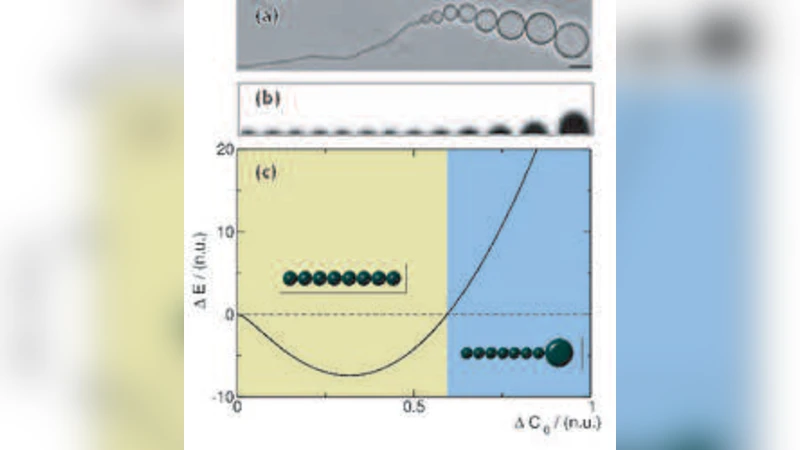
A phase-field model for dealing with dynamic instabilities in membranes is presented. We use it to study curvature-driven pearling instability in vesicles induced by the anchorage of amphiphilic polymers on the membrane. Within this model, we obtain the morphological changes reported in recent experiments. The formation of a homogeneous pearled structure is achieved by consequent pearling of an initial cylindrical tube from the tip. For high enough concentration of anchors, we show theoretically that the homogeneous pearled shape is energetically less favorable than an inhomogeneous one, with a large sphere connected to an array of smaller spheres.
💡 Research Summary
The paper introduces a phase‑field framework to study curvature‑driven pearling instabilities in lipid membranes, particularly those triggered by the adsorption of amphiphilic polymer “anchors.” Traditional membrane models based on Helfrich‑Canham curvature energy describe static equilibrium shapes but cannot capture the full dynamics of topological transformations such as tube‑to‑bead conversion. By representing the membrane as a diffuse interface described by a scalar field ψ(x,t), the authors embed interfacial energy, a double‑well potential, and a curvature term into a single free‑energy functional:
F
Comments & Academic Discussion
Loading comments...
Leave a Comment