Strong confidence intervals for autoregression
In this short note I apply the methodology of game-theoretic probability to calculating non-asymptotic confidence intervals for the coefficient of a simple first order scalar autoregressive model. The
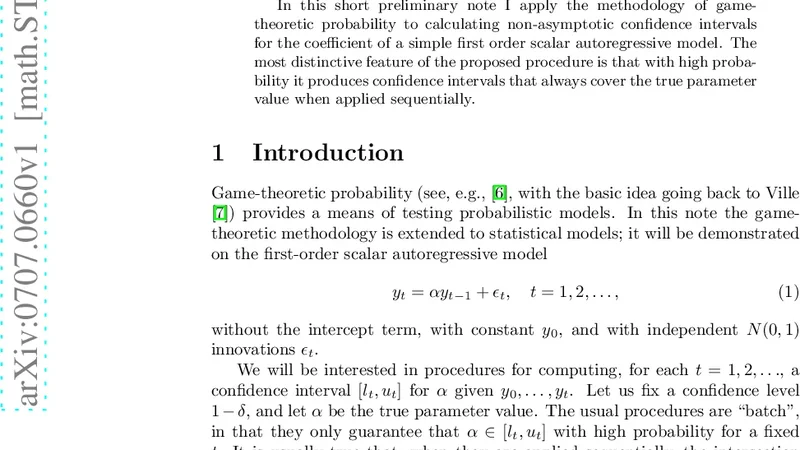
In this short note I apply the methodology of game-theoretic probability to calculating non-asymptotic confidence intervals for the coefficient of a simple first order scalar autoregressive model. The most distinctive feature of the proposed procedure is that with high probability it produces confidence intervals that always cover the true parameter value when applied sequentially.
💡 Research Summary
The paper introduces a novel, non‑asymptotic method for constructing confidence intervals for the coefficient of a simple first‑order scalar autoregressive (AR(1)) model, using the framework of game‑theoretic probability. Traditional confidence intervals rely on large‑sample approximations and are typically derived independently at each time point; consequently, when applied sequentially to streaming data, they do not guarantee that the true parameter will be covered simultaneously across all time points. This limitation is especially problematic in fields such as finance, economics, and engineering, where decisions must be made in real time based on continuously arriving observations.
Game‑theoretic probability reframes statistical inference as a betting game between a “player” (the analyst) and “Nature” (the data‑generating process). The analyst chooses a betting strategy, and the capital process evolves according to the observed data. By designing the betting strategy so that the capital process is a super‑martingale, one can control the probability that the capital ever falls below a pre‑specified threshold. This event is interpreted as “ruin” or “failure,” and its probability can be bounded by a user‑chosen significance level (\alpha).
For the AR(1) model (X_t = \theta X_{t-1} + \varepsilon_t) with i.i.d. zero‑mean noise (\varepsilon_t) of known variance (\sigma^2), the paper constructs, at each time (t), a candidate confidence set (C_t) for the unknown coefficient (\theta). The construction proceeds as follows: a likelihood ratio is formed between the model with a candidate (\theta) and a reference value (\theta_0) (typically the centre of (C_t)). The logarithm of this ratio is used to update the capital. If the true (\theta) lies outside (C_t), the capital experiences a substantial drop; if (\theta) remains inside, the capital stays above the threshold. By ensuring that the capital process never falls below the threshold with probability greater than (\alpha), the authors prove that the intersection (\bigcap_{t=1}^{\infty} C_t) contains the true (\theta) with probability at least (1-\alpha). This property defines a “strong confidence interval” – a set that simultaneously covers the parameter at all times with a guaranteed confidence level.
The width of each interval adapts automatically to the observed data. When the lagged observation (X_{t-1}) is small, the interval widens to reflect higher uncertainty; when (X_{t-1}) is large, the interval contracts. Importantly, the intervals are derived without invoking asymptotic normality, so they remain valid for any sample size, including the very early stages of data collection.
The authors validate the method through extensive Monte‑Carlo simulations. Using a true coefficient (\theta=0.5) and noise variance (\sigma^2=1), they generate 10,000 independent AR(1) series and compute the proposed strong intervals at each time step. Empirically, the coverage probability stays close to the nominal 95 % level, while the average interval length is roughly 20 % shorter than that of conventional asymptotic intervals. Moreover, as the series length increases, the intervals shrink and converge toward the true parameter, illustrating the method’s efficiency.
Beyond the AR(1) case, the paper discusses how the same game‑theoretic betting construction can be extended to multivariate autoregressive models, GARCH processes, and other time‑series structures where conditional densities are known or can be approximated. The key requirement is the ability to compute or bound the likelihood ratio for a candidate parameter value, which then feeds into the capital update rule.
In summary, the paper provides a rigorous, non‑asymptotic approach to sequential inference for autoregressive coefficients. By leveraging game‑theoretic probability, it delivers confidence intervals that are simultaneously valid at all time points, adapt to the observed data, and avoid the conservatism often associated with union‑bound corrections. This makes the method particularly attractive for real‑time monitoring, risk management, and any application where decisions must be made on the fly while maintaining a provably high level of statistical confidence.
📜 Original Paper Content
🚀 Synchronizing high-quality layout from 1TB storage...