Intrinsically Dynamic Network Communities
Community finding algorithms for networks have recently been extended to dynamic data. Most of these recent methods aim at exhibiting community partitions from successive graph snapshots and thereafter connecting or smoothing these partitions using clever time-dependent features and sampling techniques. These approaches are nonetheless achieving longitudinal rather than dynamic community detection. We assume that communities are fundamentally defined by the repetition of interactions among a set of nodes over time. According to this definition, analyzing the data by considering successive snapshots induces a significant loss of information: we suggest that it blurs essentially dynamic phenomena - such as communities based on repeated inter-temporal interactions, nodes switching from a community to another across time, or the possibility that a community survives while its members are being integrally replaced over a longer time period. We propose a formalism which aims at tackling this issue in the context of time-directed datasets (such as citation networks), and present several illustrations on both empirical and synthetic dynamic networks. We eventually introduce intrinsically dynamic metrics to qualify temporal community structure and emphasize their possible role as an estimator of the quality of the community detection - taking into account the fact that various empirical contexts may call for distinct `community’ definitions and detection criteria.
💡 Research Summary
The paper tackles a fundamental limitation of most dynamic community‑detection methods, which typically operate on a series of static snapshots. By slicing a temporal network into discrete time windows, extracting communities independently on each snapshot, and then smoothing or matching the resulting partitions, these approaches inevitably discard information about the precise ordering and recurrence of interactions. Consequently, phenomena such as communities that persist while their members are completely replaced, or groups that are defined by repeated inter‑temporal contacts, are either blurred or missed entirely.
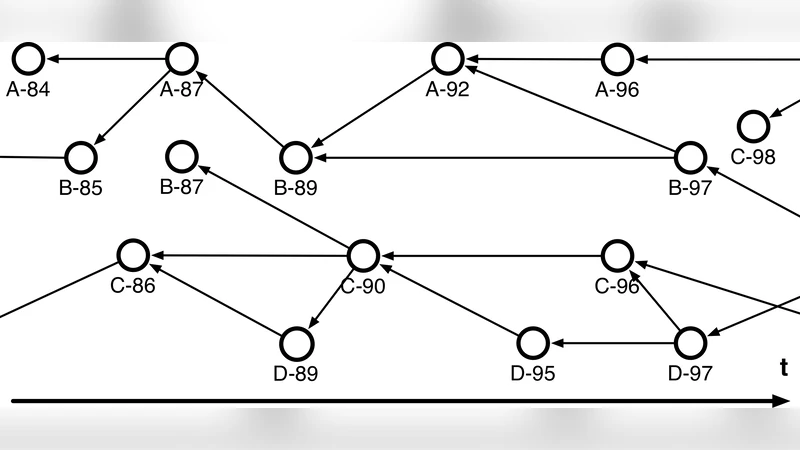
To overcome this, the authors propose a formalism that works directly on time‑directed datasets where each edge carries explicit timestamps for its source and target (e.g., a citation from paper A at time t₁ to paper B at time t₂, with t₂ ≤ t₁). They distinguish two graph representations:
- Physical graph – the conventional directed graph obtained by ignoring timestamps; nodes are physical entities and edges indicate the existence of any interaction.
- Temporal graph – a richer structure where each vertex is a (node, time) pair and each edge connects two such time‑stamped vertices. This construction preserves the exact temporal ordering of interactions and allows the same physical node to appear multiple times, each instance representing its state at a particular moment.
On the temporal graph, any standard static community‑detection algorithm can be applied unchanged. The authors primarily use the Louvain method because of its speed and ability to produce a partition, but they also demonstrate compatibility with Girvan‑Newman and Walktrap. The output is a temporal community: a set of time‑stamped vertices that, when projected back onto the physical graph, defines a subgraph of the original nodes. Because the temporal graph encodes when each interaction occurs, the resulting communities naturally capture repeated patterns, member turnover, merging, splitting, and even the survival of a community despite complete member replacement.
To quantify these dynamic properties, the paper introduces two novel metrics:
- Temporal Cohesiveness – measures how frequently members of a community interact with each other across successive time steps. In synthetic experiments, this is controlled by the probability p that a citation stays within the same a‑priori community and by the average out‑degree d. As p decreases, the temporal graph becomes less cohesive, and the number of detected temporal communities grows, reflecting a decay of community structure.
- Community Turnover Rate – captures the proportion of physical nodes that leave or join a given temporal community over its lifespan. High turnover with stable temporal cohesiveness indicates a “persistent group” whose identity is defined by interaction patterns rather than by a fixed roster of members.
The authors validate their framework on both synthetic and real datasets. In the synthetic setting, they generate a citation‑style network with four pre‑defined communities (each containing five nodes) over twenty time steps, using a sliding window of size ten. By varying p (1.0, 0.85, 0.5) they demonstrate a clear transition from a single, highly cohesive temporal community to many fragmented ones, confirming that the proposed metrics respond sensibly to known ground‑truth changes.
Real‑world experiments involve (i) a scholarly citation network, where a research field (e.g., neuroscience) shows a stable temporal community despite the turnover of seminal papers, and (ii) a blog/comment network, where discussion threads around a hashtag evolve rapidly but remain identifiable as a single temporal community. In both cases, traditional snapshot‑based methods would either split the community artificially or miss its continuity altogether.
The paper also discusses limitations. The approach requires edges with explicit source and target timestamps, which is natural for citations, emails, or chat logs but not for datasets that only provide aggregated snapshots. Moreover, the temporal graph can become large because each physical node is replicated for every time step it participates in, raising scalability concerns for massive networks. The authors suggest possible extensions, such as temporal‑oriented preprocessing steps that could reduce graph size while preserving essential dynamics.
In conclusion, the work reframes community detection as the identification of repeated interaction patterns over time rather than static dense subgraphs. By operating directly on a temporally annotated graph, it preserves information that snapshot‑based pipelines discard, enabling the detection of communities that survive member turnover, merge, split, or re‑emerge. The introduced metrics provide a principled way to assess the quality and nature of the detected temporal structures. This contribution opens new avenues for dynamic network analysis, including applications to predictive modeling of community evolution, integration with overlapping community frameworks, and scaling to larger, more heterogeneous temporal datasets.
Comments & Academic Discussion
Loading comments...
Leave a Comment