Aspects of Assembly and Cascaded Aspects of Assembly: Logical and Temporal Properties
Highly dynamic computing environments, like ubiquitous and pervasive computing environments, require frequent adaptation of applications. This has to be done in a timely fashion, and the adaptation process must be as fast as possible and mastered. Moreover the adaptation process has to ensure a consistent result when finished whereas adaptations to be implemented cannot be anticipated at design time. In this paper we present our mechanism for self-adaptation based on the aspect oriented programming paradigm called Aspect of Assembly (AAs). Using AAs: (1) the adaptations process is fast and its duration is mastered; (2) adaptations’ entities are independent of each other thanks to the weaver logical merging mechanism; and (3) the high variability of the software infrastructure can be managed using a mono or multi-cycle weaving approach.
💡 Research Summary
The paper addresses the challenge of adapting applications in highly dynamic environments such as ubiquitous and pervasive computing, where services and devices appear and disappear unpredictably. Traditional adaptation techniques either anticipate all possible configurations at design time or rely on heavyweight runtime mechanisms that cannot guarantee timely responses. To overcome these limitations, the authors propose a novel self‑adaptation mechanism called Aspect of Assembly (AA), which extends Aspect‑Oriented Programming (AOP) concepts to the level of component assemblies.
Core Concepts
- Pointcuts in AA are not limited to method execution points; they match component ports and associated metadata (port identifiers, types, attributes). This enables the selection of join points that may not be known until runtime.
- Advices are declarative specifications of structural reconfiguration rather than code snippets. An advice consists of a set of rules that can (1) instantiate black‑box components, (2) rewrite existing links between ports, or (3) create new links. The rules are expressed in a small domain‑specific language (DSL).
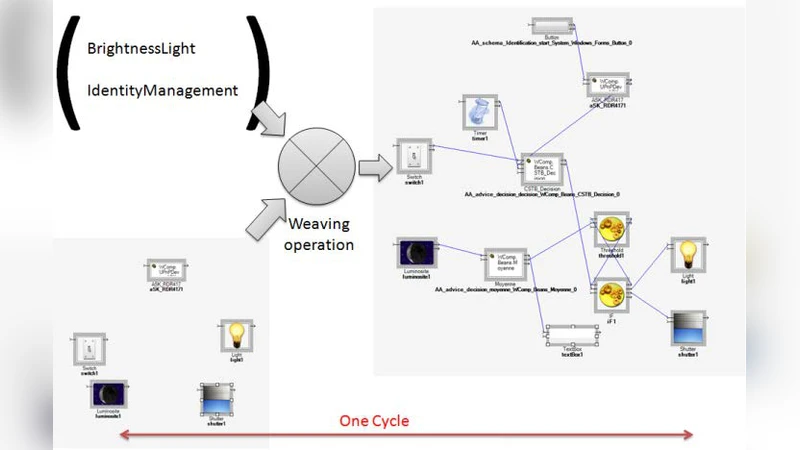
- Weaving cycles are the operational units that apply AAs to a base assembly. Two modes are defined:
- Mono‑cycle (single‑cycle) weaving, where all selected AAs are applied in one pass, producing a final adapted assembly directly.
- Multi‑cycle weaving, where AAs are applied in successive stages, allowing more complex adaptation scenarios to be built incrementally.
Logical Merging and Interference Management
A major contribution is the logical merging mechanism that resolves conflicts between advices without requiring explicit precedence rules or contracts. The merging operation is designed to be symmetric, satisfying associativity, commutativity, and idempotency. Consequently, the final assembly is deterministic regardless of the order in which AAs are woven. This approach contrasts with classic AOP, where aspect precedence must be declared and can become a source of brittleness when new aspects are added.
Performance and Timing Guarantees
The authors analyze the computational complexity of the weaving process: pointcut matching, join‑point combination generation, advice instantiation, and final merging each scale linearly with the number of AAs and matched ports. Because each step is bounded and the process does not require exhaustive search, the overall adaptation latency remains low. Empirical evaluation in two scenarios—(1) a hospital room lighting/shutter control case and (2) the ANR “Continuum” project—demonstrates adaptation times well below 200 ms, satisfying real‑time constraints for interactive environments.
Case Study Overview
In the hospital scenario, a nurse entering a room triggers a cascade of adaptations: a switch, an RFID reader, and a decision component are assembled to control shutters and lights based on patient profiles. Two AAs (IdentityManagement and a second policy AA) are woven either simultaneously (mono‑cycle) or sequentially (multi‑cycle). The system correctly distinguishes between a visually impaired patient (who requires artificial lighting) and a normal patient, adapting the component assembly on the fly while guaranteeing that the room remains functional throughout the transition.
Integration with Service‑Oriented Middleware
AA is positioned as a lightweight adaptation layer on top of existing service‑oriented middleware (e.g., SCA, SCA‑Lite). The middleware supplies events for service appearance/disappearance, which are captured by AA pointcuts. The declarative advices then instantiate or rewire components, preserving the black‑box nature of the underlying services. This separation of concerns aligns with the principle of “separation of adaptation logic from business logic” highlighted in prior work.
Contributions and Significance
- Declarative structural adaptation at the assembly level, enabling runtime reconfiguration without source‑code modification.
- Symmetric logical merging that automatically resolves inter‑aspect interference, supporting truly independent adaptation modules.
- Predictable, bounded adaptation latency through well‑defined weaving cycles, making AA suitable for time‑critical pervasive systems.
- Demonstrated applicability to realistic, heterogeneous environments (hospital, smart building) and compatibility with existing component frameworks.
Future Directions
The paper suggests extending the DSL with richer composable operators, exploring parallel weaving for large‑scale deployments, and investigating formal verification of the merging properties to further increase confidence in safety‑critical applications.
In summary, Aspect of Assembly offers a robust, low‑overhead, and formally grounded approach to self‑adaptation in dynamic computing environments. By marrying AOP’s modularity with component‑assembly semantics and a deterministic merging strategy, it provides a practical pathway for developers to build adaptable systems that can react swiftly and consistently to the ever‑changing landscape of ubiquitous services.
Comments & Academic Discussion
Loading comments...
Leave a Comment