Near Linear-Work Parallel SDD Solvers, Low-Diameter Decomposition, and Low-Stretch Subgraphs
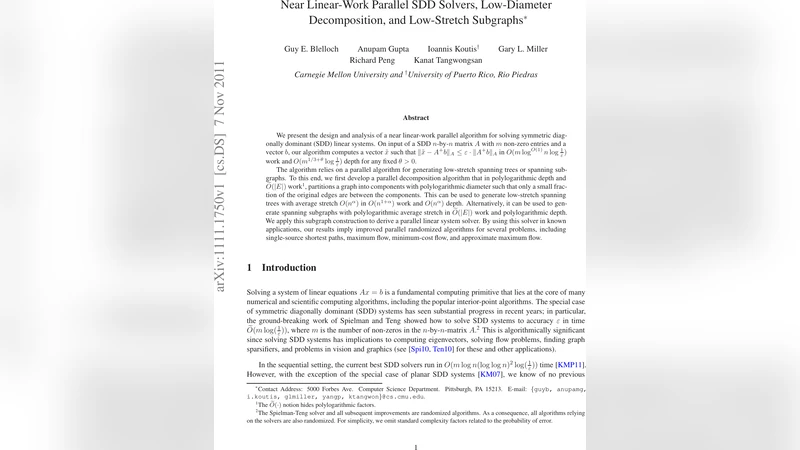
We present the design and analysis of a near linear-work parallel algorithm for solving symmetric diagonally dominant (SDD) linear systems. On input of a SDD $n$-by-$n$ matrix $A$ with $m$ non-zero entries and a vector $b$, our algorithm computes a vector $\tilde{x}$ such that $\norm[A]{\tilde{x} - A^+b} \leq \vareps \cdot \norm[A]{A^+b}$ in $O(m\log^{O(1)}{n}\log{\frac1\epsilon})$ work and $O(m^{1/3+\theta}\log \frac1\epsilon)$ depth for any fixed $\theta > 0$. The algorithm relies on a parallel algorithm for generating low-stretch spanning trees or spanning subgraphs. To this end, we first develop a parallel decomposition algorithm that in polylogarithmic depth and $\otilde(|E|)$ work, partitions a graph into components with polylogarithmic diameter such that only a small fraction of the original edges are between the components. This can be used to generate low-stretch spanning trees with average stretch $O(n^{\alpha})$ in $O(n^{1+\alpha})$ work and $O(n^{\alpha})$ depth. Alternatively, it can be used to generate spanning subgraphs with polylogarithmic average stretch in $\otilde(|E|)$ work and polylogarithmic depth. We apply this subgraph construction to derive a parallel linear system solver. By using this solver in known applications, our results imply improved parallel randomized algorithms for several problems, including single-source shortest paths, maximum flow, minimum-cost flow, and approximate maximum flow.
💡 Research Summary
The paper presents a near‑linear‑work parallel algorithm for solving symmetric diagonally dominant (SDD) linear systems, achieving both theoretical and practical improvements over prior work. The authors start by addressing a fundamental obstacle: constructing low‑stretch spanning structures (trees or ultra‑sparse subgraphs) in parallel. To this end they develop a parallel low‑diameter decomposition (LDD) algorithm that, with polylogarithmic depth and (\tilde O(|E|)) work, partitions a graph into components whose strong diameter is bounded by a parameter (\rho) while cutting only a small fraction of edges across components. The decomposition uses a novel “jitter” technique: multiple centers grow balls simultaneously, each delayed by a random offset, so that each vertex is assigned to the first center that reaches it. This probabilistic control limits the expected number of inter‑component edges to (O(k\log^3 n/\rho)) for a graph with (k) edge classes.
Building on the LDD, the authors construct low‑stretch spanning trees and, more importantly, ultra‑sparse subgraphs whose average stretch is polylogarithmic. The key observation is that for SDD solvers it suffices to have a subgraph that is only slightly denser than a tree but still preserves spectral properties; such a subgraph can be built in (\tilde O(m)) work and (\tilde O(1)) depth, eliminating the dependence on the graph’s aspect ratio that plagued earlier parallel tree‑construction methods.
These low‑stretch structures serve as preconditioners in the Spielman‑Teng framework for SDD solving. By recursively applying the preconditioner chain and terminating when the graph size drops to roughly (m^{1/3}) edges, the authors obtain a solver (named SDDSolve) that, for any fixed (\theta>0) and error parameter (\varepsilon), computes an (\varepsilon)-accurate solution in \
Comments & Academic Discussion
Loading comments...
Leave a Comment