Computability of simple games: A characterization and application to the core
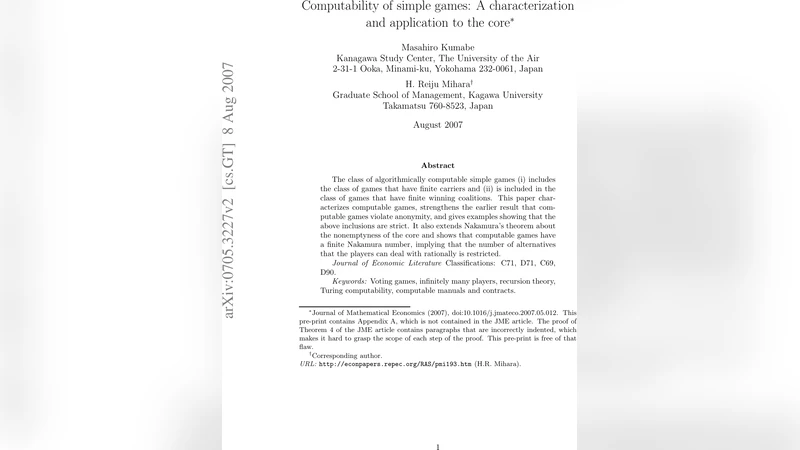
The class of algorithmically computable simple games (i) includes the class of games that have finite carriers and (ii) is included in the class of games that have finite winning coalitions. This paper characterizes computable games, strengthens the earlier result that computable games violate anonymity, and gives examples showing that the above inclusions are strict. It also extends Nakamura’s theorem about the nonemptyness of the core and shows that computable games have a finite Nakamura number, implying that the number of alternatives that the players can deal with rationally is restricted.
💡 Research Summary
The paper investigates simple cooperative games from the perspective of algorithmic computability. A simple game is a binary mapping that classifies each coalition as either winning or losing. The authors define a “computable simple game” as one whose winning‑losing decision function can be implemented by a Turing machine; in other words, there exists an algorithm that, given any finite description of a coalition, halts with the correct answer. With this definition they establish two fundamental inclusion relations. First, every simple game that possesses a finite carrier (a finite set of players whose presence alone determines the outcome of any coalition) is computable. The finiteness of the carrier guarantees a bounded input space, allowing exhaustive enumeration or a straightforward decision procedure. Second, any computable game must have a finite collection of minimal winning coalitions; equivalently, the set of winning coalitions can be generated from a finite basis. This shows that computability imposes a strong structural restriction on the game’s coalition space.
The authors then demonstrate that both inclusions are strict. They construct explicit examples of games that have a finite set of winning coalitions but are not computable because the decision procedure requires non‑recursive information. Conversely, they exhibit games without a finite carrier that are nevertheless computable, typically by embedding a decidable rule that bypasses the need for a carrier. These examples clarify that the classes “finite carrier”, “computable”, and “finite winning coalitions” are distinct, with proper containments.
Building on earlier work that showed computable games cannot be fully anonymous, the paper strengthens this result. Anonymity demands that the outcome be invariant under any permutation of players; however, to achieve algorithmic decidability one must encode specific information about particular players or subsets, breaking full symmetry. The authors provide a rigorous proof that any computable simple game must violate strict anonymity, thereby linking computational feasibility with a loss of a key fairness property.
The final contribution is an extension of Nakamura’s theorem concerning the non‑emptiness of the core. Nakamura’s number (the minimal number of alternatives that can cause the core to become empty) is a central measure of collective rationality. The classic theorem applies to arbitrary simple games, but the authors show that for computable games the Nakamura number is always finite. Consequently, the number of alternatives that a group can handle rationally under a computable rule is bounded. If the agenda contains more alternatives than this bound, the core will be empty, implying that no stable collective choice exists. This result has practical implications for the design of algorithmic decision‑making mechanisms: designers must either limit the size of the alternative set or relax computability constraints to preserve a non‑empty core.
In summary, the paper characterizes computable simple games, proves that they necessarily break full anonymity, provides strict counter‑examples to illustrate the hierarchy of related game classes, and shows that computability forces a finite Nakamura number, thereby limiting the scope of rational collective choice. The work bridges cooperative game theory with computability theory and offers clear guidance for future research on algorithmic social choice and the design of fair, stable decision procedures.
Comments & Academic Discussion
Loading comments...
Leave a Comment