The Integrals of Motion for the Deformed Virasoro Algebra
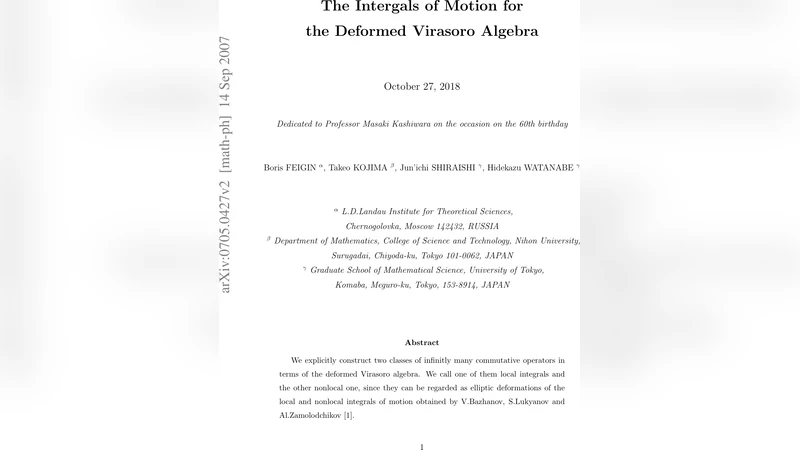
We explicitly construct two classes of infinitly many commutative operators in terms of the deformed Virasoro algebra. We call one of them local integrals and the other nonlocal one, since they can be regarded as elliptic deformations of the local and nonlocal integrals of motion obtained by V.Bazhanov, S.Lukyanov and Al.Zamolodchikov.
💡 Research Summary
The paper presents a systematic construction of two infinite families of mutually commuting operators within the framework of the deformed Virasoro algebra (DVA). The DVA is a q‑t (or elliptic) deformation of the ordinary Virasoro algebra, defined by a generating current T(z) that satisfies a quadratic exchange relation involving a structure function f(z/w) and a delta‑function term proportional to (1‑q)(1‑t⁻¹)/(1‑p), where p = qt⁻¹. In the limit p → 0 (or q → t) the algebra reduces to the classical Virasoro algebra, and the current T(z) becomes the usual stress‑energy tensor.
The authors first introduce two screening currents, S⁺(z) and S⁻(z), which commute with the DVA up to total differences. These screenings are the essential building blocks for constructing conserved quantities: S⁺ is associated with “electric” type screenings, while S⁻ corresponds to “magnetic” ones. Their operator product expansions with T(z) are simple enough that, after appropriate normal ordering, they generate objects that are invariant under the DVA.
Using these screenings, the paper defines two generating functions. The first family, called local integrals of motion, is given by
\
Comments & Academic Discussion
Loading comments...
Leave a Comment