Triangulated categories without models
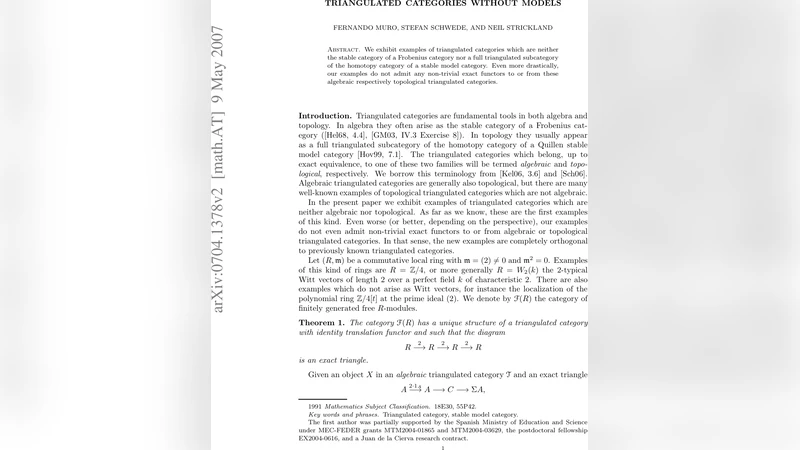
We exhibit examples of triangulated categories which are neither the stable category of a Frobenius category nor a full triangulated subcategory of the homotopy category of a stable model category. Even more drastically, our examples do not admit any non-trivial exact functors to or from these algebraic respectively topological triangulated categories.
💡 Research Summary
The paper addresses a fundamental question in triangulated‑category theory: whether every triangulated category can be realized as either the stable category of a Frobenius (algebraic) category or as a full triangulated subcategory of the homotopy category of a stable model category (topological). While many important examples—derived categories of rings, stable module categories of finite groups, and the stable homotopy category of spectra—fit into one of these two frameworks, the authors construct explicit triangulated categories that belong to neither class and, moreover, admit no non‑trivial exact functors to or from any algebraic or topological triangulated category.
The construction proceeds in two stages. First, the authors start with a well‑generated triangulated category (T) that possesses a rich supply of compact objects; typical choices are the derived category (D(R)) of a commutative Noetherian ring (R) of infinite Krull dimension or the stable module category (\operatorname{StMod}(kG)) of a finite group algebra. Inside (T) they isolate a localizing subcategory (L) that contains all compact objects of (T). The subcategory is defined by a carefully chosen set of primes (or by killing a Jacobson ideal) so that the Verdier quotient \
Comments & Academic Discussion
Loading comments...
Leave a Comment