Two Classes of Crooked Multinomials Inequivalent to Power Functions
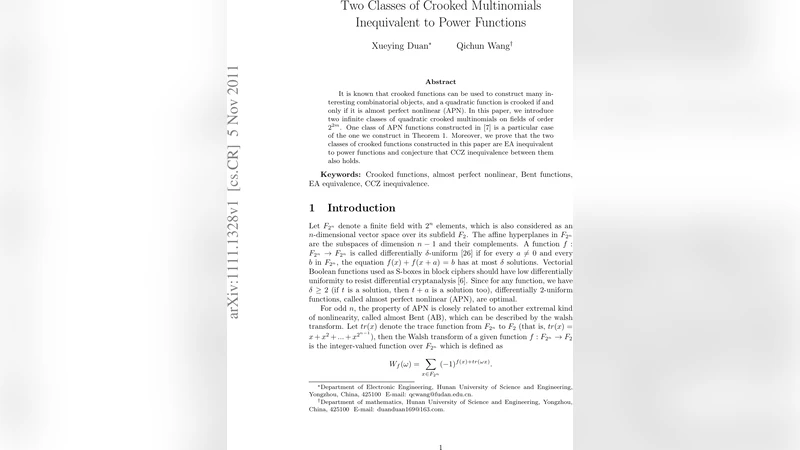
It is known that crooked functions can be used to construct many interesting combinatorial objects, and a quadratic function is crooked if and only if it is almost perfect nonlinear (APN). In this paper, we introduce two infinite classes of quadratic crooked multinomials on fields of order $2^{2m}$. One class of APN functions constructed in [7] is a particular case of the one we construct in Theorem 1. Moreover, we prove that the two classes of crooked functions constructed in this paper are EA inequivalent to power functions and conjecture that CCZ inequivalence between them also holds.
💡 Research Summary
The paper investigates the construction of new families of quadratic crooked functions over binary fields of order 2^{2m}. A function f : F_{2^n}→F_{2^n} is called δ‑uniform if for every non‑zero a and every b the equation f(x)+f(x+a)=b has at most δ solutions; the optimal case δ=2 is called almost perfect nonlinear (APN). For quadratic functions, being APN is equivalent to being crooked, i.e., for each a≠0 the set {f(x)+f(x+a) | x∈F_{2^n}} forms an affine hyperplane. Historically, the only known crooked power functions are the monomials x^{2^i+2^j} with gcd(n,i−j)=1, which are affine‑equivalent to Gold functions x^{2^s+1}.
The authors present two infinite classes of quadratic crooked multinomials, thereby extending the known landscape beyond monomials. Let n=2m and q=2^m. In the first class (Theorem 1) they fix integers i>j, a non‑field element c∈F_{2^n}\F_{2^m}, an element d not belonging to the set {u^{2^i+2^j} | u∈F_{2^n}}, and a subset K⊂{0,…,n−1} such that each polynomial P_k(x)=x^{2^k}−1 is irreducible over F_{2^n} and not equal to x+1. With arbitrary coefficients r_1,…,r_{m−1}∈F_{2^m} they define
f(x)=c x^{q+1}+∑{t=1}^{m−1} r_t x^{2^t+q·2^t}+∑{k∈K}\bigl(d^{2^k} x^{2^{i+k}+2^{j+k}}+d^{q·2^k} x^{q(2^{i+k}+2^{j+k})}\bigr).
The proof shows that for any a≠0 the expression F(x)=f(x)+f(x+a)+f(a) reduces, after using c∉F_{2^m}, to the condition x^{q}a+xa^{q}=0. Substituting x=a·t yields t^{q}=t, i.e., t∈F_{2^m}. The irreducibility of the P_k’s forces (t^{2^i}+t^{2^j})=0, which together with gcd(i−j,n)=1 implies t∈{0,1}. Hence F(x)=0 has at most two solutions, establishing APN and consequently crookedness. The authors note that when j=0, K={0} and both m and i are odd, the construction collapses to the APN trinomials introduced in
Comments & Academic Discussion
Loading comments...
Leave a Comment