Smoothed Particle Hydrodynamics: Things I wish my mother taught me
I discuss the key features of Smoothed Particle Hydrodynamics (SPH) as a numerical method - in particular the key differences between SPH and more standard grid based approaches - that are important to the practitioner. These include the exact treatment of advection, the absence of intrinsic dissipation, exact conservation and more subtle properties that arise from its Hamiltonian formulation such as the existence of a minimum energy state for the particles. The implications of each of these are discussed, showing how they can be both advantages and disadvantages.
💡 Research Summary
The paper provides a concise yet thorough overview of Smoothed Particle Hydrodynamics (SPH), focusing on the aspects that differentiate it from traditional grid‑based fluid solvers and that are most relevant to practitioners. It begins by stating the fundamental premise of SPH: fluid quantities are represented by a set of particles of fixed mass, and the density at any location is obtained by a kernel‑weighted sum over neighboring particles. Because the smoothing kernel depends only on the inter‑particle distance, the density estimate is invariant under translations, rotations, and does not retain any memory of the particle history. Consequently, mass is exactly conserved and the spatial resolution follows the mass distribution rather than a fixed volume.
From this density sum the author derives the Lagrangian of the system, L = ∑ m_j(½ v_j² − u_j), where u_j is the specific internal energy. Applying the Euler–Lagrange equations yields a discrete form of the Euler momentum equation that is symmetric, manifestly conservative, and automatically satisfies the continuity equation. This derivation underpins a list of key SPH properties: exact advection, zero intrinsic numerical dissipation, simultaneous conservation of mass, linear and angular momentum, total energy, and entropy, as well as the existence of a minimum‑energy particle configuration.
The paper then examines each property in detail. Exact advection is illustrated by a magnetic current loop that traverses a periodic domain more than ten thousand times without any distortion—a test that is notoriously difficult for Eulerian codes. Zero intrinsic dissipation follows from the Hamiltonian nature of the method; a non‑linear Alfvén wave propagates for many periods with its amplitude unchanged, provided no artificial dissipation is added. However, physical shocks require entropy generation, so artificial viscosity must be introduced explicitly. The author reviews the classic Monaghan viscosity formulation, showing that its parameters correspond to a physical shear and bulk viscosity (ν ≈ α c_s h/10). Because the viscosity scales linearly with the smoothing length, SPH can appear overly dissipative unless a robust switch—such as the Cullen & Dehnen (2010) limiter—is employed to activate viscosity only near discontinuities.
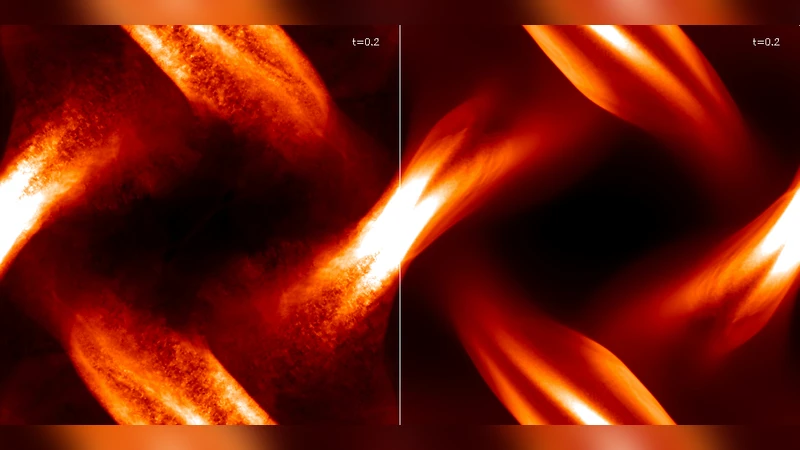
A major source of confusion in the literature concerns the treatment of contact discontinuities. In standard SPH the pressure becomes discontinuous (“pressure blip”) across a density jump, suppressing mixing and leading to the well‑known “SPH Kelvin‑Helmholtz problem”. The paper clarifies that the issue is not the instability itself but the mishandling of the discontinuity. Adding an artificial conductivity term removes the pressure blip and restores proper growth of the Kelvin‑Helmholtz roll‑up, as demonstrated in the provided figures. Similar improvements are shown for Richtmyer‑Meshkov tests.
Exact conservation of linear and angular momentum is highlighted as a decisive advantage for astrophysical problems involving orbital dynamics, warped discs, and other geometry‑independent flows. Grid‑based codes can only conserve angular momentum exactly on specially aligned meshes, whereas SPH’s particle formulation maintains it automatically. The downside of strict conservation is that numerical errors manifest as particle noise rather than catastrophic crashes. The author points out that noisy particle configurations are a symptom of a failing simulation and suggests simple “crash” checks in C, Fortran, or Python to flag such situations.
The Hamiltonian also guarantees a minimum‑energy particle arrangement, often described as a “glass‑like” lattice that the particles relax into even when the pressure is uniform. This self‑regularisation replaces the need for explicit remeshing in Lagrangian grid methods. However, because the regularising force relies on positive pressure, situations with negative pressure (e.g., tensile instability in magnetohydrodynamics) can become unstable. The paper contrasts a fully conservative but unstable formulation with a non‑conservative but stable alternative, showing that the latter can produce more reliable results despite slightly larger energy errors.
In summary, the author presents SPH as a method with remarkable theoretical elegance—exact advection, zero intrinsic dissipation, and full conservation—while acknowledging that practical implementations must address artificial dissipation, contact‑discontinuity treatment, and tensile instability. By understanding these subtleties, users can exploit SPH’s strengths for astrophysical fluid dynamics and avoid common pitfalls that have led to misconceptions in the community.
Comments & Academic Discussion
Loading comments...
Leave a Comment