Friction contribution to water-bond breakage kinetics
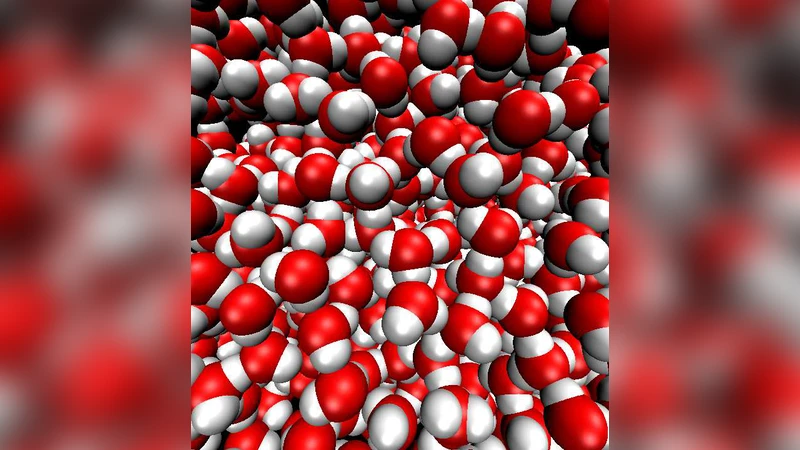
Based on the trajectories of the separation between water molecule pairs from MD simulations, we investigate the bond breakage dynamics in bulk water. From the spectrum of mean first-passage times, the Fokker-Planck equation allows us to derive the diffusivity profile along the separation coordinate and thus to unambiguously disentangle the effects of free-energy and local friction on the separation kinetics. For tightly coordinated water the friction is six times higher than in bulk, which can be interpreted in terms of a dominant reaction path that involves additional orthogonal coordinates.
💡 Research Summary
In this work the authors investigate the microscopic kinetics of water‑water bond breakage by analysing the radial separation between pairs of water molecules obtained from molecular dynamics (MD) simulations. Using the SPC/E water model, they generate 10 ns trajectories at several temperatures (280–360 K) and record the oxygen‑oxygen distance R with a temporal resolution of 10 fs (small system) or 100 fs (large system). The central methodological framework is the one‑dimensional Fokker‑Planck (FP) equation for the probability density P(R,t) along the reaction coordinate R. Starting from the full three‑dimensional overdamped FP equation, the authors integrate out the angular degrees of freedom, introduce the free‑energy profile F(R)=U(R)−2kBT ln R (derived from the radial distribution function gOO(R)), and allow the diffusivity D(R) to be position‑dependent.
The key to extracting D(R) is the spectrum of mean first‑passage times (MFPTs) τfp(R,Rt) for reaching a target separation Rt when starting from an initial distance R. For a Markovian diffusion process governed by the FP equation, τfp can be expressed analytically (Eq. 7) and inverted to give D(R) (Eq. 8). The authors therefore compute τfp from the MD trajectories for a set of target distances ranging from 0.4 nm to 1.4 nm, fit local linear slopes to τfp(R,Rt) in a narrow window (ΔR≈0.032 nm) around each R, and evaluate the integral in Eq. 8 numerically.
The resulting MFPT curves collapse onto a single master curve for each temperature, confirming that the dynamics of bond breakage is well described by a one‑dimensional Markovian diffusion process, at least for separations larger than ≈0.26 nm. At very short distances the MFPTs display a maximum, reflecting the breakdown of the diffusive approximation due to strong Lennard‑Jones repulsion; consequently D(R) is only reported for R ≥ 0.265 nm.
The diffusivity profile exhibits a pronounced dip inside the first coordination shell (≈0.28 nm). The minimum value Dmin≈0.79 nm² ns⁻¹ is roughly six times smaller than the bulk translational diffusivity of a single water molecule, which the authors determine independently from the long‑time mean‑square displacement (Dbulk≈5.1 nm² ns⁻¹). This six‑fold increase in effective friction is interpreted as a consequence of the tightly coordinated environment and the involvement of orthogonal degrees of freedom (e.g., rotational reorientation, hydrogen‑bond network rearrangements) that impede relative translation. The shape of D(R) is essentially temperature‑independent over the 80 K range studied, and the entire profile follows an Arrhenius law, mirroring the temperature dependence of the bulk diffusion coefficient.
A practical implication of the study is that conventional transition‑state theory (TST), which typically assumes a constant friction, underestimates the mean bond‑breakage time by about a factor of two for water. Incorporating the spatially varying friction obtained here yields rate predictions that agree with the MD‑derived MFPTs.
Overall, the paper demonstrates a robust protocol for disentangling free‑energy barriers and local friction from MD data, providing quantitative insight into how microscopic friction modulates bond‑breakage kinetics in bulk water. The approach is readily transferable to more complex liquids and biomolecular systems where identifying an appropriate reaction coordinate and assessing the role of orthogonal motions remain challenging. Future work could extend the analysis to explicit hydrogen‑bond definitions, alternative water models, or experimental observables such as ultrafast infrared spectroscopy, thereby testing the universality of the six‑fold friction enhancement observed for tightly coordinated water pairs.
Comments & Academic Discussion
Loading comments...
Leave a Comment