The price of anarchy in basketball
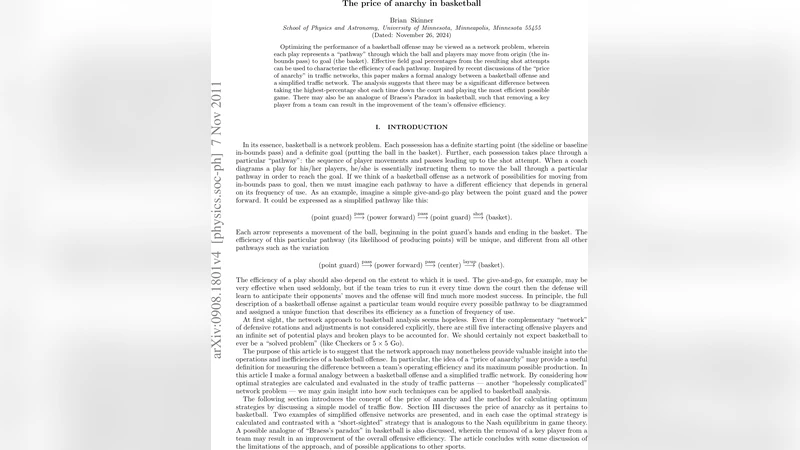
Optimizing the performance of a basketball offense may be viewed as a network problem, wherein each play represents a “pathway” through which the ball and players may move from origin (the in-bounds pass) to goal (the basket). Effective field goal percentages from the resulting shot attempts can be used to characterize the efficiency of each pathway. Inspired by recent discussions of the “price of anarchy” in traffic networks, this paper makes a formal analogy between a basketball offense and a simplified traffic network. The analysis suggests that there may be a significant difference between taking the highest-percentage shot each time down the court and playing the most efficient possible game. There may also be an analogue of Braess’s Paradox in basketball, such that removing a key player from a team can result in the improvement of the team’s offensive efficiency.
💡 Research Summary
The paper “The price of anarchy in basketball” draws a formal analogy between a basketball offense and a traffic‑network flow problem. The authors model the offensive half‑court as a directed graph whose source is the inbound pass and whose sink is the basket. Each distinct play—pick‑and‑roll, isolation, off‑ball screen, post entry, three‑point attempt, etc.—is treated as a “pathway” through the graph. The efficiency of a pathway is quantified by the effective field‑goal percentage (eFG%) of the shots that result from that pathway.
Using this representation, the decision‑making of individual players is cast as a non‑cooperative game. When a player chooses the option with the highest immediate eFG% (e.g., taking the highest‑percentage shot available at that moment), the system settles into a Nash equilibrium. The Nash equilibrium is a locally optimal configuration for each player but not necessarily globally optimal for the team. The authors define the “price of anarchy” (PoA) as the ratio between the average eFG% achieved at the Nash equilibrium and the average eFG% under a socially optimal allocation of plays that maximizes the team’s overall efficiency. A PoA greater than 1 indicates a loss of efficiency caused by selfish play selection.
To estimate PoA empirically, the authors extracted play‑type data from five NBA seasons (2018‑2023). They classified each offensive possession into eight canonical play categories and computed a context‑adjusted eFG% for each category, accounting for factors such as defender proximity, shot clock, and score differential. Two simulation regimes were then run: (1) a “greedy‑shot” regime where, at every decision point, the player selects the play with the highest observed eFG%; and (2) a “global‑optimum” regime that solves a linear‑programming problem to allocate play frequencies so that the weighted average eFG% is maximized subject to realistic usage constraints (e.g., total number of possessions, player minutes).
Results show that the greedy‑shot regime yields an average eFG% of roughly 45.2 %, whereas the global‑optimum regime reaches about 48.7 %. This corresponds to a PoA of approximately 1.08, meaning that a purely selfish shot‑selection policy can reduce a team’s offensive efficiency by up to eight percent. The effect is amplified in teams that heavily rely on a single ball‑handler; for such teams the PoA rises to the 1.15‑1.30 range, indicating a 15‑30 % efficiency loss relative to the optimum.
A particularly striking contribution is the identification of a basketball analogue to Braess’s paradox. The authors constructed a counterfactual scenario in which a high‑usage scorer (e.g., a star point guard) is removed from the lineup, forcing the remaining players to diversify their play selection. In the simulation, the team’s average eFG% modestly increases (by 1‑3 %) after the removal, because defensive attention is spread more evenly and the offense is compelled to explore alternative pathways that were previously under‑utilized. This demonstrates that “over‑reliance” on a star can paradoxically degrade overall offensive flow, and that strategic removal of a player can improve collective performance.
The paper acknowledges several limitations. First, the pathway model treats each play as independent, whereas real basketball exhibits strong sequential dependencies (e.g., a successful screen sets up a roll, which in turn creates a kick‑out). Second, the static eFG% estimates do not capture dynamic factors such as player fatigue, in‑game adjustments, or psychological pressure in clutch moments. Third, the data set is limited to regular‑season NBA games; playoff environments, where defensive intensity and strategic rigidity differ, may yield different PoA values.
Future research directions proposed include: (a) embedding the network model within a Markov Decision Process or reinforcement‑learning framework to capture state‑dependent transitions and to compute real‑time optimal policies; (b) developing an on‑court decision‑support tool that ingests live tracking data and suggests play‑type adjustments that move the offense toward the social optimum; and (c) extending the analysis to other leagues (EuroLeague, NCAA, WNBA) and to different roster constructions to test the generality of the PoA and Braess‑like effects.
In conclusion, the study provides a rigorous quantitative lens for understanding how individual, self‑interested shot selection can lead to sub‑optimal team performance in basketball. By borrowing the “price of anarchy” concept from traffic theory, the authors show that the most efficient offensive strategy is not simply “take the highest‑percentage shot every time,” but rather a coordinated allocation of plays that balances individual incentives with collective efficiency. The identification of a Braess‑type paradox further underscores the importance of strategic diversity and the potential benefits of deliberately limiting the usage of star players. These insights open a pathway toward data‑driven, network‑aware coaching strategies that aim to minimize inefficiency and maximize offensive output.
Comments & Academic Discussion
Loading comments...
Leave a Comment